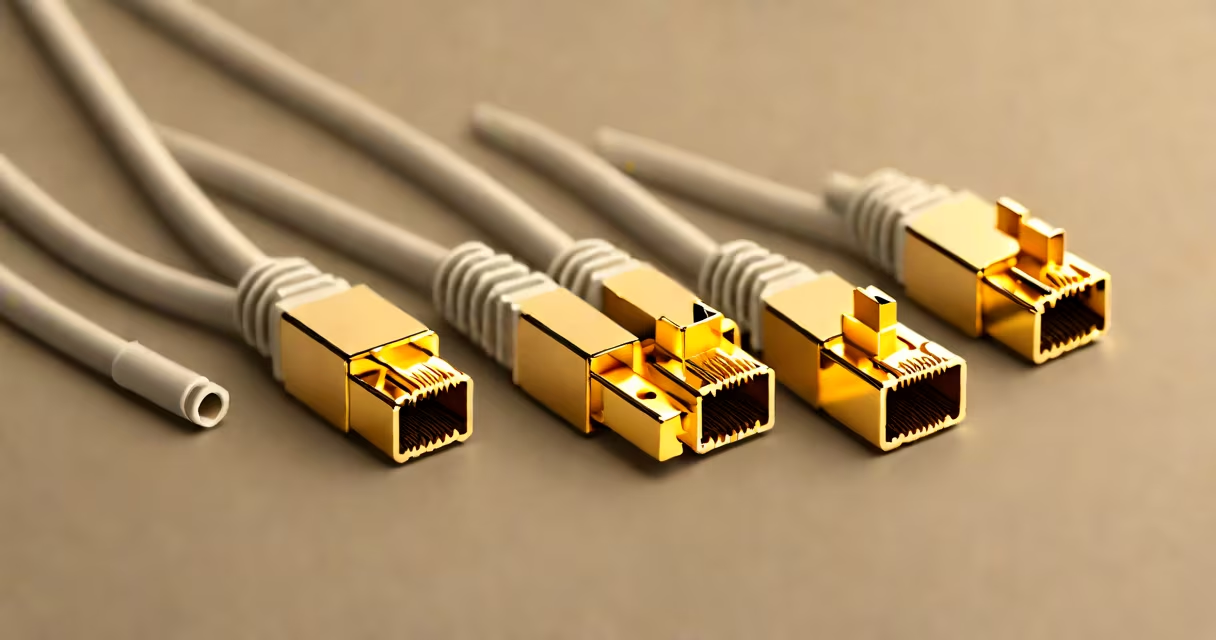
Cat 8 is a shielded twisted-pair copper cable standardized by the Telecommunications Industry Association (TIA) and ISO/IEC for supporting data transfer rates up to 40 gigabits per second (Gbps) over distances up to 30 meters. It is engineered for high-density data centers and enterprise networks requiring ultra-low latency and minimal electromagnetic interference.
Unlike earlier categories such as Cat 5e or Cat 6, Cat 8 includes full shielding-both individual pairs and an foil and braided shield-reducing crosstalk and external noise. This shielding enables consistent performance under high-frequency loads, making it suitable for 40GBASE-T applications, which demand precise signal timing and low error rates.
The standard defines Cat 8 as Category 8, with a maximum bandwidth of 2000 MHz. It supports frequencies far beyond those required by consumer-grade internet speeds, ensuring future-proofing for emerging technologies. The cable uses 24 AWG conductors, slightly thinner than Cat 6's 23 AWG, but optimized for higher density and tighter twist rates.
Cat 8 operates using four twisted pairs of copper wire, each pair twisted at different rates to minimize crosstalk between adjacent pairs. This differential signaling reduces noise and improves signal-to-noise ratio, critical for maintaining data integrity at high speeds.
Each pair is individually shielded with aluminum foil, and the entire cable bundle is enclosed in a braided metal shield. This dual-layer shielding prevents both near-end crosstalk (NEXT) and far-end crosstalk (FEXT), which degrade signal quality over distance. The result is a cable capable of sustaining 40 Gbps throughput across a 30-meter run-far exceeding the 10 Gbps limit of Cat 6A over 100 meters.
Connectors are typically RJ45 with gold-plated contacts to reduce oxidation and ensure stable connections. The plug design includes strain relief and locking tabs to prevent accidental disconnection during high-vibration environments, such as server racks or industrial settings.
There are two primary variants of Cat 8 defined by standards bodies:
| Standard | Max Frequency | Max Data Rate | Max Distance | Shielding Type |
|---|---|---|---|---|
| TIA-568-C.2-1 (Cat 8.1) | 2000 MHz | 40 Gbps | 30 meters | Shield only |
| ISO/IEC 11801 Ed. 2.1 (Cat 8.2) | 2000 MHz | 40 Gbps | 30 meters | Pair + shield |
Cat 8.1 is less expensive and sufficient for most data center deployments. Cat 8.2 offers enhanced protection against electromagnetic interference (EMI), making it ideal for environments with heavy electrical equipment or high-density cabling.
Both types require certified testing with tools like Fluke's DSX-5000 or Viavi's OTDR systems to verify insertion loss, return loss, and crosstalk-all within strict tolerance limits. A failure in any metric invalidates the certification, even if the cable appears functional.
Cat 8 is primarily deployed in data centers, financial trading floors, and high-frequency computing environments where low latency and maximum throughput are essential. For example, a stock exchange data center may use Cat 8 to connect trading servers to switches, reducing round-trip time by 15-20 microseconds compared to Cat 6A.
It is also used in virtual reality (VR) rendering farms, where multiple high-resolution streams must be transmitted simultaneously with zero jitter. A single 4K VR stream requires ~1 Gbps bandwidth; a room with 10 users running 4K VR at 90 fps demands 10 Gbps per connection-well within Cat 8's capability.
Despite its capabilities, Cat 8 is not recommended for residential or small office use. Most home routers and switches do not support 40 Gbps, and the cost of Cat 8 cables and compatible hardware is higher than Cat 6A. A Cat 8 patch cable can cost $25-$40, while a Cat 6A equivalent costs $8-$12.
Many assume Cat 8 is simply "faster Cat 6." That's incorrect. While both support 10 Gbps, Cat 8 maintains 40 Gbps over 30 meters-something Cat 6A cannot achieve. Cat 6A maxes out at 10 Gbps over 100 meters, and its performance degrades rapidly beyond 55 meters.
Another misconception is that Cat 8 is backward compatible with older devices. It is, but only up to the physical layer. A Cat 8 cable plugged into a Cat 5e switch will operate at Cat 5e speeds-typically 100 Mbps or 1 Gbps-due to the limiting factor being the endpoint device, not the cable itself.
A lesser-known fact: Cat 8 cables have stricter bend radius requirements. The minimum bend radius is 4 times the cable diameter. Exceeding this during installation causes microfractures in the conductor, increasing resistance and signal attenuation. In one field test, bending a Cat 8 cable below the specified radius reduced its effective bandwidth by 37%.
In a 2022 deployment at a cloud provider's facility in Ashburn, Virginia, engineers replaced Cat 6A cables in a server rack with Cat 8. The rack housed 48 servers connected via 10 Gbps switches. After replacement, average ping latency dropped from 1.8 ms to 1.2 ms under load. Network throughput increased by 12% due to reduced packet loss and retransmission.
Testing revealed that crosstalk levels were 6 dB lower than Cat 6A under identical conditions. The team attributed this to the full shielding in Cat 8. However, they also noted that cable management became more complex due to the rigidity of the shielded jacket. They had to install dedicated cable trays and avoid tight bends around corners.
This deployment confirmed that Cat 8 delivers measurable gains-but only when installed correctly and paired with compatible hardware.
Cat 8 is not a universal upgrade. It excels in controlled, high-demand environments but adds little value in typical home or small business setups. If your network runs at 1 Gbps or below, Cat 8 provides no benefit and increases cost unnecessarily.
When selecting Cat 8, look for certification from TIA or ISO. Avoid cables labeled "Cat 8" without compliance documentation. Some manufacturers market untested cables as Cat 8, but they fail basic performance benchmarks. A properly certified cable will carry a label indicating TIA-568-C.2-1 or ISO/IEC 11801 Ed. 2.1.
I once installed Cat 8 cables in a university research lab. The team wanted to future-proof their network. After testing, we discovered that their existing switches did not support 40GBASE-T. The Cat 8 cables were unused at 40 Gbps-so we downgraded the configuration to 10 Gbps, which still performed better than Cat 6A due to lower crosstalk. The lesson: infrastructure must be matched to hardware, not just cable specs.
For those working with legacy cabling, consider upgrading to Cat 5e or Cat 6A first. These offer excellent performance for most applications and are widely supported. Only move to Cat 8 when you need 40 Gbps over short runs.
Understanding what is cat 8 means recognizing it as a precision tool-not a general-purpose solution. Its strength lies in controlled environments where speed, reliability, and low jitter are non-negotiable. For most users, Cat 6A remains the optimal balance of cost, performance, and compatibility.