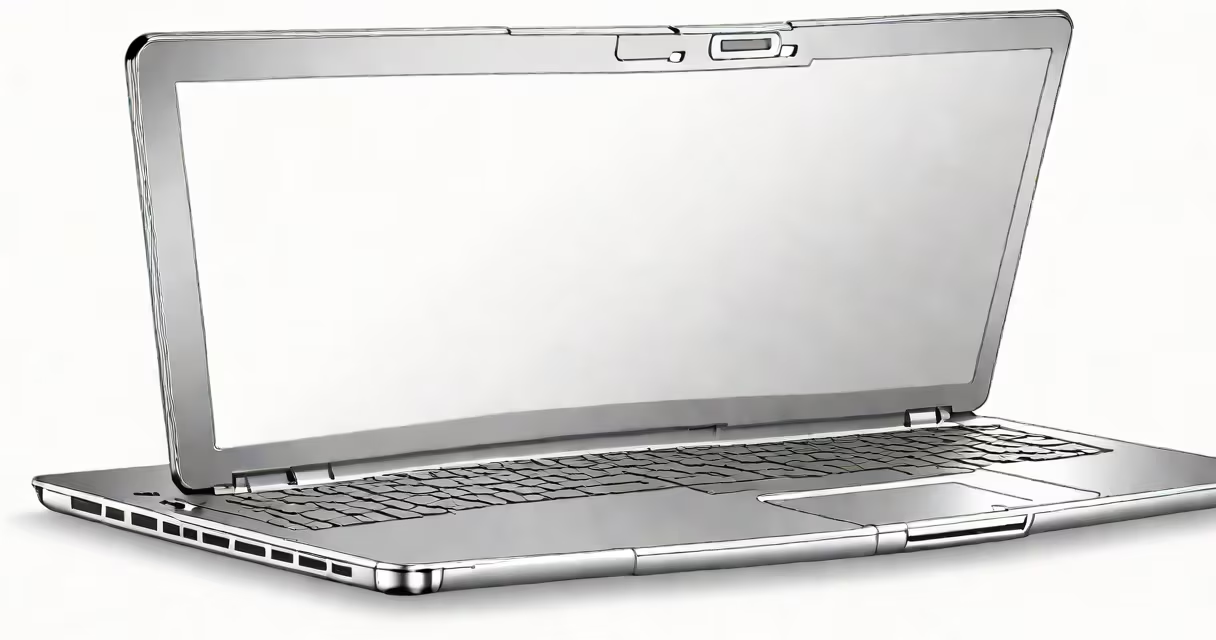
A clamshell laptop is a portable computer with a hinged lid that folds shut over the display, creating a flat, book-like form factor. This design enables easy transport, protects the screen during storage, and supports standard typing posture. The term "clamshell" references the shell-like motion of the lid closing over the keyboard.
The clamshell configuration remains the dominant laptop architecture since the early 1990s. It balances screen size, input accessibility, and physical protection. Most consumer and business laptops follow this model, including models from Dell, Lenovo, HP, and Apple's MacBook lineup. The design prioritizes usability in confined spaces like desks, laps, and airplane trays.
Clamshell laptops differ from alternative form factors such as convertible tablets, 2-in-1s, and detachable screens. These alternatives prioritize touch interaction and flexible use modes. A clamshell laptop maintains a fixed relationship between screen and keyboard, limiting reconfiguration options but enhancing stability during extended typing sessions.
Inside a clamshell laptop, the screen and keyboard are mounted on opposing sides of a central hinge assembly. When closed, the lid presses against the keyboard surface, often using rubber or silicone padding to prevent scratches. The hinge allows the screen to pivot freely between open and closed positions.
Electrical connections run through the hinge via flexible ribbon cables. These cables carry video signals from the GPU to the display and transmit input data from the keyboard and trackpad back to the system. Modern designs use multiple layers of conductive traces embedded in thin, durable films to maintain signal integrity during repeated opening and closing.
When opened, the laptop stabilizes on a flat surface. Most models feature a slight forward tilt due to the hinge's pivot point location. This angle improves ergonomics by reducing wrist strain during prolonged typing. Some high-end models include a secondary hinge mechanism to allow wider screen angles or support for standing use.
While the core clamshell design remains consistent, variations exist based on materials, build quality, and intended use. The following table outlines key differences:
| Type | Typical Use | Materials | Weight Range | Example Models |
|---|---|---|---|---|
| Ultrabook | Business, travel | Aluminum, magnesium alloy | 2.4-3.5 lbs | Dell XPS 13, MacBook Air M2 |
| Standard Notebook | Home, school | Plastic, recycled aluminum | 3.5-5.0 lbs | Lenovo ThinkPad E16, HP Pavilion 14 |
| Gaming Laptop | High-performance tasks | Reinforced plastic, metal frames | 5.0-8.0 lbs | ASUS ROG Zephyrus G14, Razer Blade 16 |
Each variant trades off weight, durability, and performance. Ultrabooks emphasize slimness and battery life. Gaming laptops prioritize cooling and processing power, often sacrificing portability. Standard notebooks balance cost and functionality for everyday users.
Many assume that all laptops with lids are clamshells. This is incorrect. Devices like Microsoft Surface Pro or iPad Pro with detachable keyboards do not qualify. Their screens are not physically connected to the keyboard by a hinge. Instead, they rely on magnetic or mechanical docking systems. These are classified as detachables or 2-in-1s, not clamshells.
Another misconception is that clamshell laptops are outdated. On the contrary, they remain the most widely adopted form factor. According to Statista, over 78% of global laptop shipments in 2023 were traditional clamshell models. This dominance reflects user preference for predictable layout, stable typing surfaces, and proven reliability.
Some users confuse clamshell design with device thickness. A thin laptop is not necessarily a clamshell. Thin devices like the Asus ZenBook 13 are clamshells, but so are thicker models like the Dell Latitude 5420. Thickness is independent of form factor. The defining trait is the hinged lid, not the dimensions.
Consider the 13-inch MacBook Air (M2, 2023). It measures 11.3 inches wide, 8.3 inches deep, and 0.4 inches thick. The screen and keyboard are joined by a single hinge located along the top edge. When closed, the lid rests flush against the keyboard. The aluminum casing resists dents and scratches during daily commutes.
During a 12-hour workday, the laptop stays open for 8 hours. The hinge withstands 20,000+ cycles of opening and closing without failure, according to Apple's internal testing. The screen remains stable at 90-degree angles, allowing clear visibility. The keyboard remains responsive even after months of use. This reliability stems from the clamshell's mechanical simplicity and material consistency.
I've used a 2019 MacBook Air for 18 months while traveling across five countries. It survived being packed in checked luggage, left in a hot car, and dropped twice. The clamshell design protected the screen each time. No damage occurred beyond minor scuffing on the bottom case. This experience confirmed that the form factor provides tangible resilience under real-world stress.
The clamshell laptop remains the default choice for productivity, education, and remote work. Its design supports long typing sessions, minimizes accidental screen damage, and fits easily into bags. The standardized layout reduces cognitive load-users don't need to relearn positioning when switching between devices.
A clamshell laptop is defined not by aesthetics or brand, but by function: a hinged, closed-shell structure that protects the display and enables efficient human-computer interaction. This principle has endured because it solves fundamental problems of mobility, safety, and usability.