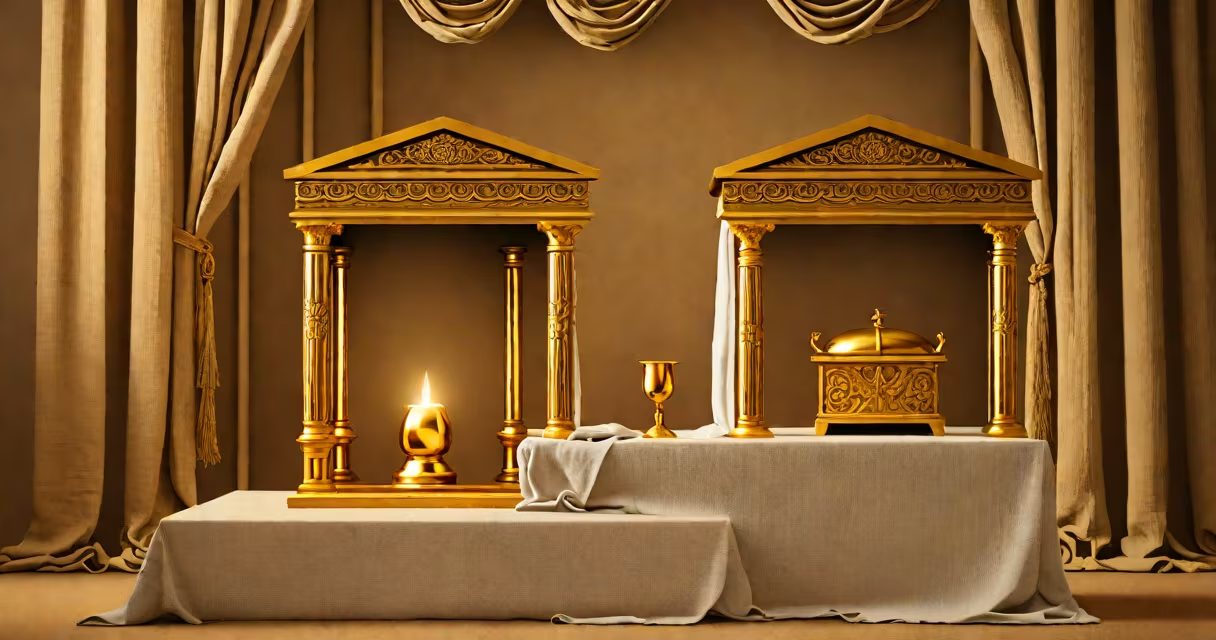
The tabernacle represents God's tangible presence among the Israelites during their wilderness wanderings, functioning as a mobile sanctuary where divine communion occurred. It was a physical manifestation of God's covenant with Israel, designed according to specific instructions given to Moses on Mount Sinai. The structure symbolized both sacred separation and accessible holiness, with its innermost chamber-the Most Holy Place-housing the Ark of the Covenant.
Constructed under divine direction, the tabernacle served as the central place of worship for the Israelites from the time of the Exodus until the construction of Solomon's Temple. Its materials-acacia wood, gold, silver, bronze, and fine linen-were chosen not for aesthetic value but for symbolic weight. Acacia wood, durable and resistant to decay, represented permanence in a transient existence. Gold, used in the innermost vessels, signified divine glory and purity. The layered fabrics-blue, purple, and scarlet thread woven into fine linen-reflected the complexity of sacred design and divine order.
According to the Book of Exodus, God instructed Moses: "Make me a sanctuary, that I may dwell among them" (Exodus 25:8). This command establishes the tabernacle not as a human-made monument, but as a response to God's initiative. The tabernacle's layout mirrored cosmic order: the outer court held the bronze altar and laver; the holy place contained the lampstand, table of showbread, and incense altar; and the Most Holy Place housed the Ark, where God's presence appeared as a cloud above the mercy seat.
Access to the tabernacle was strictly regulated. Only Aaron and his sons, consecrated as priests, could enter the holy areas. Levitical law detailed purification rituals, daily sacrifices, and annual Day of Atonement ceremonies to maintain ritual cleanliness. Failure to observe these protocols resulted in immediate death-Aaron's sons Nadab and Abihu died after offering unauthorized fire (Leviticus 10:1-2).
Each component had a role in mediating between God and humanity. The veil separating the holy place from the Most Holy Place was not merely a curtain-it was a barrier of holiness. When the high priest entered the Most Holy Place on Yom Kippur, he carried blood to atone for sins. This act symbolized the cost of access to God's presence and foreshadowed Christ's sacrifice in Christian theology.
Archaeological evidence confirms the existence of similar cultic structures in ancient Near Eastern religions, but the tabernacle differs in its monotheistic focus. Unlike Canaanite shrines dedicated to multiple gods, the tabernacle was centered on one God who demanded exclusive devotion. As noted by scholar John Walton, "The tabernacle was not a temple in the typical ancient Near Eastern sense-it was a portable, portable sanctuary designed to reflect the nature of Yahweh's rule."1
The tabernacle consisted of four primary elements, each with distinct function and symbolism:
| Component | Location | Symbolism | Biblical Reference |
|---|---|---|---|
| Outer Court | Enclosed area around the tabernacle | Access to God begins with sacrifice and cleansing | Exodus 27:9-19 |
| Holy Place | Inner chamber behind the veil | Continual worship through light, bread, and prayer | Exodus 26:31-35 |
| Most Holy Place | Innermost sanctum | Direct presence of God; inaccessible except by atonement | Exodus 26:33-34 |
| Ark of the Covenant | Within the Most Holy Place | God's throne, where He met with Moses and judged Israel | Exodus 25:10-22 |
The altar of burnt offering stood in the outer court. Each morning and evening, a lamb was sacrificed, and its blood was sprinkled on the horns. This daily ritual reinforced the idea that sin required payment-and that access to God came through substitution. The showbread, twelve loaves arranged in two rows, represented the twelve tribes of Israel and God's provision. The menorah, a seven-branched lampstand, illuminated the holy place and symbolized divine wisdom and guidance.
A lesser-known fact: the tabernacle's dimensions were based on the cubit, a unit derived from the human forearm. The standard cubit measured approximately 18 inches. The tabernacle itself was 30 cubits long (45 feet), 10 cubits wide (15 feet), and 10 cubits high (15 feet)-proportions that align with ancient Near Eastern sacred architecture but were uniquely focused on divine revelation rather than celestial alignment.
Many assume the tabernacle was a permanent structure. In reality, it was designed to be dismantled and transported. When the Israelites moved, the tabernacle was packed into wooden frames and carried by the Levites. This mobility emphasized that God was not confined to a location but accompanied His people through the wilderness.
Another misconception is that the tabernacle was purely a religious building. It was also a political and social center. The tabernacle's location determined where the tribes encamped. The tribe of Judah camped to the east, Reuben to the south, Ephraim to the west, and Dan to the north-forming a sacred circle around the central sanctuary. This arrangement reflected a theocratic order where spiritual authority governed spatial organization.
Some interpret the tabernacle as a prototype for later temples. While Solomon's Temple reused many tabernacle elements-such as the bronze sea and the cherubim-the tabernacle's portability distinguished it as a temporary, changing space. The temple, by contrast, was fixed and enduring. The difference underscores a shift from nomadic faith to settled nationhood.
I once visited the reconstructed tabernacle at the Israel Museum in Jerusalem. Standing beneath the thick blue and purple curtains, I noticed how dim the interior was-intentionally so. Light filtered only through the small entrance and the menorah's flames. The atmosphere felt heavy with anticipation. That experience clarified why the tabernacle was not meant to be seen from the outside. Its sacredness resided in the unknown, in the space beyond sight.
In modern practice, the tabernacle's symbolism persists. Churches often use the altar as a focal point, echoing the tabernacle's sacrificial heart. Some Christian communities hold "tabernacle services," where participants gather in temporary shelters to emphasize God's presence in transient circumstances. The concept also appears in literature and film-such as the 2014 movie *The Book of Mormon*, which references the tabernacle as a metaphor for faith in uncertain times.
The tabernacle represents more than a historical structure-it embodies the ongoing desire for connection with the divine. It stands as a model of sacred architecture where form follows function, and function follows relationship. In its design, God did not demand grandeur, but intimacy. He asked for obedience, not opulence. And in that, the tabernacle remains a living symbol of what it means to dwell with God.