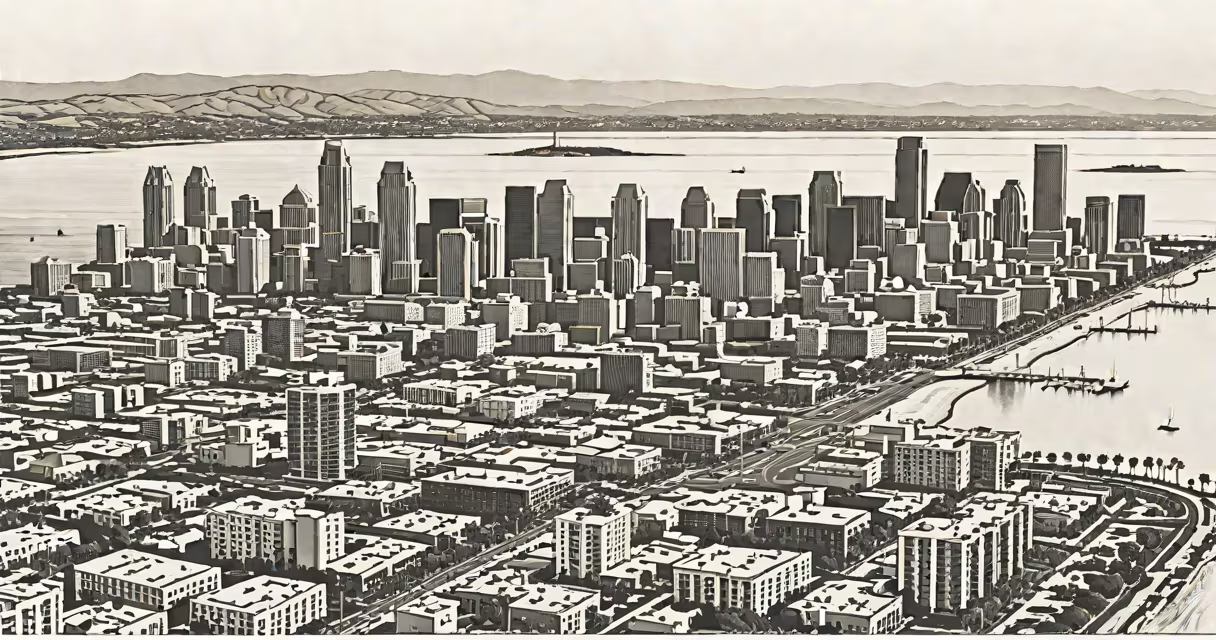
San Diego is located in San Diego County, one of 58 counties in California. The city lies within the larger jurisdiction of the county, which handles regional services such as public health, law enforcement, and infrastructure.
San Diego County spans approximately 4,295 square miles and includes 18 incorporated cities, 16 unincorporated communities, and over 100 census-designated places. The county seat is San Diego city's central government district, though the county administration operates from the County Administration Center in downtown San Diego.
The county was established in 1850 following California's admission to the Union. It was carved from the original Los Angeles County and named after the Spanish name for the city, "San Diego," which itself derives from the feast day of Saint Didacus, a 13th-century Spanish saint.
San Diego County governs regional matters beyond municipal control. This includes managing the county jail system, operating public health clinics, overseeing environmental regulations, and coordinating emergency response during wildfires and storms.
For example, the county runs the San Diego County Health Department, which monitors disease outbreaks and administers vaccination programs. During the 2020-2022 pandemic, the county issued local health orders, including mask mandates and capacity limits, based on infection rates.
Each city within the county maintains its own mayor, city council, police department, and fire department. But the county provides shared services such as the Sheriff's Department, which handles law enforcement in unincorporated areas and supports city police forces during large-scale emergencies.
While San Diego is the largest city in the county, other major population centers include Chula Vista, Carlsbad, Oceanside, and Escondido. These cities operate under their own charters but are subject to county-wide zoning laws and tax policies.
Some notable locations within the county:
Even within the city of San Diego, neighborhoods vary widely in character. Downtown San Diego is a commercial and cultural center, while neighborhoods like Pacific Beach and La Jolla attract tourists and professionals alike. The city's boundaries extend from the Pacific Ocean to the inland valleys, covering diverse terrain and climates.
Many people assume San Diego is its own independent entity or part of a different region due to its size and prominence. However, it is entirely contained within San Diego County. The county is not a city, nor is it a state-it is a level of local government beneath the state of California.
A common mistake is confusing San Diego County with neighboring counties. For example, Orange County lies to the north, Riverside County to the east, and Imperial County to the south. San Diego County shares a border with Baja California, Mexico, making it the only California county that touches another country's landmass.
Another misconception is that San Diego County includes all of Southern California. While it is part of the broader region, it is distinct from Los Angeles County, Ventura County, and others. The county's unique geography-coastal cliffs, desert foothills, and mountain ranges-shapes its climate zones and influences urban planning decisions.
In October 2023, a wildfire broke out near the community of Rancho Santa Fe, located in the northeastern part of San Diego County. The incident prompted coordinated action between the city of San Diego's fire department, the San Diego County Fire Authority, and the California Department of Forestry and Fire Protection (Cal Fire).
The county activated its Emergency Operations Center, which served as the central command for evacuations, shelter placements, and resource distribution. Over 1,200 residents were evacuated from high-risk zones, and temporary shelters were set up at community centers across the county. The county's GIS mapping system helped track fire spread in real time, guiding both responders and the public.
This event illustrates how county-level coordination enables rapid, unified responses across multiple jurisdictions. Without the structure of San Diego County, managing such a complex emergency would require direct state intervention or fragmented efforts among dozens of city agencies.
| Attribute | Detail |
|---|---|
| County Name | San Diego County |
| State | California |
| Area | 4,295 sq mi (11,124 km²) |
| Population (2023 estimate) | 3.4 million |
| County Seat | San Diego (city) |
| Bordering Countries | Mexico (via Tijuana) |
| Major Cities | San Diego, Chula Vista, Carlsbad, Oceanside, Escondido |
San Diego County is home to over 3.4 million residents, according to the U.S. Census Bureau's 2023 estimates. The county's economy is driven by defense, tourism, biotechnology, and international trade. Major employers include the U.S. Navy's Pacific Fleet headquarters, Qualcomm, and Scripps Research Institute.
When visiting or relocating to San Diego, knowing that the city is part of San Diego County ensures accurate navigation of local services. For example, property taxes are assessed at the county level, and voter registration is processed through county election offices.
As someone who once lived in a rental apartment in Mission Valley, I remember receiving a notice about a new countywide ballot measure related to affordable housing. The document came from the San Diego County Registrar of Voters, not the city. That moment clarified how county functions differ from city ones.
Understanding what county San Diego is in removes confusion about jurisdiction, service access, and civic participation. seeking mental health support, knowing you're in San Diego County directs you to the correct authority.
San Diego is in San Diego County. This fact anchors everything from emergency management to education funding. It defines how services are delivered and how communities interact with government.