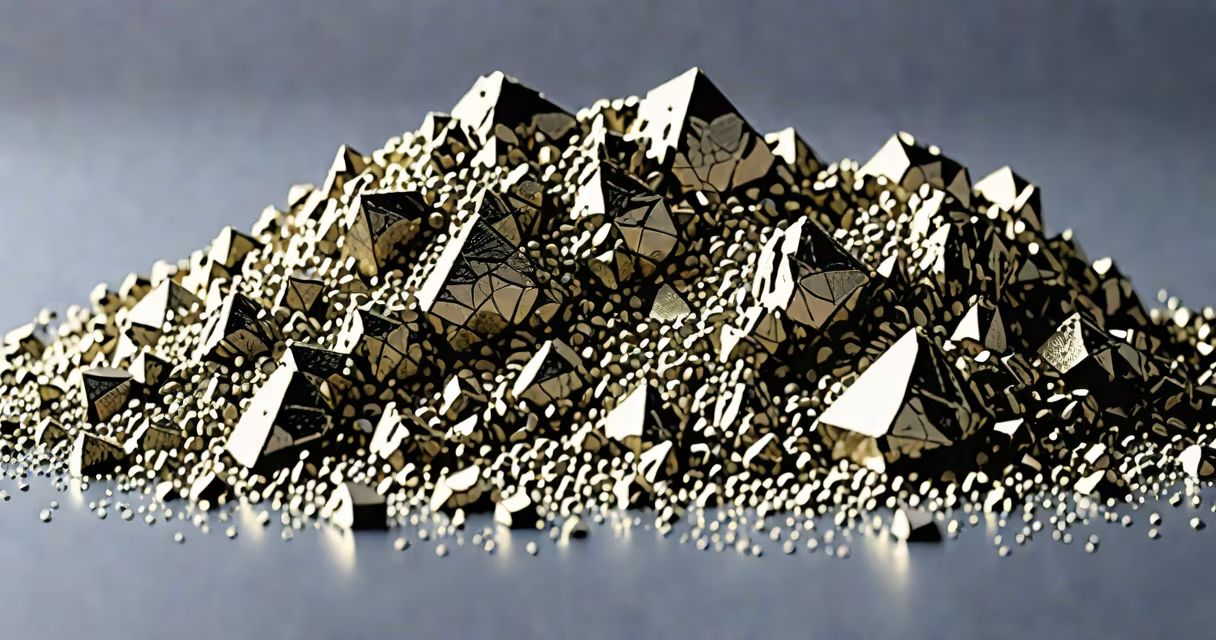
Boron is a chemical element with atomic number 5, essential in industrial, agricultural, and technological applications due to its unique properties, including high thermal stability, neutron absorption, and ability to form strong covalent bonds.
Boron occurs naturally in minerals such as kernite, ulexite, and tincal. It is not found free in nature. The element's primary commercial form is boric acid and borax, both derived from evaporite deposits. These compounds are processed into refined boron for specialized uses.
Elemental boron is a metalloid with a high melting point (2,076°C) and low density. Its ability to absorb neutrons makes it valuable in nuclear reactors. Boron nitride, a compound of boron and nitrogen, mimics diamond in hardness and is used in abrasives and heat-resistant coatings.
Boron's effectiveness stems from its electron-deficient structure. With only three valence electrons, it forms electron-deficient bonds, especially in boranes-compounds like diborane (B₂H₆). These molecules exhibit unusual bonding patterns, including three-center two-electron bonds, which contribute to their reactivity and utility in organic synthesis.
In materials science, boron enhances strength and thermal resistance. Adding just 0.5% boron to steel increases hardness and wear resistance. This alloying technique is used in armor plating and high-speed cutting tools. Boron carbide (B₄C), another compound, ranks among the hardest known materials, second only to diamond and cubic boron nitride.
Boron's neutron-absorbing capability enables its use in control rods within nuclear reactors. When exposed to slow neutrons, boron-10 captures them and emits alpha particles and lithium-7 ions. This reaction stops chain reactions safely. Over 90% of reactor control rods contain boron-based alloys.
Boron appears in several forms, each suited to specific applications:
| Form | Primary Use | Key Property |
|---|---|---|
| Boric acid (H₃BO₃) | Pest control, antiseptic, flame retardant | Low toxicity, water-soluble |
| Borax (Na₂B₄O₇·10H₂O) | Glass and ceramic production, detergents | High solubility, buffering capacity |
| Boron carbide (B₄C) | Armor, grinding wheels, nuclear shielding | Hardness ~35 GPa, neutron absorption |
| Amorphous boron powder | Pyrotechnics, rocket propellants | High reactivity, exothermic combustion |
Each form leverages boron's physical and chemical traits. For example, amorphous boron burns with a green flame and releases significant energy-ideal for flares and incendiary devices.
The global demand for boron is driven by construction, electronics, and agriculture. In 2023, Turkey produced 54% of the world's mined boron, followed by the United States (14%) and Russia (10%), according to the U.S. Geological Survey.
In agriculture, boron is a micronutrient critical for plant cell wall formation and reproductive development. Deficiency reduces crop yields-especially in crops like alfalfa, broccoli, and apples. A study published in Journal of Plant Nutrition found that applying 0.5-1.0 kg/ha of boron increased apple fruit set by 22% in deficient soils.
Industrial glass production relies heavily on boron. Borosilicate glass, containing 10-13% boron oxide (B₂O₃), resists thermal shock and chemical corrosion. This material is used in labware, cookware, and optical lenses. Pyrex, a well-known brand, uses borosilicate glass in its products.
Advanced semiconductors use boron doping to create p-type silicon. During wafer fabrication, boron atoms replace silicon atoms in the crystal lattice, creating holes that carry positive charge. This process is fundamental to making transistors in microchips.
Boron is often confused with borax, but they are distinct. Borax is a salt of boric acid and contains sodium, while elemental boron is pure. Confusing the two leads to misuse-such as using borax as a dietary supplement, which is unsafe due to sodium content and potential toxicity.
Another misconception is that boron is abundant in Earth's crust. While it ranks 10th in abundance among elements, it is rarely concentrated in exploitable ores. Only about 0.001% of Earth's crust is boron by weight, and most of it is locked in insoluble minerals.
A lesser-known fact: boron is essential in human health. Research from the European Journal of Clinical Nutrition indicates that adequate boron intake may support bone mineral density and reduce inflammation. However, daily intake above 20 mg/day may cause gastrointestinal distress. The recommended dietary allowance (RDA) is not established, but typical intake ranges from 1-3 mg/day.
Consider a solar power plant in California using parabolic trough collectors. These systems concentrate sunlight onto a receiver tube filled with heat transfer fluid. To improve efficiency, engineers coat the tube's inner surface with a boron-doped silicon layer.
This coating enhances infrared reflectivity and reduces thermal emissivity. The result is a 15% increase in heat retention compared to uncoated tubes. Over a year, this improvement translates to 1.2 million kWh more electricity generated annually from a single 100 MW facility.
Boron nitride is used in the insulation layers between photovoltaic cells. Its high dielectric strength prevents arcing and improves long-term reliability in outdoor installations.
During a visit to a research facility in New Mexico, I observed a prototype boron-doped graphene composite being tested for new battery anodes. The material showed 30% higher charge capacity than standard graphite anodes. This application is still in early development but shows promise for electric vehicles.
Boron's impact spans from microscopic semiconductor doping to macro-scale infrastructure. Its versatility arises not from abundance, but from precision engineering and targeted chemistry.