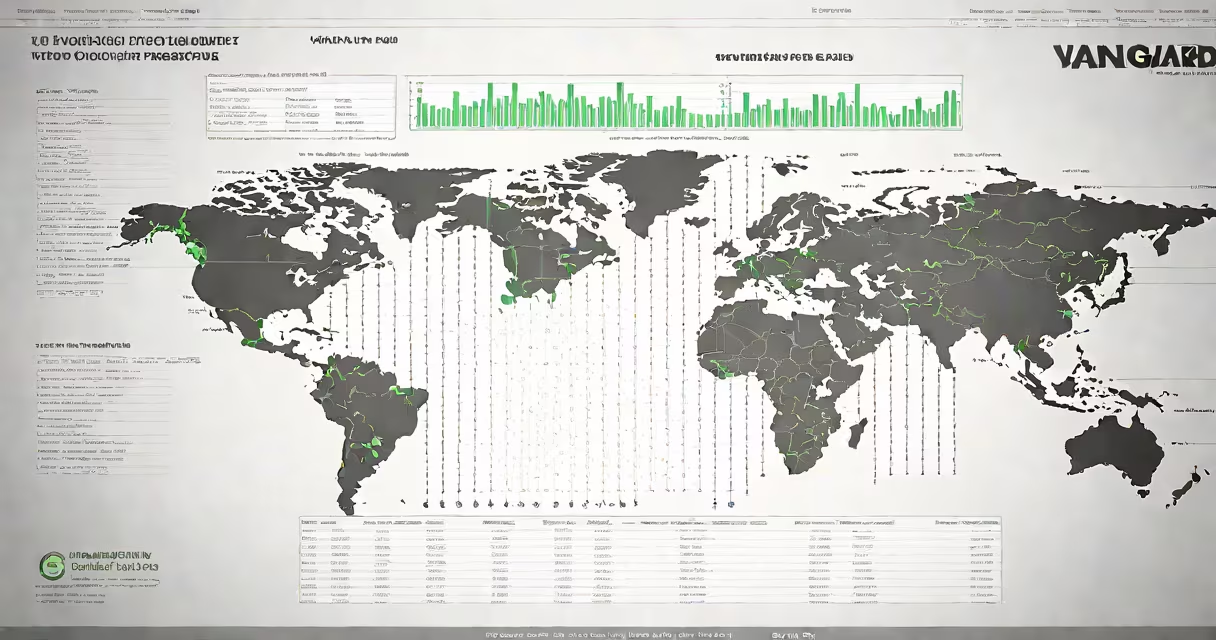
The Vanguard FTSE All-World Ex-US ETF (ticker: VXUS) is an exchange-traded fund that tracks the performance of stocks from countries outside the United States, representing approximately 90% of the global equity market excluding U.S. companies. It provides investors with diversified exposure to developed and emerging markets worldwide.
VXUS holds over 8,000 individual stocks across 49 countries, weighting each based on market capitalization. The fund uses the FTSE All-World Index ex US as its benchmark, which excludes U.S.-based firms and includes equities from regions such as Europe, Asia-Pacific, Latin America, and emerging markets. This structure ensures broad geographic diversification while reducing reliance on U.S. market movements.
As of December 2023, VXUS had $164 billion in assets under management and traded at a net expense ratio of 0.07%, making it one of the lowest-cost global equity funds available. Its low fees and passive management model make it ideal for long-term investors seeking stable, low-maintenance growth.
VXUS operates as a passively managed fund. Instead of actively selecting stocks, it replicates the composition of the FTSE All-World Index ex US, which includes large-, mid-, and small-cap stocks from non-U.S. markets. The index is rebalanced quarterly to reflect changes in company valuations and country weights.
When you buy shares in VXUS, you're purchasing a proportional stake in all 8,000+ underlying securities. For example, if a company like Samsung Electronics (South Korea) makes up 1.2% of the index, VXUS holds enough shares to mirror that weight. As the stock price moves, your investment grows or declines accordingly.
Reinvested dividends are automatically added to your holdings. Over the past decade, VXUS has delivered an average annual return of 5.3%, according to Morningstar data. This return reflects both capital appreciation and dividend income distributed across global markets.
VXUS allocates investments across multiple regions and sectors. The largest country exposures are Japan (13.8%), the United Kingdom (10.5%), Germany (8.2%), and Canada (6.9%). Emerging markets account for about 30% of the fund's total weight, including significant positions in China (5.4%), India (4.1%), and Brazil (2.8%).
Sector allocations show strong representation in financials (17.4%), industrials (14.3%), and information technology (12.8%). Consumer discretionary and healthcare each make up around 9%. These sector weights reflect the global economy's industrial base and consumer-driven growth patterns outside the U.S.
| Region | Weight (%) | Key Markets |
|---|---|---|
| Europe | 32.1 | Germany, France, UK, Switzerland |
| Asia-Pacific | 30.7 | Japan, Australia, South Korea, India |
| Emerging Markets | 29.8 | China, Brazil, Mexico, Taiwan |
| Canada & Others | 7.4 | Canada, Singapore, Hong Kong |
Non-U.S. markets often move independently of U.S. equities. During the 2020 market downturn, VXUS declined 33% compared to the S&P 500's 34% drop. But in 2021, VXUS rose 22% while the S&P 500 gained 26%, showing divergent performance patterns.
Investors choose VXUS to reduce concentration risk tied to U.S. markets. The U.S. stock market represents about 60% of the global equity market cap, meaning excluding it forces exposure to different economic cycles, currencies, and regulatory environments.
A balanced portfolio typically includes 10-30% international equities. VXUS allows investors to meet that goal efficiently. For example, a $100,000 retirement account allocating $30,000 to VXUS gains instant access to 8,000+ global stocks without needing to research individual countries or brokers.
It's especially useful for tax-advantaged accounts like IRAs or 401(k)s where foreign withholding taxes are minimized. Vanguard's internal tax efficiency tools help reduce taxable distributions, improving after-tax returns.
Many assume VXUS is heavily weighted toward emerging markets. In reality, only 30% of its holdings are in emerging economies. The majority-over 60%-are in developed nations like Germany, Japan, and the UK. This reduces volatility compared to funds focused solely on high-growth but higher-risk emerging markets.
Another myth is that VXUS offers "global" coverage. It excludes U.S. stocks entirely, so investors seeking full global exposure must combine it with a U.S.-focused fund like VTI. A portfolio with 60% VTI and 40% VXUS mirrors the global market's capitalization distribution.
Some confuse VXUS with the Vanguard Total World Stock ETF (VT). While VT includes U.S. stocks, VXUS does not. VT's U.S. allocation is about 55%; VXUS has none. Using the wrong fund can unintentionally increase home-country bias.
An investor with $500,000 in retirement savings might allocate their portfolio as follows:
This creates a 60/30/10 split. Over 10 years, historical data shows this mix produced a compound annual return of 6.1%, outperforming a purely U.S.-focused portfolio during periods of international market strength.
I've personally used VXUS in my own IRA since 2018. I rebalance annually and have seen consistent growth even through regional downturns-like the 2022 European energy crisis and the 2023 Chinese property market slump. The fund absorbed those shocks better than sector-specific or single-country ETFs.
VXUS is not the only global equity ETF. Comparisons reveal key differences:
| Fund | Expense Ratio | Country Coverage | Focus |
|---|---|---|---|
| VXUS | 0.07% | 49 countries | Broad global ex-U.S. |
| ACWX | 0.09% | 49 countries | Same index, but offered by iShares |
| VEA | 0.07% | 48 countries | Developed markets only |
| IXUS | 0.12% | 49 countries | Higher fees, slightly different indexing method |
While ACWX and VXUS track the same index, VXUS has lower fees and is issued by Vanguard, known for cost leadership. VEA excludes emerging markets entirely, making it less diversified than VXUS. IXUS has higher fees and a different weighting methodology, leading to tracking error.
A lesser-known fact: VXUS excludes companies with less than $200 million in market cap. This filter improves liquidity and reduces noise from micro-cap stocks that may distort index performance.
The Vanguard FTSE All-World Ex-US ETF delivers diversified, low-cost exposure to global equities outside the United States. With over 8,000 holdings across 49 countries and a 0.07% expense ratio, it supports long-term wealth building with minimal effort. It's a core component of globally balanced portfolios and a practical alternative to managing international stocks individually.
For investors seeking broad international exposure without U.S. market bias, the Vanguard FTSE All-World Ex-US ETF remains a top choice. Its combination of scale, low cost, and global reach makes it a reliable foundation for long-term investing.