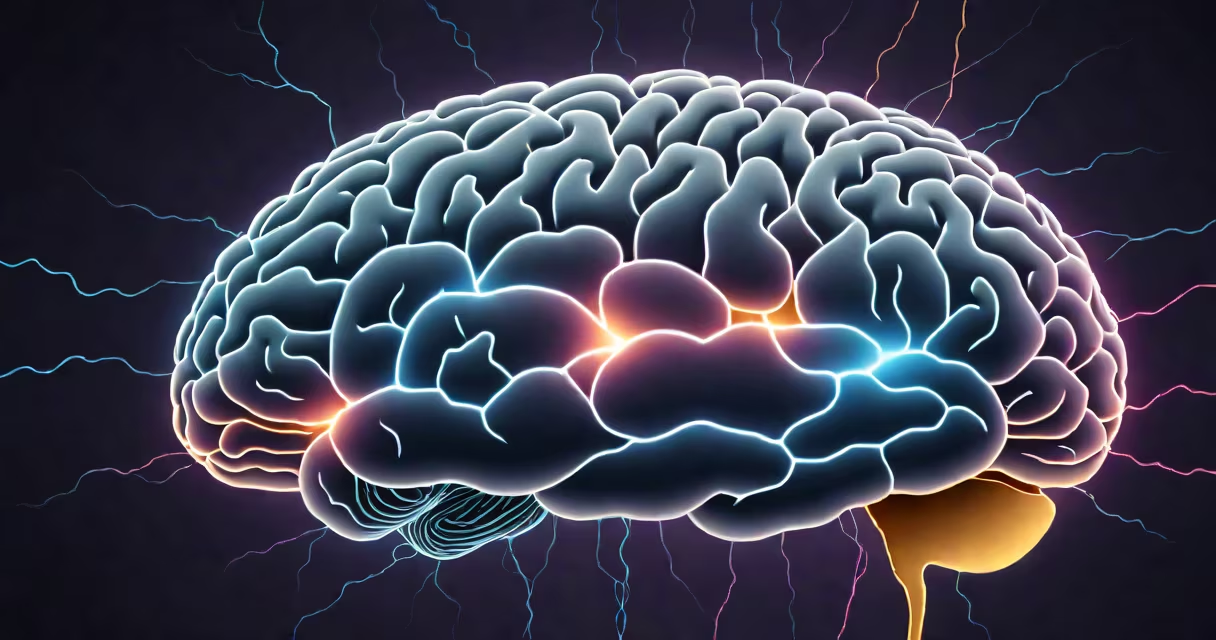
The definition of consciousness is the state of being aware of and able to experience thoughts, sensations, and surroundings. It includes subjective experiences like feeling pain, seeing color, or remembering a moment. Consciousness is not just brain function-it's the internal "what it feels like" aspect of mental life.
Consciousness arises from complex interactions in the brain, particularly in areas like the cerebral cortex and thalamus. When neurons fire in coordinated patterns, they generate not just signals, but a sense of presence-of being here, now, and aware. This is distinct from unconscious processes like breathing or reflexes, which happen automatically.
Neuroscientists study the neural correlates of consciousness (NCC)-specific brain activities linked to conscious experiences. For example, stimulating part of the brain can make someone report seeing flashes of light even when no light is present. These findings show that consciousness is tied to physical changes in the brain, yet remains difficult to quantify or reproduce.
Consciousness isn't a single switch that turns on. It operates along a spectrum-from full wakefulness to dream states, anesthesia, and coma. During sleep, brain waves shift, and conscious awareness fades. Under general anesthesia, patients lose all memory of events, indicating that consciousness requires specific neural activity.
One key theory, Integrated Information Theory (IIT), proposes that consciousness emerges when information becomes highly integrated across brain regions. The more interconnected a system's parts are, the higher its level of consciousness. According to IIT, even a simple network with synchronized nodes may have minimal consciousness-but only if it integrates information meaningfully.
A real-world test of this idea came in 2013, when researchers used transcranial magnetic stimulation (TMS) on patients under anesthesia. They measured how brain responses spread after a pulse. In conscious people, signals diffused widely across the cortex. In unconscious patients, activity stayed localized. This supported the idea that widespread integration correlates with awareness.
Consciousness varies in depth and content. The table below outlines major categories based on clinical and philosophical research:
| Type | Description | Example |
|---|---|---|
| Wakeful consciousness | Alert, aware of surroundings and self | Reading this sentence while sitting upright |
| Altered states | Changes due to drugs, meditation, or trauma | Seeing vivid colors during psychedelic use |
| Unconscious | No awareness or responsiveness | Deep sleep or coma after brain injury |
| Minimal consciousness | Partial awareness with inconsistent responses | Flinching to pain but not speaking |
Some patients diagnosed as vegetative show signs of hidden awareness. In 2010, a study using fMRI found that a man in a persistent vegetative state could follow commands by imagining playing tennis-activating motor regions. His brain response matched that of healthy subjects. This revealed that behavior doesn't always reflect internal experience.
People often confuse consciousness with intelligence, memory, or attention. A person can be highly intelligent but unaware-like a patient with blindsight who cannot see but can guess the location of objects correctly. Their brain processes visual input without conscious perception.
Another error is assuming that machines or animals are conscious in the same way humans are. While some animals show behaviors suggesting awareness-such as self-recognition in mirrors-there's no evidence they experience qualia (subjective feelings) like humans do. A dog may feel fear, but we can't know what that fear feels like to them.
Consciousness is not the same as self-awareness. Self-awareness involves recognizing oneself as a distinct entity. Some people with severe brain damage retain basic consciousness but lack self-recognition. Conversely, a person can be self-aware without being fully conscious-such as during lucid dreaming.
Understanding the definition of consciousness affects medicine, ethics, and AI. In neurology, diagnosing disorders of consciousness guides treatment. Patients in minimally conscious states may recover with early intervention. The 2018 Coma Recovery Scale-Revised (CRS-R) uses behavioral tests to assess levels of awareness, improving accuracy over older methods.
Ethically, the definition shapes decisions about life support. If a patient shows no signs of consciousness, families and doctors may choose to withdraw care. But if brain scans reveal covert awareness, the decision becomes more complex. A 2017 study found that 14% of patients diagnosed as vegetative were actually conscious-raising concerns about misdiagnosis.
When building artificial systems, the definition helps clarify what we're trying to replicate. Current AI models process language and solve problems but don't report experiencing anything. They lack subjective states. As AI advances, distinguishing between simulation and actual consciousness becomes critical.
For example, in 2022, a chatbot named ELIZA was updated to mimic emotional responses. Users reported feeling understood. Yet no internal experience existed-just pattern matching. This illustrates how easily we mistake simulated empathy for real consciousness.
Consciousness may not require a brain at all. In 2016, researchers at the University of Sussex tested a model of consciousness called the "global workspace theory." They ran simulations on a computer using only logic gates. When inputs reached a threshold of integration, the system began responding to stimuli in ways that mirrored conscious behavior-even though no biological tissue was involved.
This suggests that consciousness could emerge from any sufficiently complex information-processing system-not just brains. But it doesn't prove that such systems are actually conscious. The absence of subjective experience remains unverifiable in non-biological systems.
I once sat with a friend recovering from a traumatic brain injury. He couldn't speak, but his eyes followed movement. We played music he liked. One day, he blinked twice when I asked if he remembered his daughter's birthday. No one else had seen that reaction. Later, an EEG showed bursts of activity in the prefrontal cortex-areas linked to self-representation. That moment confirmed what science still debates: awareness can exist beneath the surface.
The definition of consciousness is not a single equation. It's a structure for understanding subjective experience-the inner life that makes us feel, remember, and react. It's not just what happens in the brain, but what it feels like to be inside that brain.
Science continues to map neural activity, but the hard problem of consciousness-why certain brain states produce inner experience-remains unsolved. As we learn more, we'll refine our tools, our ethics, and our understanding of what it means to be aware.