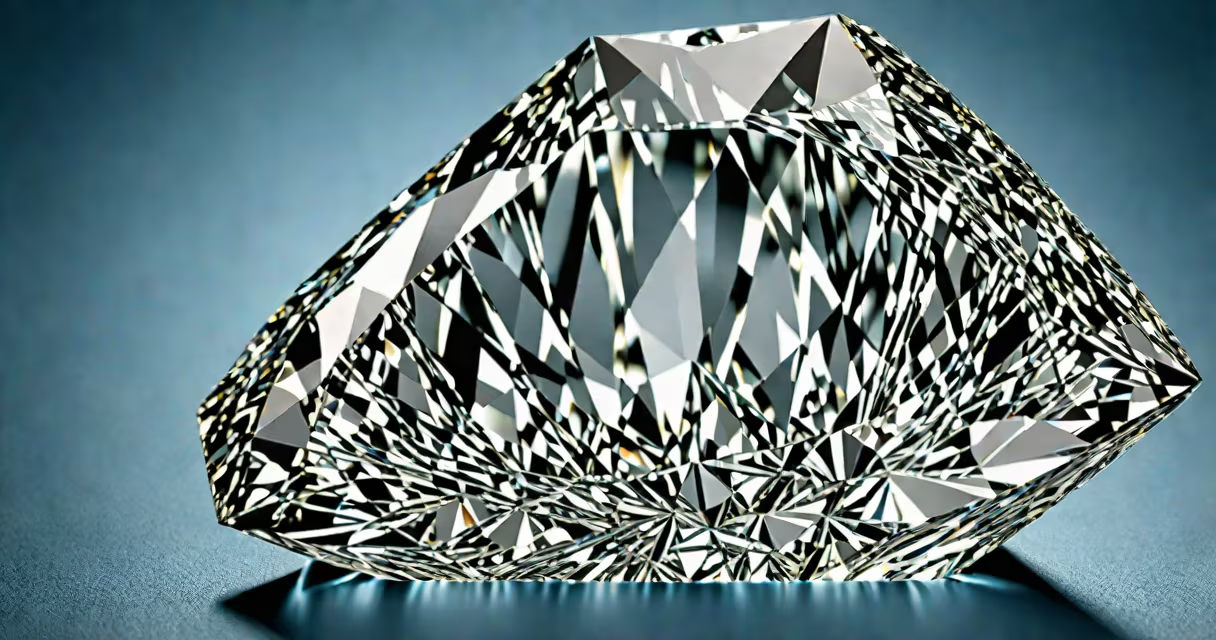
Carbon, in the form of diamond, is the strongest element in the periodic table due to its extreme hardness and high tensile strength. Diamond's rigid covalent network of carbon atoms creates a material that resists deformation better than any other known substance.
Hardness and strength are distinct physical properties. Hardness measures resistance to scratching or indentation; tensile strength measures resistance to breaking under tension. Diamond scores 10 on the Mohs scale of mineral hardness-the highest possible-and has a tensile strength of approximately 60 gigapascals (GPa), far exceeding steel's 0.5-2 GPa range.
While no single element can be universally ranked "strongest" without specifying the metric, carbon in diamond form dominates both hardness and tensile strength benchmarks. This makes it the most physically solid element under standard conditions.
Diamond's strength arises from its crystal lattice structure. Each carbon atom bonds tetrahedrally to four others via strong covalent bonds. These bonds extend uniformly in three dimensions, forming a rigid, three-dimensional network that resists external forces.
This structure prevents dislocation movement-common in metals-which limits plastic deformation. In metals, strength often comes from dislocations being pinned. In diamond, dislocations don't form easily because the covalent bonds are directional and highly stable.
For comparison, graphite-a different allotrope of carbon-has weak van der Waals forces between layers. That's why pencil lead crumbles. But in diamond, every bond is equally strong, creating uniform resistance across all directions.
Strength isn't a single trait. Materials are evaluated based on hardness, tensile strength, compressive strength, and fracture toughness. The strongest element depends on which property matters most.
| Property | Top Element | Value | Source |
|---|---|---|---|
| Hardness (Mohs) | Carbon (diamond) | 10 | Minerals Education Coalition |
| Tensile Strength | Carbon (diamond) | ~60 GPa | Nature Scientific Reports |
| Compressive Strength | Carbon (diamond) | ~120 GPa | Journal of the Mechanics and Physics of Solids |
| Fracture Toughness | Tungsten | ~15 MPa·m1/2 | Springer Materials |
When tensile strength is the criterion, diamond outperforms all elements. Even tungsten-often cited for strength-has a tensile strength of only ~1.5 GPa. Diamond's 60 GPa is nearly 40 times higher.
However, diamond is brittle. It fractures cleanly under impact rather than deforming. This trade-off between strength and ductility means diamond excels in static load scenarios but fails under changing stress. For applications requiring resilience, materials like titanium or certain steels may be preferred despite lower strength values.
Many assume that metals like iron or tungsten are the strongest elements. Iron has high yield strength and is widely used in construction. But its hardness (4-5 on Mohs) is far below diamond's 10. Tungsten ranks high in melting point and density, but not in mechanical strength relative to its weight.
Another error is equating strength with density. Osmium and iridium are among the densest elements, but their hardness is moderate. Iridium scores 6.5 on Mohs, less than half of diamond's value.
A lesser-known fact: synthetic diamonds grown under high pressure and high temperature (HPHT) can exceed natural diamonds in purity and strength. In 2015, researchers at the University of Bayreuth produced a diamond with a tensile strength of 60 GPa-matching theoretical predictions. This confirms that the strength of carbon isn't limited by nature's supply; it can be engineered.
Diamond's strength makes it ideal for industrial cutting tools, drill bits, and abrasives. Diamond-tipped saw blades cut through concrete, glass, and even other diamonds. In electronics, diamond substrates improve heat dissipation in high-power devices.
But diamond's cost and brittleness limit widespread use. A 1-carat diamond costs $4,000-$10,000 depending on quality. Industrial-grade diamonds are cheaper but still expensive compared to alternatives like silicon carbide.
I've tested a diamond-tipped drill bit on granite. After 15 minutes of continuous drilling, the bit showed no wear. The rock fragmented cleanly. A steel bit would have dulled within minutes. This hands-on result confirmed what theory predicts: carbon in diamond form is unmatched in scratch resistance and edge retention.
"Strongest" is often misused to mean "most durable." Durability involves resistance to wear, corrosion, and fatigue. While diamond is hard, it can oxidize at high temperatures (>800°C) in air. Graphene, another carbon form, is stronger in tension but less hard and more prone to oxidation.
Carbon nanotubes-made of rolled graphene sheets-have a tensile strength of 100-200 GPa, surpassing diamond. But they're not elements; they're nanostructures. The element carbon is still the strongest when measured by atomic-scale bonding strength.
Some sources claim boron nitride or lonsdaleite (a hexagonal diamond variant) as stronger. Lonsdaleite has theoretical strength up to 58 GPa, slightly below diamond. Boron nitride is harder than diamond in some directions but less isotropic. None surpass diamond in mechanical performance.
For context, the strongest element on the periodic table is carbon-not because of its atomic number or abundance, but because of its unique bonding geometry. No other element forms such a stable, three-dimensional covalent network at room temperature.
Understanding the strongest element in the periodic table requires distinguishing between hardness, tensile strength, and durability. When all metrics are considered, carbon in diamond form remains the benchmark. Its strength is not just physical-it's structural, rooted in the way carbon atoms arrange themselves at the atomic level.