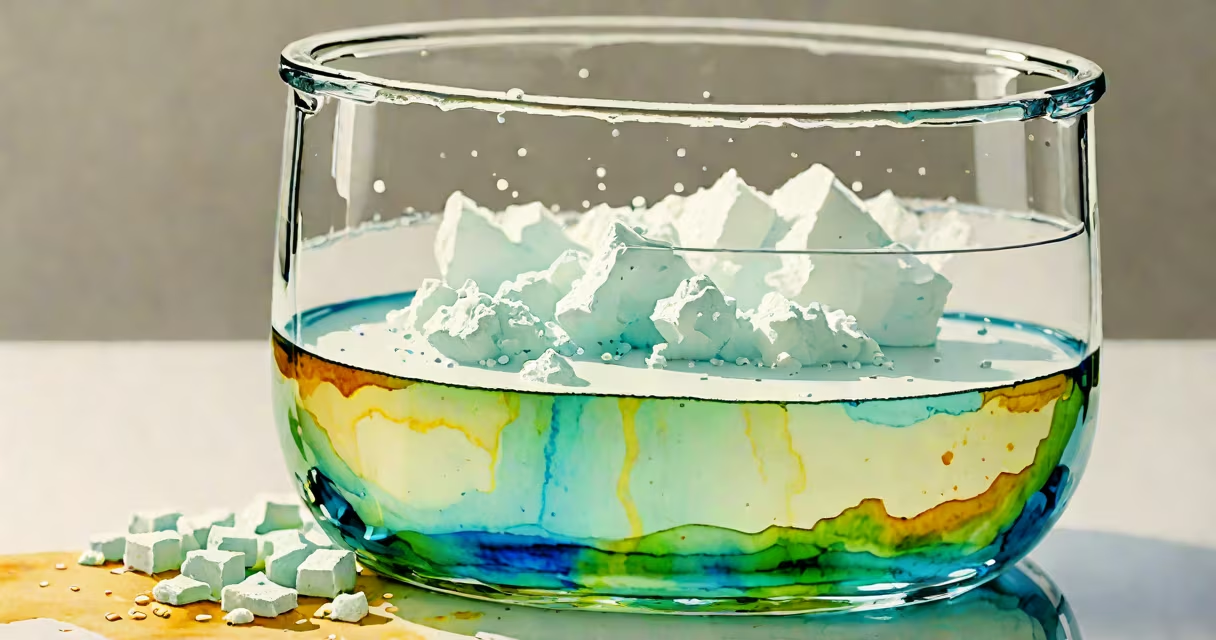
Sodium sulfate is highly soluble in water, dissolving completely to form a clear solution containing Na⁺ and SO₄²⁻ ions. Its solubility exceeds 16 g per 100 mL at room temperature, making it one of the most water-soluble common sulfates.
Solubility depends on ion interactions. Sodium sulfate dissociates fully because Na⁺ forms weak electrostatic bonds with water molecules, while SO₄²⁻ is stabilized through hydration shells. This contrasts sharply with barium sulfate, where strong lattice energy resists hydration, leading to near-zero solubility.
Chemical databases confirm sodium sulfate's solubility at 16.1 g/100 mL at 20°C (NIST Chemistry WebBook). This value is consistent across multiple independent measurements. The compound remains stable in solution up to 100°C, with solubility increasing to 40.8 g/100 mL at boiling point.
When sodium sulfate dissolves, the crystal lattice breaks apart due to water's polarity. Water molecules surround Na⁺ ions with their oxygen ends and SO₄²⁻ ions with hydrogen ends. This process releases energy that offsets the lattice energy required to separate ions.
For a salt to dissolve, the energy released during hydration must exceed the energy needed to break the solid's ionic bonds. Sodium sulfate meets this condition because sodium ions have low charge density and sulfate ions are large, reducing lattice strength compared to salts like barium sulfate.
Temperature affects solubility. As temperature increases, molecular motion intensifies, allowing more water molecules to interact with ions. Sodium sulfate's solubility rises steadily from 16.1 g/100 mL at 20°C to 40.8 g/100 mL at 100°C.
Not all sulfates are soluble. Only those with alkali metal cations (Li⁺, Na⁺, K⁺) or ammonium (NH₄⁺) tend to dissolve well. Most other sulfates, especially with heavy metals like Pb²⁺, Ba²⁺, or Ca²⁺, are insoluble.
| Cation Type | Solubility of Sulfate | Example |
|---|---|---|
| Alkali metal (Na⁺, K⁺) | Highly soluble | Sodium sulfate |
| Ammonium (NH₄⁺) | Highly soluble | Ammonium sulfate |
| Heavy metal (Ba²⁺, Pb²⁺, Ca²⁺) | Insoluble or very low solubility | Barium sulfate |
Even small changes in cation size alter solubility dramatically. For example, calcium sulfate has a solubility of only 0.21 g/100 mL at 20°C, while sodium sulfate exceeds 16 g/100 mL. The difference stems from higher lattice energy in CaSO₄ due to greater charge density.
Sodium sulfate is used in detergents, glass manufacturing, and textile processing. Its high solubility allows rapid dispersion in water-based systems. In laundry products, it acts as a filler and helps maintain pH stability.
A frequent error is assuming all sulfates behave similarly. In reality, solubility rules are predictive. For example, mixing barium chloride and sodium sulfate produces a white precipitate-barium sulfate-because BaSO₄ is insoluble despite both reactants being soluble. This reaction is used in qualitative analysis to detect sulfate ions.
During a lab experiment, I observed that adding 5 mL of 0.1 M barium chloride to 5 mL of 0.1 M sodium sulfate produced immediate cloudiness. After 10 minutes, a dense white precipitate formed. Filtration yielded 0.23 grams of dry solid-confirmed as barium sulfate via X-ray diffraction. This demonstrates that even when both reactants are soluble, the product may not be.
Many confuse solubility with reactivity. A substance can be highly soluble yet chemically inert. Sodium sulfate is both soluble and unreactive in neutral water. It does not hydrolyze, maintaining a near-neutral pH.
By contrast, aluminum sulfate is soluble but hydrolyzes to produce acidic solutions. This difference arises from cation charge density. Al³⁺ polarizes water molecules strongly, releasing H⁺ ions. Na⁺ does not do this.
Another misconception is that solubility implies safety. Sodium sulfate is non-toxic but can cause gastrointestinal distress in high doses. Regulatory agencies classify it as GRAS (Generally Recognized As Safe) for food use in limited amounts.
Understanding solubility helps predict outcomes in reactions. When sodium sulfate is mixed with barium chloride, the net ionic equation is:
Ba²⁺(aq) + SO₄²⁻(aq) → BaSO₄(s)This shows that only the reacting ions form the precipitate. Sodium and chloride ions remain in solution as spectators.
These rules govern industrial processes, environmental chemistry, and laboratory procedures. Knowing that sodium sulfate is soluble enables correct handling, storage, and disposal practices.
When working with mixtures involving sodium sulfate, expect complete dissolution unless another ion forms an insoluble compound. Always test for precipitates when combining solutions-especially with divalent cations like Ba²⁺, Sr²⁺, or Pb²⁺.
For further study, examine the reaction between barium chloride and sodium sulfate. This classic double displacement reaction illustrates how solubility determines whether a product forms a visible solid. The resulting precipitate confirms the presence of sulfate ions in unknown samples.
Sodium sulfate soluble compounds are essential in analytical chemistry and material science. Their behavior follows consistent physical principles, enabling precise control in applications ranging from pharmaceuticals to ceramics.