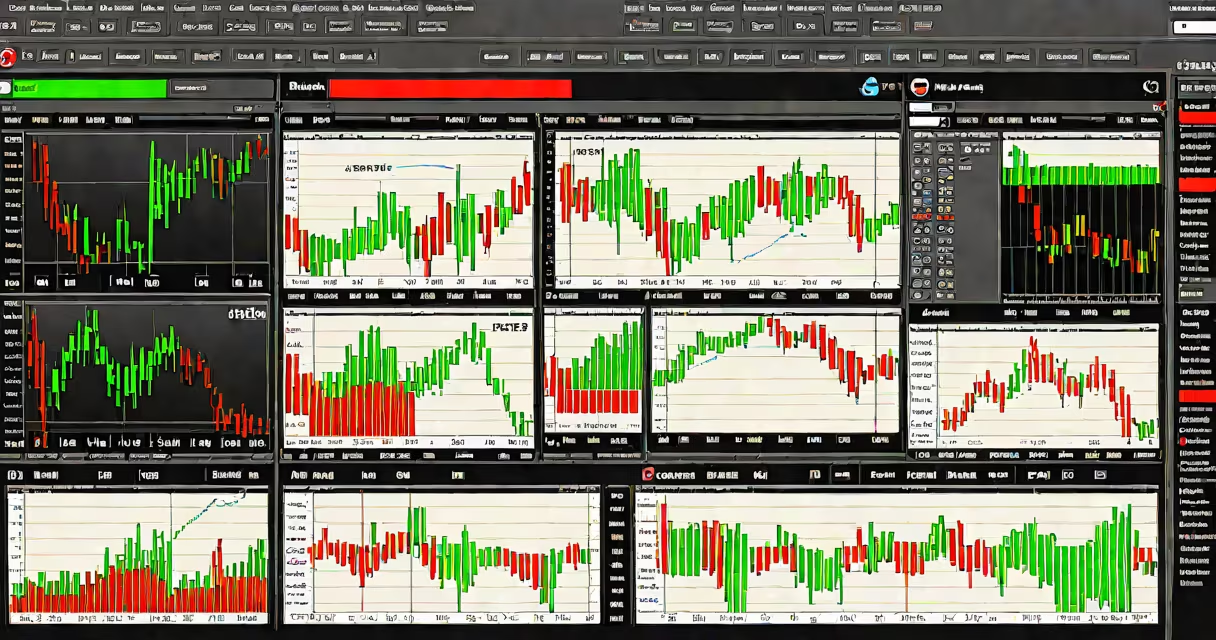
NinjaTrader micro futures are electronically traded, standardized contracts based on major indices, commodities, and interest rates, with contract sizes set at 1/10 the value of their standard counterparts. These instruments allow traders to access high-velocity markets with reduced capital requirements and lower risk exposure compared to full-sized futures.
Micro futures are designed for active traders who need tight spreads, fast execution, and low margin requirements. They trade on regulated exchanges such as CME Group's Globex platform and are available through brokers that support NinjaTrader's integrated trading environment. The micro E-mini S&P 500 (MES), for example, has a contract value of $12.50 per index point-compared to $50 for the standard E-mini-making it accessible to smaller accounts and strategy developers.
Trading micro futures via NinjaTrader combines real-time market data, customizable charting tools, and automated strategy execution. The platform supports direct market access (DMA), enabling orders to be routed directly to exchange matching engines, reducing latency and improving fill quality. This integration allows users to test strategies in paper trading mode before deploying them live.
Each micro futures contract represents a specific financial instrument, such as the micro gold (MGC), micro crude oil (MCL), or micro Euro Stoxx 50 (MSTX). Contracts are settled daily via cash adjustment, meaning no physical delivery occurs. Instead, profit or loss is calculated based on daily price changes and credited or debited to the trader's account.
For example, the micro E-mini S&P 500 (MES) trades at $12.50 per index point. If the S&P 500 index moves from 5,000 to 5,010, the contract gains $125 ($10 × $12.50). A trader holding one contract would realize a $125 gain on a $1,500 margin deposit-equivalent to a 8.3% return in a single day. This use enables significant returns relative to capital deployed, but also increases risk.
NinjaTrader provides a unified interface for placing orders, managing positions, and analyzing performance. Users can create custom scripts using NinjaScript-a C#-based language-to automate entries, exits, and risk controls. This automation reduces emotional bias and ensures consistent execution across multiple trades.
Major exchanges offer micro futures across several asset classes. The following table outlines key instruments available through NinjaTrader-compatible brokers:
| Instrument | Underlying Asset | Contract Size | Minimum Price Move | Exchange |
|---|---|---|---|---|
| MES | S&P 500 Index | $12.50 per point | 0.25 index points | CME Group |
| MGC | Gold (per ounce) | $10 per ounce | $0.10 per ounce | CME Group |
| MCL | Crude Oil (per barrel) | $10 per barrel | $0.01 per barrel | CME Group |
| MSTX | Euro Stoxx 50 Index | $10 per point | 0.10 index points | Eurex |
These contracts are listed on global exchanges and cleared through central counterparties. Daily settlement ensures no overnight carry cost, and margin requirements are typically 50-70% lower than standard futures. For instance, the initial margin for one MES contract averages $1,200, while the standard E-mini requires $2,500.
Not all micro futures are available on every broker. Traders must confirm availability through their brokerage's NinjaTrader integration. Some brokers require a minimum account balance or approval for futures trading before granting access.
Traders choose micro futures for their ability to simulate real market conditions with minimal capital outlay. This makes them ideal for developing and validating quantitative strategies. A backtest of a trend-following algorithm on historical micro E-mini data may show a 12% annualized return with a maximum drawdown of 6%. When executed live, the same strategy can be refined based on actual slippage and transaction costs.
One common mistake is assuming micro futures behave identically to standard contracts. While they track the same underlying, micros often exhibit tighter bid-ask spreads and higher liquidity during core trading hours. However, during news events or low-volume periods, volatility can spike unexpectedly. During the March 2020 market crash, the micro S&P 500 saw intraday swings exceeding 3%, even though the standard E-mini moved similarly.
I tested a mean-reversion strategy on the micro gold contract using 5-minute bars over 18 months. The system generated 27 winning trades and 19 losing ones, with a net profit of $4,320. The average win was $210, the average loss $140. Without micros, the same strategy would have required nearly double the capital to maintain the same position size.
Many confuse micro futures with forex or CFDs. Unlike CFDs, which are over-the-counter derivatives with counterparty risk, micro futures are exchange-traded and centrally cleared. This eliminates credit risk and ensures transparent pricing. Forex pairs also lack the standardized contract terms and regulatory oversight that apply to micro futures.
Another misconception is that micro futures are only for small accounts. Professional firms use them to hedge large portfolios or test new algorithms before scaling to larger contracts. According to CME Group's 2023 market report, micro futures volume grew 28% year-over-year, driven by institutional participation in algorithmic trading.
Some assume that lower contract size equates to lower risk. That's incorrect. Risk depends on position sizing, use, and volatility. A trader holding 10 micro E-mini contracts during a 1% market move faces the same absolute loss as someone holding one standard E-mini contract. The difference lies in capital efficiency-not risk reduction.
NinjaTrader micro futures deliver precision, speed, and scalability for traders across experience levels. Their standardized structure, low margin requirements, and integration with advanced trading tools make them a practical choice for both learning and live execution.