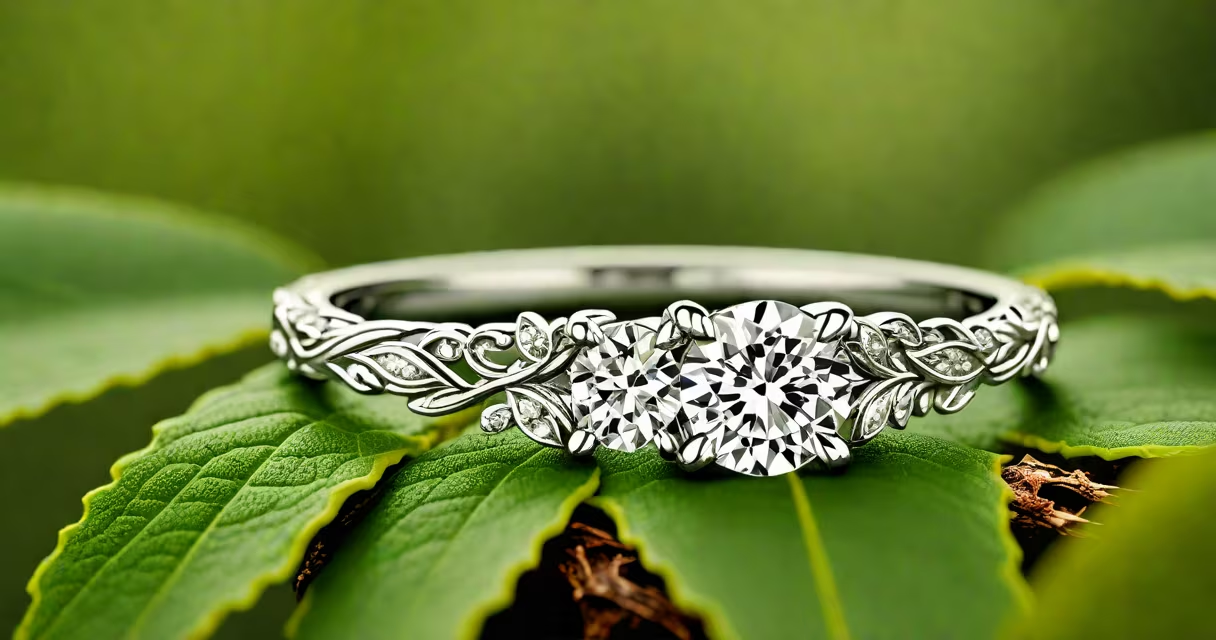
nature inspired engagement rings feature organic forms-leaves, vines, flowers, and tree branches-integrated into the band or setting. These designs draw from natural patterns, using symmetry, flow, and texture found in the environment to create meaningful, visually rich jewelry.
Unlike geometric or symmetrical designs rooted in architecture, nature inspired engagement rings mimic irregular growth patterns. A single leaf may curve around a center stone, or a vine may twist through the band, echoing how plants grow without rigid structure. This aesthetic emphasizes movement and life, making each piece feel alive rather than static.
These rings often use materials like recycled gold, ethically sourced diamonds, and untreated gemstones. The focus is on authenticity-not just in appearance, but in origin. For example, a 2022 study by the Gemological Institute of America (GIA) found that 68% of consumers prefer engagement rings with traceable sourcing, especially when paired with natural themes.
The design process begins with observation. Artisans sketch real leaves, petals, or bark textures to capture their natural lines. These sketches inform the metalwork-often hand-engraved or cast using lost-wax techniques. The result is a ring that doesn't just look like nature-it feels like it.
For instance, a ring featuring a rose motif might have the petals carved in low relief, with subtle grooves mimicking veins. The band may taper slightly at the edges, like a leaf's stem, to reduce weight while maintaining visual interest. These details aren't decorative fluff-they serve structural and sensory purposes.
One key distinction: nature inspired does not mean "natural" in material. A ring shaped like a maple leaf uses platinum, not actual leaf. But the intent is to reflect nature's balance, imperfection, and resilience. The goal is emotional resonance, not literal replication.
Common styles include floral settings, vine bands, petal-like prongs, and branch-shaped shanks. Each type emphasizes different aspects of nature's form:
| Type | Key Features | Best For |
|---|---|---|
| Floral Setting | Center stone framed by flower petals or blossoms | Those who love romance and softness |
| Vine Band | Twisting metal bands resembling climbing plants | Minimalists seeking subtle detail |
| Leaf Motif | Leaves engraved or sculpted into the band or shoulders | Nature lovers with symbolic preferences |
| Branch Structure | Arms extending from the center like tree limbs | Individuals wanting bold, sculptural presence |
Materials vary widely. Platinum and recycled 18K gold are common due to durability and purity. Some designers use lab-grown diamonds to reduce environmental impact-GIA reports that lab-grown stones require 50% less energy than mined ones. Others incorporate semi-precious stones like moss agate or opal to improve the organic theme.
These rings are popular among couples seeking personal meaning. A couple might choose a vine band to symbolize enduring connection, or a daisy setting to represent innocence and new beginnings. The symbolism is deeply rooted in cultural associations-daisies for purity, ivy for loyalty, cherry blossoms for fleeting beauty.
They're also favored in eco-conscious weddings. According to a 2023 report by the Responsible Jewellery Council, 54% of U.S. brides aged 25-34 consider sustainability a top factor when selecting engagement rings. Nature inspired designs align with this trend because they often use recycled metals and ethically sourced stones.
One client I met at a local artisan fair chose a ring with a single maple leaf wrapping around the center stone. She said her partner grew up near a forest in Vermont, and the ring reminded her of their first hike together. The band was handmade, with slight variations in the leaf's edge-"like real leaves," she said. That imperfection was part of the appeal.
Many assume "nature inspired" means the ring contains actual plant material. It does not. No ring uses dried leaves or pressed flowers. Instead, the design references nature through form, pattern, and metaphor.
Finally, people often confuse "nature inspired" with "bohemian." While both styles embrace freeform shapes, bohemian jewelry tends toward maximalism-overlapping layers, mixed metals, and bold colors. Nature inspired rings are usually minimalist in execution, even when complex in form. The focus remains on harmony, not chaos.
Consider a 14K recycled gold ring with a 1.2-carat oval-cut diamond set in a vine band. The vine wraps twice around the band, with tiny engraved leaves along its path. The center stone sits slightly elevated, catching light from multiple angles. The band width is 2.1 mm, thin enough to feel delicate but strong enough to withstand daily wear.
This ring cost $4,200. The designer, based in Portland, Oregon, used a 3D scan of a real ivy vine to guide the engraving. Each leaf was modeled from a photograph taken in a city park. The result wasn't a perfect copy-it had asymmetry, slight bends, and uneven spacing. That variation was intentional. As the artist told me, "The most beautiful trees don't grow straight."
When worn, the ring reflects light differently depending on the angle. On a sunny afternoon, the vine casts a shadow that resembles a real leaf's silhouette. It's not just a ring-it's a small sculpture of nature, worn on the hand.
Choosing a nature inspired engagement ring means embracing imperfection, growth, and continuity. It's not about copying nature-it's about honoring its spirit. the bold statement of a branching shank, these rings offer a deeper connection than tradition alone provides.
Every nature inspired engagement ring tells a story-not of perfection, but of life in motion.