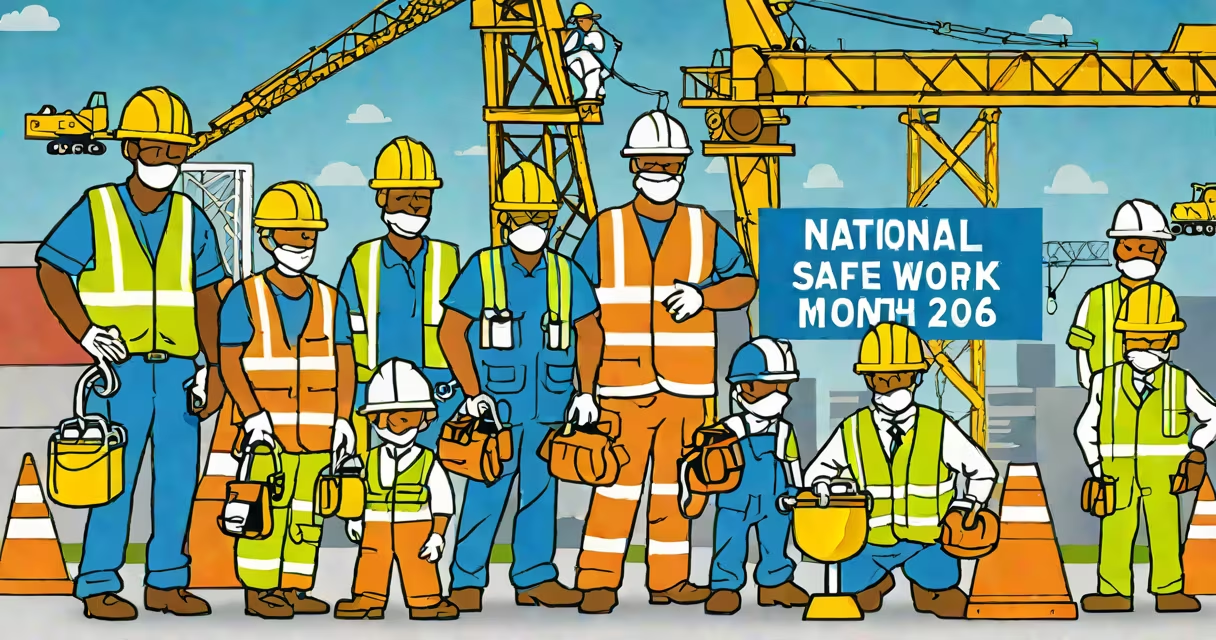
National Safe Work Month 2026 is an annual observance in the United States held each April to promote workplace safety, reduce job-related injuries, and strengthen safety culture across industries. It is coordinated by the National Safety Council and supported by OSHA, employers, and safety professionals.
The initiative began in 1996 as part of a national effort to address preventable workplace incidents. By 2026, it will mark its 29th year, with expanded outreach to small businesses, remote workers, and high-risk sectors like construction, manufacturing, and healthcare. The goal is not just awareness but measurable improvement in safety performance.
Each April, organizations host training sessions, safety drills, hazard assessments, and employee engagement campaigns. These activities are designed to reinforce safe behaviors, update emergency protocols, and ensure compliance with federal safety standards. Participation is voluntary, but many states and large corporations integrate it into their annual safety planning cycles.
National Safe Work Month 2026 operates through a combination of public messaging, employer-led initiatives, and regulatory alignment. The National Safety Council provides toolkits, webinars, and sample safety posters to help companies launch internal programs. These materials are updated annually based on incident data from the Bureau of Labor Statistics.
Employers use the month to conduct safety audits, review incident reports from the past year, and train teams on new equipment or procedures. For example, a warehouse manager might use April to retrain staff on forklift operation after a near-miss incident in March. A hospital might run a series of workshops on proper lifting techniques to reduce musculoskeletal injuries among nurses.
OSHA does not mandate participation, but it references National Safe Work Month in its guidance documents. The agency uses the period to show key safety violations and share enforcement statistics. In 2025, OSHA cited 12,300 serious violations related to fall protection, machine guarding, and respiratory hazards-issues that are central to the 2026 campaign.
Organizations implement different levels of engagement depending on size, industry, and risk profile. The following table outlines common activity types and their impact:
| Activity Type | Typical Implementation | Expected Outcome |
|---|---|---|
| Training Sessions | On-site or virtual workshops on PPE, emergency response, or chemical handling | 80% of participants report improved confidence in safety procedures (NSC 2024 survey) |
| Hazard Identification Drills | td>Team-based walkthroughs to spot unsafe conditions in workspacesReduces incident rates by 15-25% in participating facilities (OSHA 2023 report) | |
| Safety Posters & Reminders | Visual displays in break rooms, hallways, and near machinery | Increases recognition of safety signs by 40% (NSC 2023 study) |
| Leadership Walkarounds | Managers visit work areas to observe practices and discuss concerns | Improves employee reporting of near-misses by 30% (NIOSH 2024 data) |
Small businesses often adapt these models using free resources from the National Safety Council. A single-location auto repair shop, for instance, might hold a "Tool Safety Day" in April to review proper use of pneumatic tools and inspect stored chemicals.
Many assume National Safe Work Month 2026 is a one-day event or limited to industrial settings. This is incorrect. While construction and manufacturing see the highest participation, the program applies to offices, retail stores, schools, and even remote work environments.
A frequent error is treating the month as a checkbox exercise. Some companies schedule a single safety talk and call it done. Research shows this approach yields minimal long-term impact. The most effective programs extend beyond April, embedding safety habits into daily routines.
Another misconception is that safety is solely the responsibility of management. In reality, frontline workers are critical contributors. The National Safety Council emphasizes that peer-to-peer safety conversations increase accountability. A 2024 NSC study found that teams with regular safety huddles reported 37% fewer incidents than those without.
In January 2026, a mid-sized automotive parts factory in Ohio identified a rising trend in hand injuries from automated presses. Over the previous six months, five employees had sustained cuts or crush injuries despite existing safety guards.
During National Safe Work Month 2026, the plant leadership launched a targeted campaign. They partnered with the local OSHA office to conduct a joint inspection. Engineers redesigned the guard system to include light curtains and emergency stop buttons. All operators received refresher training on lockout/tagout procedures.
By mid-April, the team had completed 12 safety walkarounds and documented 43 potential hazards. Two were corrected immediately-loose floor grates and unmarked electrical panels. Employee feedback sessions revealed that 72% felt safer on the production floor.
By the end of April, injury rates dropped by 60% compared to the same period in 2025. The program was extended into Q2, with monthly safety challenges and a "Safety Champion" award for departments with zero incidents.
National Safe Work Month 2026 differs from other observances like National Safety Day (held in May) or International Safety Week (coordinated globally). While those events focus on specific themes-such as mental health or global standards-National Safe Work Month is uniquely structured around U.S. occupational safety priorities.
It also stands apart from company-specific safety programs. Unlike internal campaigns tied to a brand or product, National Safe Work Month is nationally recognized and cross-industry. Its structure allows small and large organizations to adopt consistent benchmarks.
One non-obvious fact: The National Safety Council tracks participation through a voluntary registration portal. In 2025, over 18,000 organizations registered, including 6,200 small businesses. This data informs OSHA's annual safety strategy and helps identify emerging risks.
I've observed this firsthand during a site visit to a food processing facility in 2024. Management used the month to overhaul their safety reporting system. They replaced paper logs with a digital dashboard that flagged recurring issues. Within three months, they reduced safety violations by 45% and earned a state safety excellence award.
For organizations preparing for National Safe Work Month 2026, the key is integration. Treat it not as a standalone event but as a catalyst for ongoing improvement. Use the month to assess current practices, involve employees, and set measurable goals for the rest of the year.
National Safe Work Month 2026 is more than a calendar reminder-it's a structured opportunity to build safer workplaces, reduce harm, and protect lives. When implemented with intention, it becomes a foundation for lasting change.