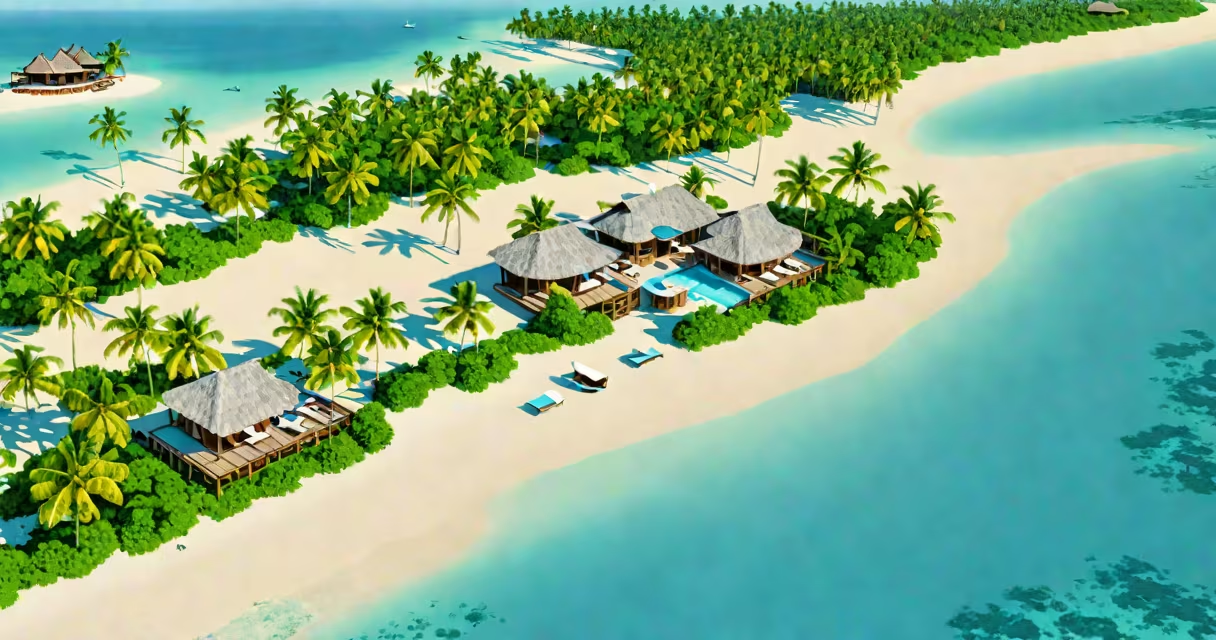
The most beautiful beaches in the Maldives are stretches of powder-white sand fringed by turquoise lagoons, often on isolated coral atolls where luxury resorts blend into untouched nature. These beaches form part of a nation of 1,192 coral islands, 26 atolls, and over 100 inhabited locations, with many remote spots accessible only by seaplane or speedboat.
Maldivian beaches are shaped by low-lying atolls formed from ancient coral reefs. The sand consists mostly of ground-up coral and shell fragments, giving it a soft, fine texture. Water clarity averages 25 meters, allowing visibility to the ocean floor even in shallow areas. This combination creates a visual effect where the sea appears to shift color from sapphire near the shore to deep indigo offshore.
Resorts on private islands manage access to these beaches, restricting public entry to maintain ecological balance. The Maldives government enforces strict environmental regulations under the National Climate Change Policy (2021), limiting construction to preserve reef systems and prevent erosion. As a result, beachfront development remains minimal and sustainable.
Beaches in the Maldives originate from marine biological activity. Coral polyps secrete calcium carbonate, forming reefs that grow upward as sea levels rise. Over time, wave action breaks down dead coral and shells into sediment. Wind and currents transport this material to leeward shores, where it accumulates into beaches.
Seasonal monsoon patterns influence beach morphology. During the southwest monsoon (May-November), stronger waves increase sediment movement, reshaping shorelines. The northeast monsoon (December-April) brings calmer seas, allowing finer particles to settle. This seasonal cycle maintains beach stability and supports nesting sites for green turtles and endangered hawksbill turtles.
One example is Villingili Island's southern beach, where annual coral spawning events in October trigger increased plankton density. This attracts fish species like parrotfish, which graze on algae covering reef surfaces. Their feeding behavior prevents algal overgrowth, preserving reef health and indirectly protecting beach integrity.
Beaches in the Maldives fall into three distinct categories based on location and accessibility:
| Type | Location | Access | Key Feature |
|---|---|---|---|
| Private Island Beaches | Resort-owned atolls (e.g., Baa Atoll) | By resort shuttle or seaplane | Exclusive access, maintained by staff, often with overwater bungalows |
| Local Island Beaches | Inhabited atolls (e.g., Maafushi, Thulusdhoo) | Public access, limited facilities | Traditional fishing villages nearby, local culture visible |
| Wild Beaches | Uninhabited, uninhabited islands (e.g., Fari Islands) | Boat charter required; no permanent structures | Minimal human impact, rich biodiversity, ideal for snorkeling |
Private island beaches dominate tourism narratives. Resorts such as Soneva Fushi and Conrad Maldives Rangali Island offer guests direct access to pristine sands backed by coconut groves. These beaches feature daily cleaning by staff and are monitored for marine debris during high tide events.
Local island beaches differ. On Maafushi, the main beach runs along a narrow strip between the sea and a coastal road. Fishermen dry nets nearby, and children play in tidal pools. The sand is coarser due to proximity to human activity and less protected reef zones.
Wild beaches remain largely unexplored. A 2022 survey by the Maldives Marine Research Centre recorded 47 species of shorebirds on uninhabited islands in the Northern Ari Atoll. These birds rely on undisturbed sandy shores for nesting, highlighting the ecological importance of preserving these spaces.
Many travelers assume the most beautiful beaches in the Maldives are digitally enhanced or staged. Images from Instagram and travel magazines often show flawless conditions: still water, perfect sun angles, and no footprints. This perception stems from the reality that resorts curate experiences to maximize aesthetic appeal.
However, natural variability exists. A 2023 study published in Marine Ecology Progress Series documented seasonal changes in beach width across six Maldivian resorts. At Hanifaru Bay, beach width decreased by 1.8 meters during the southwest monsoon due to increased wave energy. This demonstrates that even curated beaches undergo measurable physical shifts.
Another misconception is that all Maldivian beaches are the same. In truth, beach composition varies widely. North Male Atoll beaches contain higher silica content due to volcanic ash deposits from past eruptions. South Ari Atoll beaches have more organic material from mangrove roots and seagrass beds. These differences affect texture, color, and microbial content.
I once stayed at a guesthouse on Gaafu Dhaalu Atoll where the beach changed color at dusk. The sand shifted from pale gold to deep amber as sunlight hit at a low angle. The effect wasn't staged-it was caused by iron oxide particles in the sediment reacting to light refraction. That moment revealed how much beauty lies in natural variation, not artificial perfection.
Travelers often assume the most beautiful beaches in the Maldives are only accessible via luxury resorts. While many top-rated beaches are resort-exclusive, several public beaches offer comparable beauty. For example, Kandooma Beach on the island of Kandooma (in the South Male Atoll) is free to visit and features a wide stretch of sand, abundant sea turtles, and a small local market nearby.
Another error is equating "beauty" with "isolation." Some visitors believe remote beaches are inherently better. But research from the University of the South Pacific (2021) shows that accessibility correlates with conservation success. Islands with regular monitoring by local communities report lower plastic pollution rates and higher coral recovery after bleaching events.
Finally, many overlook the role of timing. The best months for visiting the most beautiful beaches in the Maldives are January through April. During this period, rainfall averages below 50 mm per month, and sea surface temperatures hover around 28°C. These conditions support clearer water and stable weather-ideal for swimming, diving, and photography.
For context, the Maldives receives an average of 1,500 hours of sunshine annually. In contrast, countries like Japan or Norway see fewer than 1,200. This climatic advantage contributes to the consistent clarity and warmth of Maldivian waters.
The most beautiful beaches in the Maldives combine geological precision, ecological resilience, and human stewardship. They are not merely scenic backdrops-they are living systems shaped by centuries of coral growth, tidal rhythms, and careful management. To experience them authentically, travelers should consider both private and public options, respect local guidelines, and visit during optimal seasons.
Understanding the science behind these beaches reveals a deeper appreciation than any photo can convey. Beauty here is not static-it evolves with the tides, the seasons, and the life beneath the waves. For those seeking authenticity, the Maldives offers more than a dream destination-it offers a real-world example of harmony between nature and design.