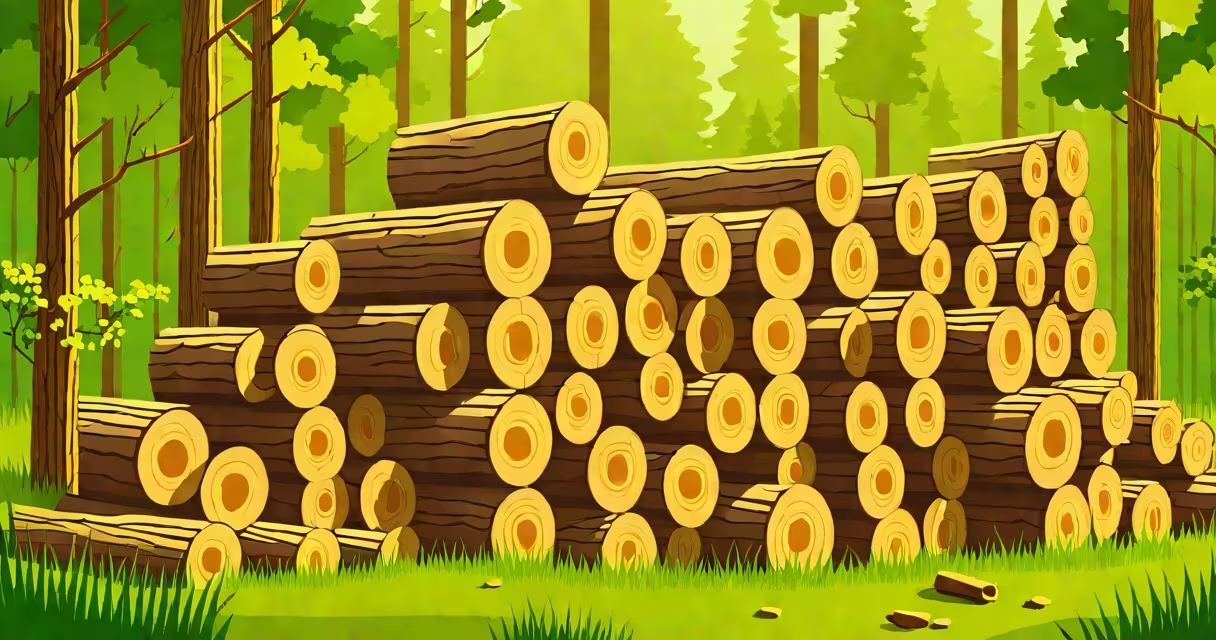
Wood biomass refers to organic material derived from trees, logging residues, wood processing waste, and dedicated energy crops that can be burned or converted into fuel. It is a major source of renewable energy worldwide, accounting for over 60% of global biomass energy consumption according to the International Energy Agency (IEA).
Wood biomass functions as a carbon-neutral energy source when sustainably managed. Trees absorb carbon dioxide during growth. When burned, they release CO₂, but new trees planted to replace them reabsorb the same amount over time. This cycle makes wood biomass a low-net-emission alternative to fossil fuels.
The primary forms include sawdust, wood chips, pellets, and whole logs. These materials are processed and combusted in power plants, industrial boilers, or residential stoves. The U.S. Department of Energy reports that wood biomass contributes about 1.5% of total U.S. energy supply annually, with higher shares in rural and Nordic regions.
When wood biomass burns, chemical energy stored in cellulose and lignin molecules converts into heat. This thermal energy can drive steam turbines to produce electricity or provide direct heating. Modern biomass power plants achieve 25-35% efficiency in converting biomass to electricity, comparable to older coal plants.
Advanced systems use gasification or pyrolysis to convert biomass into syngas or bio-oil. These liquid and gaseous fuels can run engines or be refined into drop-in replacements for diesel and jet fuel. The U.S. National Renewable Energy Laboratory (NREL) has demonstrated that pyrolysis oil from hardwood can achieve 40% energy density relative to petroleum-based fuels.
A typical 100 MW biomass power plant consumes about 150,000 tons of wood pellets annually. For context, this requires roughly 1.2 million cubic meters of wood, equivalent to 150 hectares of sustainably managed forest per year.
Wood biomass falls into four main categories based on origin and processing level:
| Type | Source | Processing Level | Common Use |
|---|---|---|---|
| Primary residues | Logging slash, bark, limbs | Minimal | On-site heating, small-scale power |
| Secondary residues | Mill waste: sawdust, shavings, trimmings | Compressed into pellets | Residential heating, export fuel |
| Energy crops | Fast-growing trees: poplar, willow, eucalyptus | Harvested, chipped, dried | Large-scale power generation |
| Urban wood waste | Construction debris, pallets, furniture | Shredded, sorted, pelletized | Industrial process heat |
Secondary residues make up nearly 70% of wood biomass used in Europe, according to Eurostat. In Sweden, over 80% of residential heating comes from wood pellets sourced from mill waste and forest thinning operations.
Wood biomass is most prevalent in countries with abundant forest cover and cold climates. Finland, Sweden, and Canada lead in per capita wood biomass use for heating. In Finland, wood biomass supplies 28% of national energy demand, primarily through district heating networks powered by wood-fired boilers.
Developing nations use wood biomass for cooking and basic heating. The World Bank estimates that 2.6 billion people globally rely on solid biomass for household energy, mostly in sub-Saharan Africa and South Asia. However, inefficient stoves cause indoor air pollution linked to 3.8 million premature deaths annually, according to WHO.
In industrial settings, biomass reduces reliance on imported fossil fuels. A paper mill in Maine uses bark and wood chips from its own operations to generate 90% of its steam needs, cutting annual natural gas use by 1.2 million therms.
Wood biomass is often mistaken for being inherently carbon neutral. While the combustion releases CO₂, the carbon neutrality depends on regrowth rates and land-use changes. If forests are cleared for biomass without replanting, net emissions increase. The European Environment Agency warns that biomass from deforestation can emit up to 20% more CO₂ per unit of energy than coal over a 20-year period.
Another misconception is that all biomass is equally efficient. Pellets have a higher energy density than raw wood-about 18 MJ/kg versus 12 MJ/kg. This difference affects transportation costs and storage space. A truck carrying 20 tons of wood chips occupies 40% more volume than the same mass in pellets.
I once observed a biomass facility in Oregon where poorly sorted feedstock caused boiler clogging. The system ran at 65% capacity due to contamination from soil and metal fragments. After installing a magnetic separator and optical sorter, output rose to 92%. This illustrates that feedstock quality matters as much as source material.
Wood biomass is not interchangeable with other biomass types. Agricultural residues like corn stover or sugarcane bagasse have different moisture content, ash composition, and ignition characteristics. Mixing them with wood biomass can reduce efficiency and increase maintenance costs.
Wood biomass differs from fossil fuels in both origin and environmental impact. Fossil fuels release carbon sequestered over millions of years. Wood biomass recycles carbon within decades. But the time frame matters: if a forest takes 50 years to regrow, the carbon debt persists for that duration.
According to the IEA, wood biomass accounted for 58% of global renewable energy consumption in 2022. That share exceeds solar (17%) and wind (12%) combined in certain regions. In the Nordic countries, biomass provides more renewable energy than all other sources combined.
Despite its scale, wood biomass faces challenges. Supply chains require consistent sourcing. Seasonal availability affects reliability. And policy frameworks vary widely-some countries subsidize biomass, others restrict it due to land-use concerns.