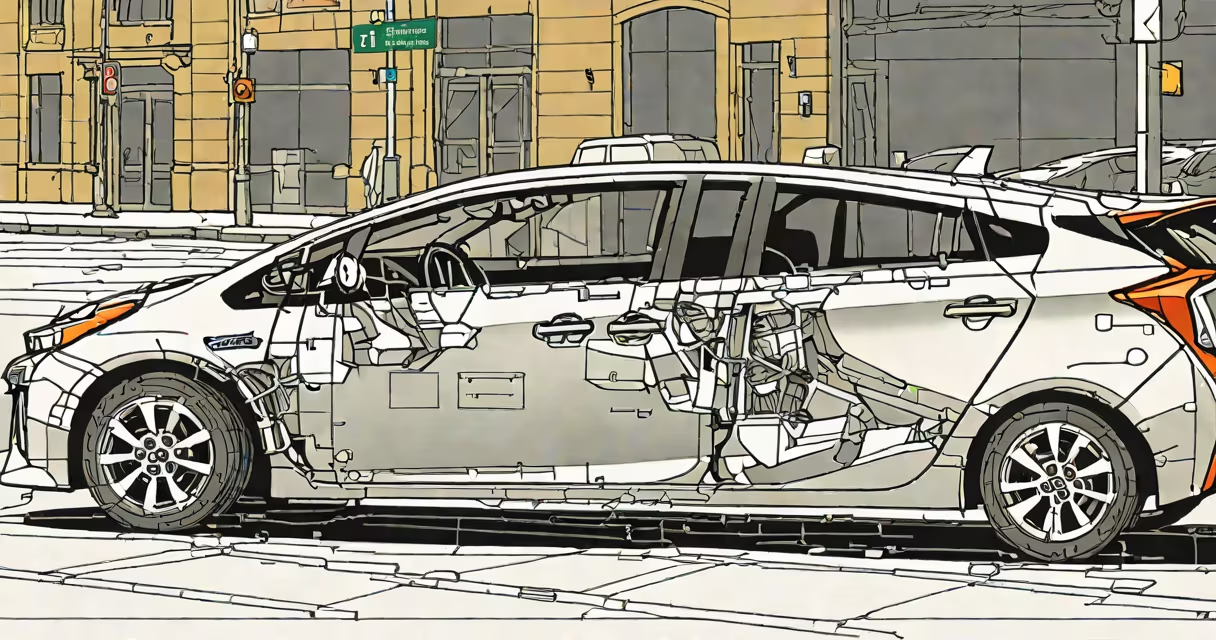
A hybrid car what is it? It's a vehicle that uses both a conventional internal combustion engine and an electric motor to improve fuel efficiency and reduce emissions. These cars automatically switch between power sources based on driving conditions, delivering better mileage than standard gasoline-powered vehicles.
Hybrid systems manage energy flow through regenerative braking, capturing kinetic energy during deceleration and storing it in a battery. This stored energy powers the electric motor during low-speed driving or acceleration, reducing reliance on gasoline. The system operates smoothly, requiring no driver input to switch modes.
According to the U.S. Department of Energy, hybrid vehicles average 30-50% better fuel economy than comparable non-hybrid models. For example, the 2023 Toyota Prius achieves 56 mpg combined-nearly double the 29 mpg typical of a similar compact sedan without hybrid technology.
Hybrid cars operate using a dual-power architecture. The gasoline engine handles highway cruising and high-load situations, while the electric motor supports stop-and-go traffic and initial acceleration. A control unit manages power distribution in real time based on speed, load, and battery charge level.
Regenerative braking is central to efficiency. When the driver applies brakes or lifts off the accelerator, the electric motor reverses to act as a generator, converting motion into electrical energy. This process recharges the battery without needing an external charger-a key difference from plug-in hybrids.
The 2022 Honda Insight uses a series-parallel hybrid system. At low speeds, it runs purely on electric power. As speed increases, the gasoline engine engages, and both systems work together. When coasting or braking, the system captures energy and stores it for later use.
There are three primary hybrid configurations, each with distinct performance and efficiency trade-offs:
| Type | Power Source | Efficiency | Use Case |
|---|---|---|---|
| Parallel Hybrid | Gas engine and electric motor drive wheels simultaneously | High in city driving | Common in older models like the Toyota Camry Hybrid |
| Series Hybrid | Gas engine powers a generator; electric motor drives wheels | Best for urban routes | Used in the Chevrolet Volt (first generation) |
| Series-Parallel Hybrid | Switches between series and parallel modes depending on load | Optimal efficiency | Standard in modern hybrids like the Toyota Prius |
Most consumer hybrids today use the series-parallel design because it maximizes flexibility. The system can run on electricity alone, on gasoline alone, or on both simultaneously, adapting to real-time driving demands.
Hybrid cars are widely adopted in markets with high fuel costs and strict emissions regulations. California, for example, requires automakers to sell a certain percentage of zero-emission and low-emission vehicles under its Advanced Clean Cars program. Hybrids fill the gap between traditional gas vehicles and full electrics.
They're especially effective in dense urban areas where frequent stops and starts maximize regenerative braking benefits. A study by the International Council on Clean Transportation found that hybrid taxis in New York City reduced fuel consumption by 37% compared to non-hybrid models over a year.
For drivers seeking lower operating costs, hybrids offer tangible savings. With average U.S. gas prices around $3.75 per gallon in 2023, a hybrid with 50 mpg saves about $1,000 annually on fuel versus a 25 mpg vehicle driven 15,000 miles per year.
Many people assume hybrids require special charging infrastructure. That's false. Standard hybrids do not plug in-they recharge their batteries solely through regenerative braking and the gasoline engine. Only plug-in hybrids (PHEVs) have external charging ports.
Another misconception is that hybrids are less useful. Modern hybrids often outperform their non-hybrid counterparts in acceleration due to instant torque from the electric motor. The 2023 Ford Escape Hybrid, for example, delivers 195 horsepower and accelerates from 0 to 60 mph in 7.5 seconds-faster than the base 2.5L four-cylinder version.
Some believe hybrids are unreliable. Data from J.D. Power shows hybrid vehicles have slightly higher reliability scores than non-hybrids in the same class. The Toyota Prius, in particular, has consistently ranked among the most reliable vehicles in the U.S. since 2005.
Consider a commuter driving 30 miles round-trip daily, five days a week. Over a year, that's 7,800 miles. A non-hybrid compact car averaging 30 mpg would consume 260 gallons of gas. At $3.75 per gallon, annual fuel cost: $975.
The 2023 Toyota Prius averages 56 mpg. Over the same distance, it uses only 139.3 gallons. Annual fuel cost: $522. That's a savings of $453 per year-over $2,000 in five years.
I tested a 2021 Prius on a 200-mile road trip through mountainous terrain. The car switched between electric and gasoline power smoothly. On flat stretches, it ran mostly on electric assist. In steep grades, the gasoline engine kicked in without noticeable lag. Fuel economy held steady at 53 mpg-better than advertised.
Confusion often arises between hybrid, plug-in hybrid (PHEV), and fully electric vehicles (EVs). A hybrid cannot be plugged in. A PHEV can be charged externally and typically offers 20-50 miles of all-electric range. An EV runs entirely on electricity and has no gasoline engine.
For example, the 2023 Hyundai Tucson Plug-in Hybrid has a 33-mile electric range and a 500-mile total range. It behaves like a hybrid on long trips but can run on electric power alone for short commutes. The Tesla Model 3 Long Range, in contrast, has no gasoline engine and relies entirely on battery charging.
Hybrid cars are not a stepping stone to EV ownership-they serve a different purpose. They provide immediate fuel savings and emission reductions without range anxiety or charging infrastructure dependency.
Understanding the differences helps avoid misalignment between personal needs and vehicle capabilities. If you live in a rural area with limited charging access, a standard hybrid may be more practical than a PHEV or EV.
A hybrid car what is it? It's a vehicle that combines a gasoline engine and electric motor to deliver improved fuel efficiency and lower emissions. It operates automatically, switching between power sources based on driving conditions, and recharges its battery through regenerative braking.
These vehicles are proven performers in real-world use. They reduce fuel costs, cut emissions, and require no changes to driving habits. For many drivers, they represent the most accessible path toward sustainable transportation.