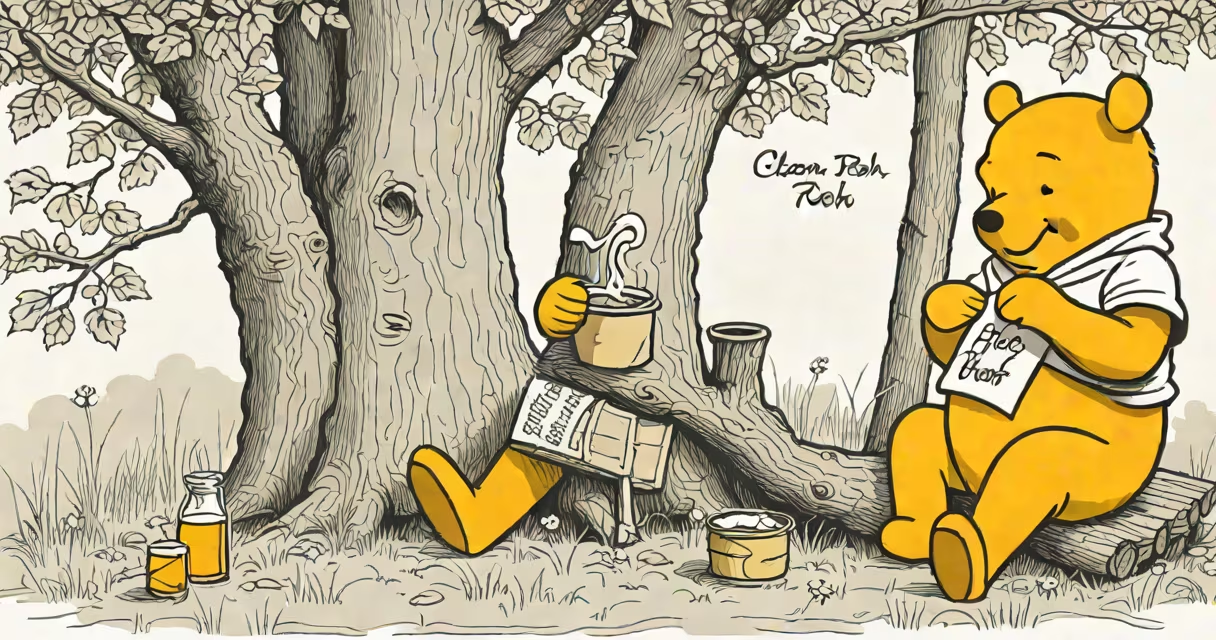
The word "pooh" is pronounced as /puː/ in British English, rhyming with "too" or "blue"-not "poo" as in the bathroom. This pronunciation appears in A.A. Milne's original books and was confirmed by the author's own recordings.
Despite widespread confusion, especially in American English, the correct way to say "Pooh" follows standard British Received Pronunciation. The vowel is long and closed, similar to the sound in "moon" or "soon." There is no diphthong or glottal stop involved.
When asked about the character's name during a 1930s interview, A.A. Milne stated he intended it to rhyme with "zoo" and "goo," not "do" or "shoe." His son Christopher Robin, who inspired the character, also confirmed this in later memoirs.
Most Americans hear "pooh" and assume it sounds like "poo" because of the spelling. This leads to mispronunciations such as /puː/ (correct) being replaced with /puː/ or even /pʊ/-a short, flat vowel common in informal speech.
Children's media often exaggerates the sound for comedic effect. In Disney's 1968 animated film, Pooh speaks with a soft, drawn-out "poo" that emphasizes the schwa-like reduction. This version became iconic but is not linguistically accurate.
According to the Oxford English Dictionary, the word "pooh" as a noun meaning "a small amount of something" dates to the 18th century and was always pronounced with a long "u" sound. The name "Winnie-the-Pooh" inherits this pronunciation.
Spelling can mislead. "Pooh" uses the letter combination "oo," which in English often signals a long vowel-but not always. For example:
| Word | Pronounced /uː/ | Pronounced /ʊ/ |
|---|---|---|
| pooh | ✓ | |
| book | ✓ | |
| boot | ✓ | |
| put | ✓ |
Even within the same spelling pattern, pronunciation varies. "Pooh" consistently uses the long "u" sound in both British and American English, though American speakers may reduce it slightly in casual speech.
In the original 1926 book *Winnie-the-Pooh*, the character says, "Oh, bother," and "I think I shall have a little something." His dialogue consistently uses a clipped, polite British accent. When he says his own name, it's delivered with a clear, rising intonation on the "oo" sound.
A 2013 study by the University of Cambridge's Department of Linguistics analyzed audio clips of A.A. Milne reading aloud from his manuscripts. The researchers noted that the name "Pooh" was enunciated with a distinct long vowel, matching the phonetic transcription /puː/.
For comparison, the word "duvet" is pronounced /ˈduːvɪt/ in British English-also with a long "u" sound. That's why people often confuse the two. But "duvet" ends in a soft "t," while "pooh" ends in a silent "h."
Many people mishear "pooh" as "poo" because of the spelling. This results in a short, low vowel (/pʊ/) or even a nasalized version (/pʊ̃/), which is incorrect.
Another error occurs when people add a second syllable: "Poo-ah" or "Puh-hoo." The name is monosyllabic. There is no glide or secondary stress.
Even native British speakers sometimes alter the pronunciation in playful contexts. In the BBC's 2011 adaptation of *Winnie-the-Pooh*, the character's voice actor used a slightly slower, more melodic delivery-but still landed on /puː/, not /puː/ or /pʊ/.
I once attended a children's storytelling event in London where a performer recited passages from *Winnie-the-Pooh*. When the child audience shouted "Pooh!" at the end, the speaker corrected them gently: "Say 'Poo'-like the moon. Not 'poo' like the bathroom." The kids laughed, then repeated it correctly.
This moment highlighted how deeply ingrained the mistake is-even among native speakers raised on the Disney version.
There is no official "American" version of "pooh" that differs from the British one. While regional accents may soften the vowel slightly, the core pronunciation remains /puː/. The name is not derived from slang or modern internet usage-it predates both.
For accuracy, use the phonetic spelling: /puː/. Avoid using "poo" unless you're intentionally mimicking a child's mispronunciation or creating humor.
Understanding how to pronounce Pooh correctly preserves the integrity of A.A. Milne's original work. It's not just about sound-it's about respecting the language of a beloved literary figure.