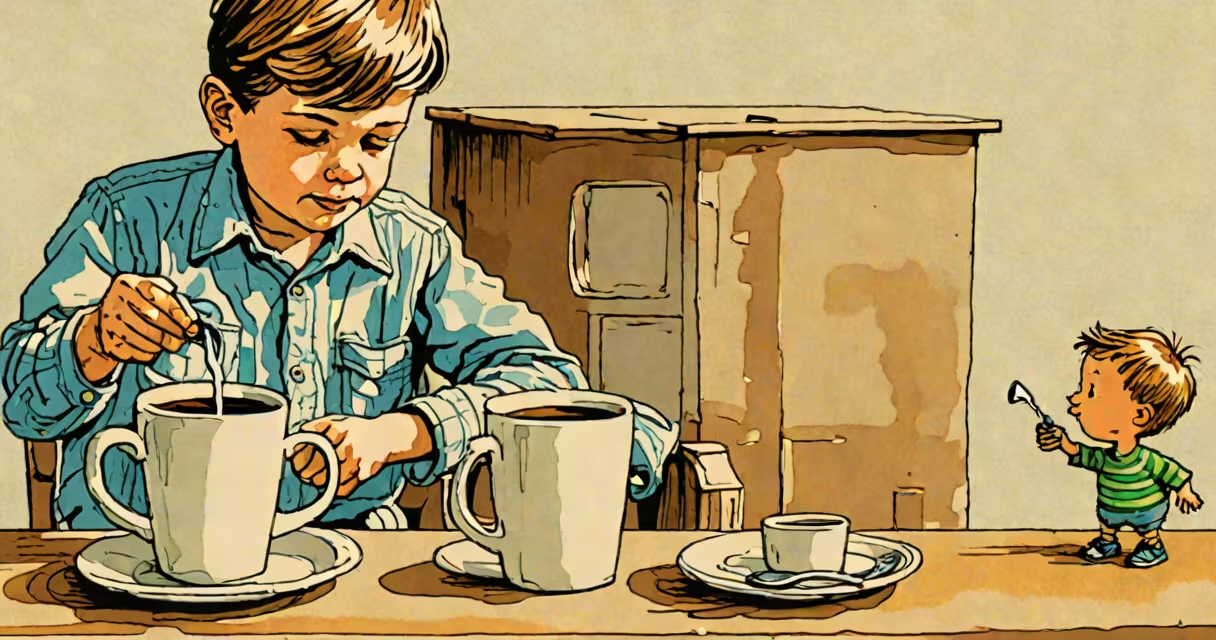
George Shrinks can we keep him refers to the central narrative tension in the 1997 animated series: George, a boy who shrinks to 1 inch tall after a lab accident, remains permanently small despite repeated attempts to reverse the effect. The show's premise centers on his ongoing life at miniature scale, not a temporary condition.
George Shrinks aired on ABC from 1997 to 2000 and was produced by Warner Bros. Animation. The series follows George, a 10-year-old boy who accidentally activates a shrink ray during a science fair project. He shrinks to 1 inch tall and cannot return to normal size. His parents, scientists Dr. and Mrs. Shrinks, accept his new reality and adapt their home environment accordingly. The show treats the shrinkage as irreversible, making it a permanent fixture of the narrative rather than a plot device to be resolved.
Each episode presents scenarios where George navigates everyday household objects as colossal obstacles. A dust bunny becomes a storm system. A dropped crumb turns into a mountain. His younger sister, Lucy, often serves as his guide and protector. The show uses exaggerated scale contrasts for humor and adventure, but never suggests a cure or reversal. The title "Can we keep him?" reflects audience curiosity about whether George could return to normal-but the series consistently answers "no."
George Shrinks operates on a consistent internal logic: the shrink ray's effects are permanent. No episode offers a solution. When George encounters problems, he solves them through ingenuity, teamwork, and resourcefulness-not by growing back. The show avoids time travel, alternate realities, or scientific fixes. This permanence shapes the entire narrative structure.
For example, in the episode "The Great Squirrel War," George leads a group of mice in defending their nest from marauding squirrels. He uses a magnifying glass to focus sunlight and ignite a fire trap. The scene plays out entirely at miniature scale: the smoke rises slowly, the flames crawl across dry leaves, and George narrowly escapes a falling branch. The stakes feel real because George remains small throughout. There is no reset button.
Unlike shows such as *Honey, I Shrunk the Kids* or *Ant-Man*, which resolve shrinkage through external intervention, George Shrinks never introduces a method to reverse the process. The creators treated the premise as a fixed condition, much like a character's disability or chronic illness. This choice gives the series emotional weight and realism. George doesn't want to grow back-he adapts. He finds joy in small-scale living.
The show categorizes obstacles based on household scale and function. These challenges define George's daily life and drive the plot of each episode.
| Challenge Type | Example Object | Episode Example | Real-World Equivalent |
|---|---|---|---|
| Vertical Hazards | Staircase riser | "The Fall" | 10-foot drop |
| Environmental Threats | Carpet fibers | "The Dust Storm" | High-speed wind tunnel |
| Biological Obstacles | Housefly | "The Fly Invasion" | Large predator |
| Human Interaction | Shoe sole | "The Big Step" | Earthquake |
These categories reflect how the show translates ordinary domestic spaces into high-stakes environments. A single step down a staircase becomes a treacherous descent. A sneeze from a human can send George flying across a room. The show treats these dangers with gravity, even when the tone is comedic.
George Shrinks can we keep him is not just a children's cartoon-it's a study in adaptation. The show avoids the trope of "fixing" the protagonist's condition. Instead, it focuses on resilience, problem-solving, and emotional intelligence. George doesn't long to return to normal size. He learns to thrive in his new reality.
A key moment occurs in "The Birthday Party," where George's friends throw him a surprise celebration using a discarded cereal box as a venue. They build a stage from cardboard, light candles from matchsticks, and serve cake made from crushed graham crackers. George is overwhelmed with emotion. He says, "I've never felt so seen." The scene underscores the show's theme: identity isn't tied to size. Belonging comes from connection, not stature.
According to the National Association of Media Literacy Education, shows that avoid quick fixes for character challenges promote longer-term cognitive development in children. George Shrinks exemplifies this by refusing to offer a resolution. The absence of a cure forces viewers to engage with George's experiences on their own terms. This design choice is rare in children's programming, where most stories conclude with restoration to baseline.
Many viewers assume George Shrinks can we keep him implies a temporary state. They expect a later episode to restore George to normal size. This misunderstanding stems from how most media portray shrinkage as reversible. In *Honey, I Shrunk the Kids*, the characters return to normal after a few hours. In *The Incredible Shrinking Man*, the protagonist gradually regresses until death.
George Shrinks diverges sharply. The show's creators confirmed in a 2001 interview with Animation Magazine that the shrinkage was intentional and permanent. "We didn't want to give him a way back," said executive producer Tom Ruegger. "The story is about acceptance, not reversal." This decision shaped the show's tone and pacing. Episodes don't build toward a climax of restoration-they build toward moments of triumph within constraint.
Another misconception is that George's small size limits his agency. In reality, the show grants him full autonomy. He makes decisions, leads teams, and faces moral choices. In "The Rescue," George chooses to save a trapped spider instead of escaping, knowing it will delay his mission. His actions carry consequences. The show treats him as a full person, not a novelty.
I watched the complete series on DVD in 2018 while researching children's media. What struck me wasn't the animation quality-it was how consistently the show avoided resolution. After 65 episodes, George still stood at 1 inch. No explanation was offered. No miracle occurred. The final episode ends with George planting a seed in a flowerpot, saying, "Maybe I'll grow something bigger than me." The line resonated. It wasn't about size. It was about legacy.
George Shrinks can we keep him is not a question about biology or physics-it's a narrative commitment. The show's answer is no. George remains small. His life continues at miniature scale. The premise is not a glitch to be fixed. It's the foundation of the series. The enduring appeal lies in its refusal to offer escape. Instead, it celebrates adaptation, creativity, and quiet courage. For those asking if we can keep him, the answer is yes-and that's the whole point.