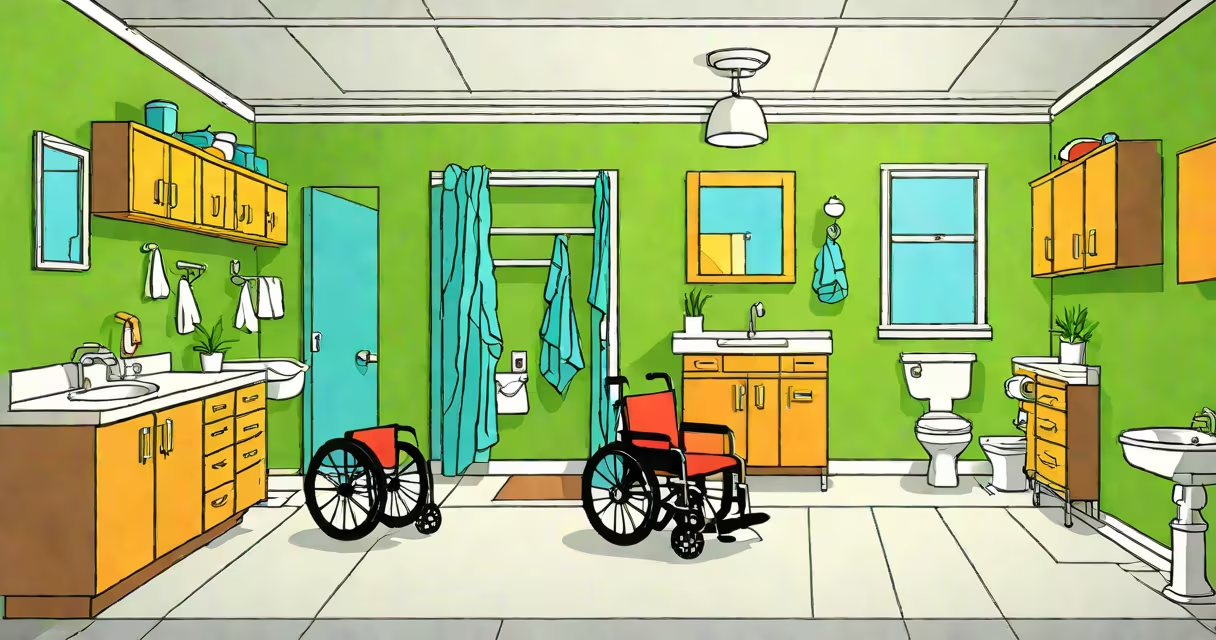
Disability housing assistance refers to government-funded programs and services that provide financial aid, home modifications, or access to barrier-free housing for individuals with physical, sensory, or cognitive disabilities. These programs aim to ensure stable, independent living by reducing housing costs and addressing accessibility needs.
Eligibility is determined by income level, disability status, and specific program criteria. Assistance includes rent subsidies, grants for home adaptations, and priority placement in accessible public or subsidized housing. The U.S. Department of Housing and Urban Development (HUD) and the Social Security Administration (SSA) administer most federal initiatives.
Programs distribute funds through direct payments, vouchers, or property modifications. Rent assistance typically covers a portion of monthly housing costs based on household income. For example, the Section 8 Housing Choice Voucher Program limits rent payments to 30% of a family's adjusted income. Households earning below 50% of the area median income qualify for priority placement.
Home modification grants fund changes like stair lifts, widened doorways, or roll-in showers. The U.S. Department of Veterans Affairs offers up to $6,000 for veterans with service-connected disabilities to adapt their homes. Non-veterans may access similar funds through state-level programs, such as California's Home and Community-Based Services (HCBS) waiver.
Some programs require applicants to submit documentation from a licensed medical professional confirming disability status. The SSA uses a list of qualifying conditions under the Blue Book, including spinal cord injuries, severe vision loss, and major depressive disorder with functional impairment. A diagnosis alone doesn't guarantee approval-functional limitations must meet strict criteria.
Disability housing assistance falls into three main categories: rental subsidies, home ownership support, and accessibility modifications. Each serves different life stages and housing goals.
| Type | Key Features | Eligibility Requirements | Examples |
|---|---|---|---|
| Rental Subsidies | Monthly rent payments; often tied to income | At or below 30-50% AMI; documented disability | Section 8 vouchers, HUD's Housing Choice Voucher Program |
| Home Ownership Support | Down payment assistance, low-interest loans | Stable income; credit history; disability documentation | FHA 203(k) loan for home repairs, USDA Rural Development loans |
| Accessibility Modifications | Grants or tax credits for structural changes | Disability certification; project cost cap | VA Specially Adapted Housing Grant, Medicaid HCBS waivers |
Section 8 vouchers are among the most widely used tools. In 2023, HUD allocated over $26 billion to 2.3 million households nationwide. Participants choose their own housing, as long as landlords accept vouchers and units meet HUD's accessibility standards. Units must have features like roll-under sinks, lever-style door handles, and non-slip flooring.
Many assume disability housing assistance applies only to low-income seniors. This is incorrect. While older adults make up a large share of recipients, the programs serve people of all ages with disabilities. A 28-year-old with cerebral palsy qualifies for the same Section 8 benefits as a 75-year-old with mobility impairments.
Another misconception is that all accessible housing meets legal standards. The Fair Housing Act requires new construction to comply with the 2010 ADA Standards for Accessible Design. But many older buildings labeled "accessible" lack proper features. A unit with a ramp but no grab bars in the bathroom fails to meet minimum safety requirements.
A key distinction lies between "reasonable accommodations" and "modifications." Reasonable accommodations are temporary adjustments, like allowing a service animal in a no-pets building. Modifications involve permanent structural changes, such as installing a stair lift. Only modifications qualify for grant funding.
In 2022, Maria, a 42-year-old woman with multiple sclerosis, applied for disability housing assistance in Chicago. Her annual income was $28,000-below 50% of the city's median income. She submitted her SSA disability award letter and a doctor's note confirming functional limitations in walking and balance.
She received a Section 8 voucher covering 70% of her rent. With the remaining $800, she rented a two-bedroom apartment in a building certified under HUD's Accessibility Guidelines. The unit had a roll-in shower, lowered kitchen counters, and a bedroom with a clear floor space of 60 inches by 60 inches. She also applied for a $4,500 grant through Illinois' HCBS waiver to install a ceiling track lift in her bedroom.
"The process took six months," Maria said. "But once approved, the housing stability changed everything. I stopped relying on friends for rides to appointments. I could work part-time from home."
Applications are processed through local housing authorities (LHAs) or state social services departments. Contact your state's housing agency or visit HUD.gov to find regional offices. Some programs have waiting lists lasting years-apply early.
Be cautious of scams. Legitimate agencies never charge application fees. The U.S. Federal Trade Commission warns against third-party services demanding upfront payments. Always verify an organization's legitimacy using the HUD Consumer Complaint Center or your state's attorney general website.
For those needing immediate shelter, emergency housing programs exist. The U.S. Interagency Council on Homelessness reports that 38% of homeless individuals in 2023 had a disability. Programs like HUD's Continuum of Care offer temporary placements while applicants complete paperwork.
Understanding disability housing assistance begins with knowing it's not a single program but a network of overlapping supports. The goal is not just affordability-it's independence. A person with a disability shouldn't have to choose between paying rent and accessing necessary care.