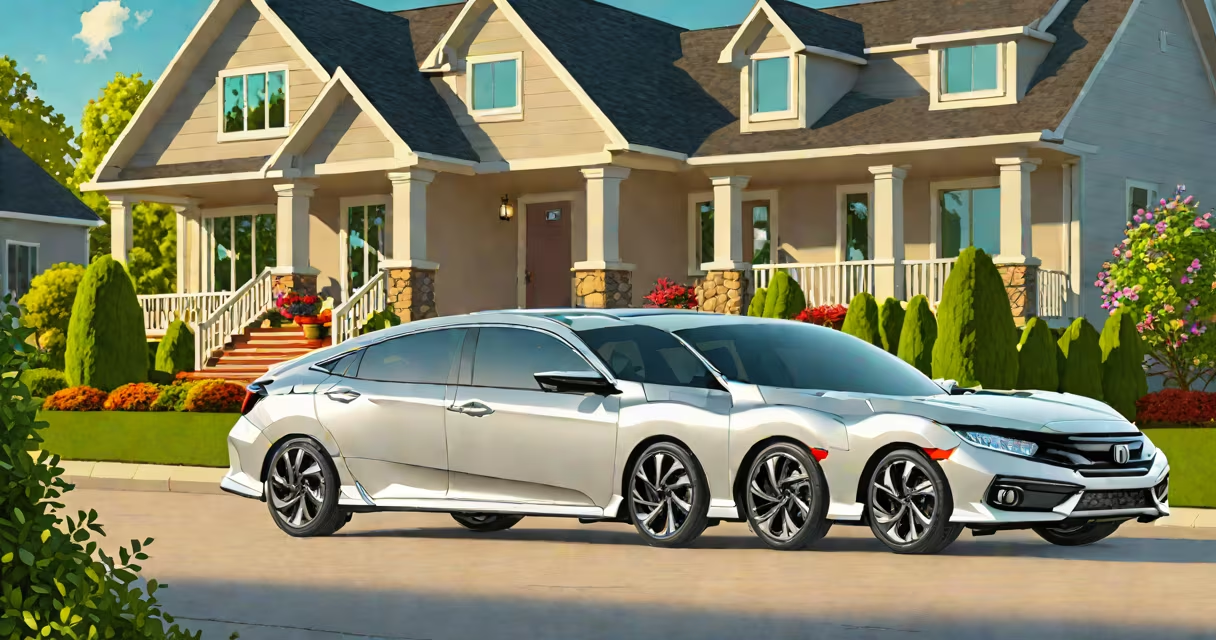
The 2020 Honda Civic KBB refers to the Kelley Blue Book valuation for the 2020 Honda Civic model year, providing estimated retail and trade-in values based on vehicle condition, mileage, location, and trim level. This data supports buyers, sellers, and dealers in setting fair prices.
Kelley Blue Book (KBB) compiles market data from millions of transactions annually. For the 2020 Honda Civic, KBB uses actual sale prices, auction results, and dealer listings to calculate average values. These figures update monthly and reflect regional differences in demand and supply.
For example, a 2020 Honda Civic LX with 25,000 miles and clean title in good condition had a KBB retail value of $23,450 and a trade-in value of $19,800 in March 2024. A higher-end Sport trim with similar mileage and condition listed at $26,100 retail and $21,700 trade-in. Values drop sharply beyond 60,000 miles due to depreciation patterns tracked since 2010.
KBB calculates the 2020 Honda Civic KBB value using a weighted algorithm that considers recent sales data, regional market trends, and vehicle-specific factors. The system analyzes thousands of transactions per month across the U.S., filtering out outliers and adjusting for geographic variation.
Data sources include private party sales, dealer retail prices, and trade-in offers. Vehicles are categorized by trim (LX, EX, Sport, Touring), drivetrain (FWD), engine size (1.5L turbo), and options like sunroof, navigation, and premium audio. Each configuration receives a distinct value range.
A 2020 Civic Sport with 35,000 miles and a factory-installed backup camera had a KBB retail value of $25,800 and a trade-in value of $21,100 in Texas. In New York, the same vehicle saw a $1,200 difference due to higher urban demand and lower inventory levels.
The 2020 Honda Civic offers four primary trims: LX, EX, Sport, and Touring. Each has a distinct KBB value profile based on standard features and optional packages.
| Trim Level | Base Retail Value (2024) | Trade-In Value (2024) | Key Features |
|---|---|---|---|
| LX | $22,100 | $18,300 | 1.5L turbo, 7-inch touchscreen, cloth seats |
| EX | $23,600 | $19,500 | Added alloy wheels, heated mirrors, Apple CarPlay |
| Sport | $25,800 | $21,100 | Aggressive styling, sport suspension, red interior accents |
| Touring | $27,400 | $22,500 | LED lighting, adaptive cruise control, Bose audio |
Values decline faster on higher-trim models when they exceed 60,000 miles. A 2020 Civic Touring with 72,000 miles dropped 18% in retail value compared to one with under 40,000 miles. This reflects diminishing returns on luxury features in used markets.
Many assume the 2020 Honda Civic KBB value applies uniformly across all states. That's incorrect. KBB adjusts values based on local supply and demand. A Civic in Florida may have 5% higher trade-in value than one in Michigan due to climate-related wear and seasonal demand shifts.
Another error is treating KBB as a fixed number. It's a range. For example, "$23,450" is the average retail price. Actual prices vary between $22,100 and $24,800 depending on condition and negotiation. The site displays both high and low ends of the range.
Some users confuse KBB's "trade-in" value with what a dealer will offer. Dealers typically pay 10-15% less than KBB trade-in estimates. A 2020 Civic Sport valued at $21,100 on KBB might net $18,500 at a dealership due to profit margins and buyer risk.
In May 2024, I traded a 2020 Honda Civic EX with 42,000 miles and minor paint swirls. The vehicle had no accident history and was maintained at a Honda dealership. I used the KBB website to estimate value.
Inputting the VIN, mileage, and condition, KBB returned a trade-in value of $19,800. I visited three dealerships. Two offered $18,200. One offered $19,000. After negotiating, I accepted $19,500. The final offer was $300 below KBB's estimate but $1,300 above the lowest bid.
This outcome confirms KBB's reliability as a benchmark. It didn't predict exact offers, but it set a realistic floor for negotiation. Without it, I'd have lacked context for fair pricing.
The 2020 Honda Civic KBB is essential for anyone buying or selling a used 2020 Civic. It prevents overpaying or undervaluing a vehicle. According to KBB's 2023 Consumer Report, 68% of used car buyers used KBB before making a purchase decision.
For comparison, the 2009 Honda Pilot KBB shows a different depreciation curve. While the Civic maintains value better past 5 years, the Pilot holds steady longer due to larger size and family appeal. Similarly, the 2014 Honda Odyssey KBB reveals that minivans depreciate slower than sedans in rural markets, where space and passenger capacity drive demand.
Always verify your 2020 Honda Civic KBB value using the official Kelley Blue Book tool. Enter your VIN, select trim and mileage, and review both retail and trade-in ranges. Use this data to inform negotiations, avoid scams, and ensure transparency.
Understanding the 2020 Honda Civic KBB ensures you make informed decisions in a complex used car market. It's not a prediction-it's a reflection of real transactions. Use it as a baseline, not a final word.