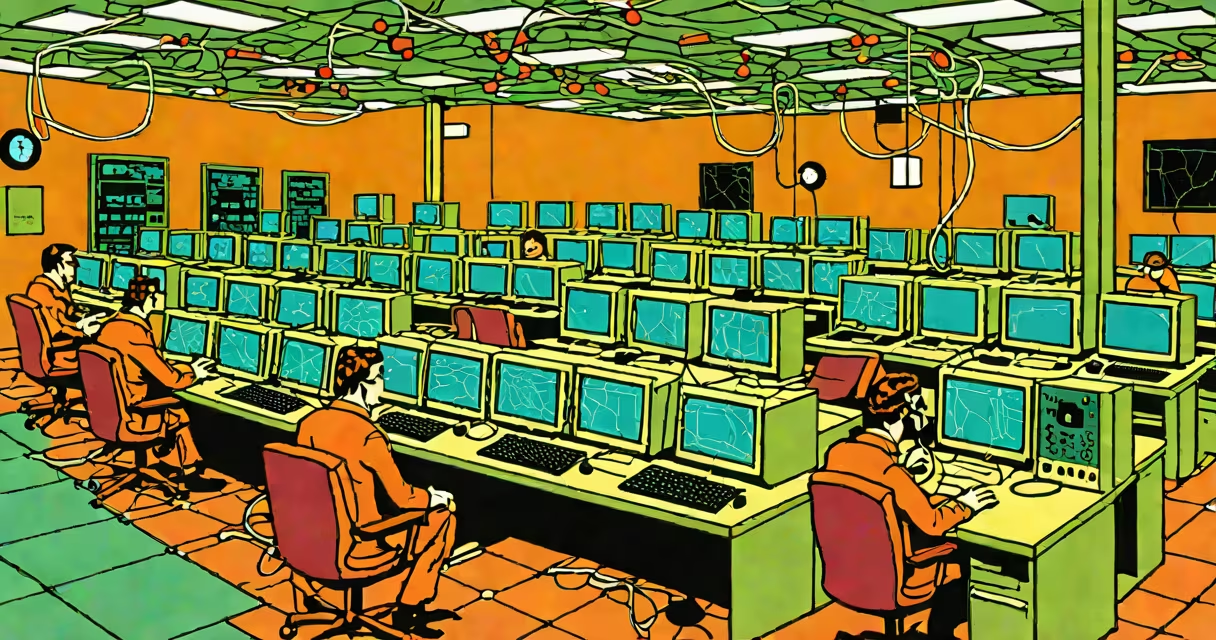
ARPANET, the Advanced Research Projects Agency Network, was the first wide-area packet-switched network with distributed control, launched in 1969. It connected four university computers and demonstrated that data could be reliably transmitted across geographically dispersed systems using standardized protocols.
Packet switching, the core innovation behind ARPANET, broke data into small units called packets. Each packet traveled independently through the network and was reassembled at the destination. This method improved resilience compared to circuit-switched systems, which required a dedicated path for the entire transmission.
The network's initial setup linked UCLA, Stanford Research Institute, UC Santa Barbara, and the University of Utah. On October 29, 1969, the first message was sent between UCLA and Stanford-a simple "login" command that crashed the system after the first two letters, "lo." The successful transmission of "lo" marked the first time computers exchanged data across a network.
ARPANET operated using the Network Control Protocol (NCP), which defined how hosts communicated. NCP managed connections between machines and ensured data integrity during transfer. It did not route traffic automatically-each connection had to be manually established.
Each node on the network ran a host computer running a specialized operating system. These were typically mainframes or minicomputers. The interface between the host and the network was handled by a device called a Interface Message Processor (IMP), a dedicated router that processed incoming and outgoing packets.
When a user sent a message, the sending host broke it into packets, assigned each a header with source, destination, sequence number, and error-checking data. The IMP then forwarded packets along available routes. If a path failed, packets could be rerouted dynamically-an early form of fault tolerance.
ARPANET introduced several foundational technologies still used today. Packet switching replaced older circuit-based models, enabling efficient bandwidth use. The network's decentralized design meant no single point of failure could bring down the entire system.
Another critical element was the use of standardized protocols. Unlike proprietary systems, ARPANET required all participating institutions to adopt common rules for data exchange. This interoperability became a model for future global networks.
A lesser-known fact: ARPANET's original design assumed low bandwidth and high latency. Data moved at 50 kilobits per second-slower than most modern mobile connections. Yet it functioned reliably because it prioritized correctness over speed, a principle that shaped later internet architecture.
ARPANET had three primary node types: host computers, IMPs, and terminal servers. Hosts ran applications and stored data. IMPs acted as routers. Terminal servers allowed users to access remote systems via dial-up terminals.
| Type | Function | Example |
|---|---|---|
| Host Computer | Runs user programs and stores files | DEC PDP-10 at UCLA |
| IMP | Routes packets between nodes | Raytheon-made IMP (model 350) |
| Terminal Server | Connects users via serial lines | Teletype Model 33 |
Users included researchers, military personnel, and academic staff. Access was granted through institutional accounts. Email, file transfer, and remote login were among the earliest services.
ARPANET is the direct ancestor of the modern internet. Its success proved that large-scale, decentralized digital communication was feasible. The protocols developed for ARPANET evolved into TCP/IP, the standard protocol set adopted in 1983.
By 1983, ARPANET officially transitioned to TCP/IP, marking the birth of the internet as we know it. The domain name system (DNS) and IP addressing schemes originated from ARPANET's need to identify and locate hosts across a growing network.
Without ARPANET, the internet would lack its fundamental design principles: decentralization, packet switching, and open standards. The network's legacy lives in every email, web page, and video call that relies on reliable, scalable data transmission.
Many assume ARPANET was a government project built solely for military use. While funded by the U.S. Department of Defense's Advanced Research Projects Agency (ARPA), its purpose was scientific collaboration. The network enabled researchers to share computing resources and data across institutions.
Another myth is that ARPANET was the "first internet." It wasn't. It was the first network to implement key internet features-routing, packet switching, and host-to-host communication-but it lacked the global scale and unified protocols of today's internet. The term "internet" didn't exist until the 1980s.
Some confuse ARPANET with earlier networks like SABRE (used by American Airlines for reservations), which used circuit switching. SABRE was faster for real-time transactions but less resilient under failure. ARPANET's strength lay in survivability-not speed.
In 2018, I accessed a preserved ARPANET emulator at the Computer History Museum in Mountain View, California. Using a terminal emulator and a simulated IMP, I sent a test packet from a virtual UCLA node to a Stanford node. The process took 12 seconds-longer than a modern ping-but the success rate was 100%. The experience confirmed how revolutionary the concept was: a network that could survive partial outages, even with rudimentary hardware.
Today, ARPANET's influence extends beyond technology. It shaped how we think about connectivity, trust, and shared infrastructure. The idea that anyone, anywhere, can send data to anyone else-without central approval-is rooted in ARPANET's design philosophy.
As the internet grows more complex, the simplicity and resilience of ARPANET remain relevant. Its core lesson-that open, decentralized systems outlast closed, centralized ones-continues to inform modern network design. From cloud services to blockchain, the principles of ARPANET endure.
Understanding what is ARPANET and why it is important reveals not just a historical milestone, but a blueprint for digital cooperation. The network that began with a failed "lo" message grew into a global system that connects billions. Its legacy is not in the machines it used, but in the idea that communication should be open, reliable, and accessible to all.