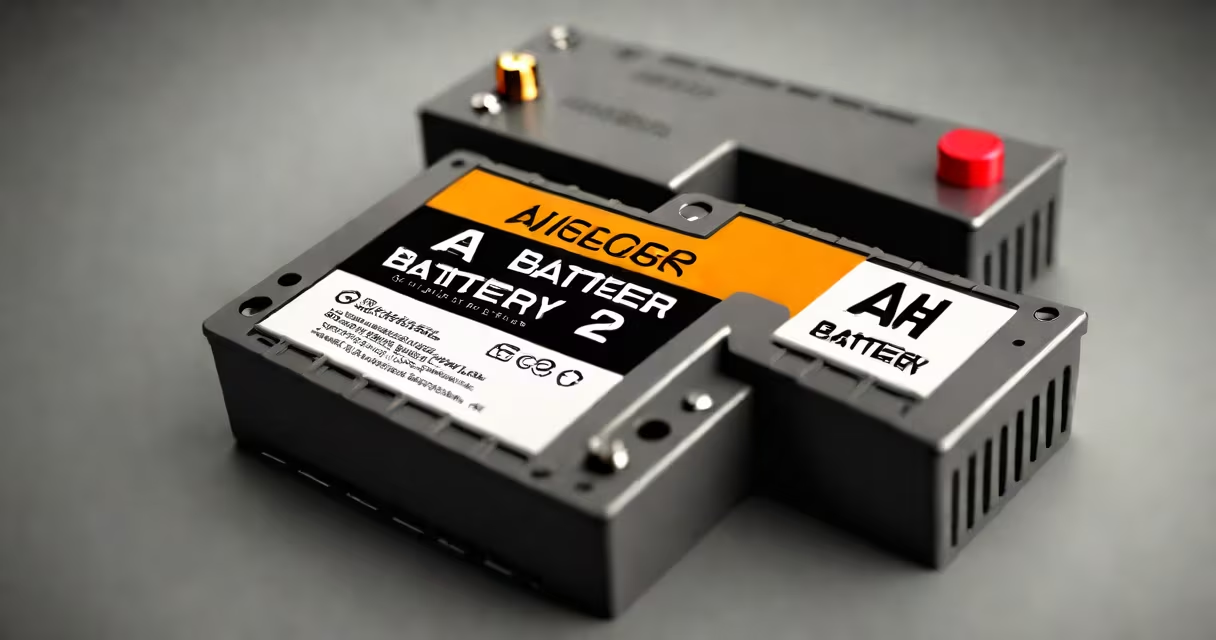
Ah stands for ampere-hour, a unit measuring how much electrical charge a battery can deliver over time. A 2Ah battery can supply 2 amps of current for one hour, or 1 amp for two hours, under standard conditions.
Ah quantifies battery capacity-the total amount of energy stored and available for use. It's a key specification for comparing batteries, especially in applications like electric scooters, solar systems, and backup power supplies. Higher Ah values indicate longer runtime under the same load.
For example, a 12V 2Ah battery stores 24 watt-hours of energy (12 volts × 2 amp-hours). This is less than a 12V 5Ah battery, which holds 60 watt-hours. The difference matters when choosing between batteries for tools or emergency lighting.
Ah measures the total charge a battery can deliver at a constant rate over a specific period. One ampere-hour equals 3,600 coulombs of charge. It's not about peak power-it's about sustained output.
If a device draws 0.5 amps continuously, a 2Ah battery lasts approximately four hours (2 ÷ 0.5 = 4). But actual runtime varies due to temperature, discharge rate, and internal resistance. Discharging too quickly reduces usable capacity.
Battery manufacturers test Ah ratings at 25°C using a slow discharge rate (typically 20 hours). A 2Ah battery rated at C/20 delivers 0.1A for 20 hours. Fast discharges yield lower effective capacity-this is known as the Peukert effect.
Battery capacity is often labeled in either ampere-hours (Ah) or milliampere-hours (mAh). The conversion is straightforward: 1 Ah = 1,000 mAh. A 2Ah battery equals 2,000 mAh.
| Label | Equivalent | Common Use |
|---|---|---|
| 2Ah | 2,000 mAh | Car starters, UPS systems |
| 5,000 mAh | 5.0 Ah | Power banks, smartphones |
| 100Ah | 100,000 mAh | Solar storage, marine batteries |
Despite the numerical equivalence, context changes meaning. A 5,000 mAh power bank powers a smartphone through multiple charges. A 100Ah lead-acid battery in a boat runs lights and a bilge pump for days.
One common mistake is assuming higher mAh always means better performance. A 5,000 mAh battery in a low-voltage device may last longer than a 2,000 mAh high-voltage battery-but voltage matters too. Energy is measured in watt-hours (Wh), not just Ah.
Ah alone doesn't tell you how long a battery lasts under real loads. A 2Ah battery at 12V stores 24 Wh. A 2Ah battery at 3.7V (like a phone battery) stores only 7.4 Wh. Voltage affects total energy.
For accurate comparisons, calculate watt-hours: multiply voltage by amp-hours. A 12V 2Ah battery has 24 Wh. A 3.7V 2Ah battery has 7.4 Wh. The former stores more usable energy even though both have the same Ah rating.
I once tested two identical-looking 2Ah lithium-ion packs-one labeled 3.7V, the other 7.4V. The 7.4V pack powered a small drone for twice as long because it delivered double the energy. This mismatch in voltage and Ah misled users who assumed they were equivalent.
People often confuse Ah with voltage or power. Ah is not watts. A 2Ah battery at 12V provides 24 watts for one hour-but only if the load draws exactly 2 amps. Most devices draw variable current.
Another error: assuming Ah is linear. In reality, discharge curves aren't flat. As a battery depletes, voltage drops. Many devices stop working before the battery reaches zero Ah due to voltage thresholds.
Some brands advertise "high-capacity" batteries based on Ah alone, ignoring cycle life. A 5,000 mAh battery that degrades to 3,000 mAh after 500 cycles still shows 5,000 mAh on paper. True longevity requires checking cycle count and capacity retention.
Suppose you need a battery for a 12V 3W LED light that runs 8 hours daily. You want it to last 3 days on a single charge.
Step 1: Total energy needed = 3W × 8 hours/day × 3 days = 72 watt-hours.
Step 2: Minimum Ah required = 72 Wh ÷ 12V = 6Ah.
So a 6Ah battery is needed. A 2Ah battery would last only 8 hours total-just one day. Even though 2Ah seems close to 6Ah, it falls short by 67%.
This example shows why Ah must be paired with voltage and expected load. A 5,000 mAh battery (5Ah) in a 3.7V phone may last longer than a 2Ah battery in a 12V system-but only if the device's power draw is similar.
Understanding what Ah means in battery helps avoid mismatches in runtime, size, and cost. Always compare watt-hours-not just amp-hours-to make informed choices.