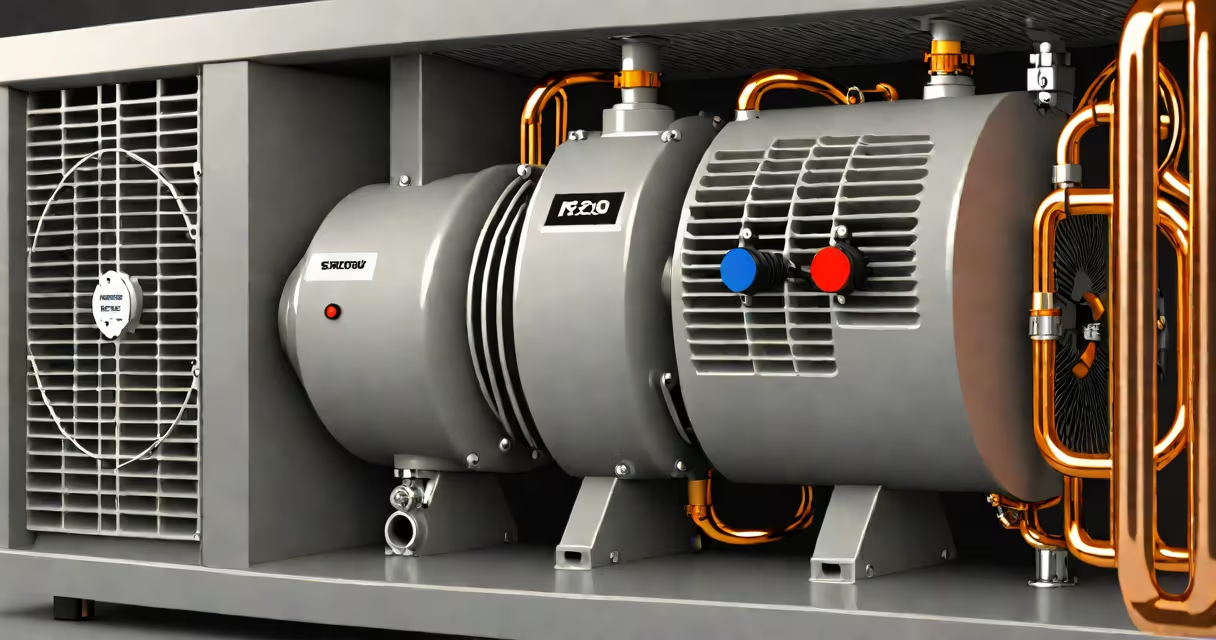
The compressor in an HVAC system pressurizes refrigerant gas, enabling it to absorb heat indoors and release it outdoors. This process drives both cooling and heating cycles in air conditioners and heat pumps.
Compressors are the central mechanical heart of most residential and commercial HVAC systems. They operate by drawing in low-pressure, low-temperature refrigerant vapor from the evaporator coil, compressing it into a high-pressure, high-temperature gas, and then sending it to the condenser. This compression increases the refrigerant's energy level, allowing it to reject heat efficiently when cooled in the condenser coil.
Without a functioning compressor, the refrigeration cycle cannot complete. The system fails to cool or heat effectively, leading to discomfort and increased energy use. Modern HVAC units rely on electrically driven compressors, typically powered by a single-phase or three-phase motor, depending on system size and application.
The compressor initiates the refrigeration cycle by increasing the pressure and temperature of the refrigerant. After leaving the evaporator, the refrigerant enters the compressor as a low-pressure vapor at around 40°F (4°C). Inside the compressor, the refrigerant is compressed-typically to pressures between 200 and 400 psi-raising its temperature to 160-200°F (70-93°C).
This high-pressure, high-temperature gas flows into the condenser coil, usually located in the outdoor unit. As ambient air passes over the condenser fins, heat transfers from the refrigerant to the outside environment. The refrigerant cools and liquefies, becoming a high-pressure liquid. It then moves through the expansion valve, which reduces pressure and temperature before entering the evaporator coil indoors.
When the refrigerant absorbs indoor heat in the evaporator, it turns back into a vapor. The cycle repeats as long as the thermostat calls for cooling. A failure in the compressor halts this loop entirely, stopping the entire system.
There are several compressor designs used in HVAC. The most common types are scroll, reciprocating, and rotary compressors. Each varies in efficiency, noise, and reliability.
| Type | How It Works | Common Use | Efficiency & Noise |
|---|---|---|---|
| Scroll | Two interleaved spiral-shaped scrolls rotate to trap and compress refrigerant. | Residential AC, heat pumps, newer systems. | High efficiency (SEER 16+), quiet operation. |
| Reciprocating | Pistons move up and down in cylinders to draw in and compress refrigerant. | Older residential systems, small commercial units. | Limited efficiency (SEER 12-14), higher noise and wear. |
| Rotary | A rotating vane or screw mechanism compresses refrigerant in a continuous motion. | Small commercial systems, some heat pumps. | Moderate efficiency, lower vibration than reciprocating. |
Scroll compressors dominate new installations due to their durability and energy savings. According to the U.S. Department of Energy, scroll compressors offer 10-15% better seasonal energy efficiency than older reciprocating models in similar-sized systems.
Compressors are essential in all vapor-compression refrigeration systems. They power air conditioners, heat pumps, and refrigeration units. In cooling mode, they move heat from indoors to outdoors. In heating mode-used by heat pumps-they reverse the flow, pulling heat from outside air even when temperatures drop below freezing.
For example, a typical 3-ton residential air conditioner uses a scroll compressor rated at about 3.5 horsepower. It runs at 60 Hz, cycling on and off based on thermostat demand. During peak summer days, the compressor may run for 15-20 minutes per cycle, maintaining indoor temperatures between 72-75°F (22-24°C).
Heat pumps rely on compressors to function year-round. When outdoor temperatures fall below 40°F (4°C), the system reverses the refrigerant flow using a reversing valve. The outdoor coil becomes the evaporator, absorbing heat from cold air, while the indoor coil acts as the condenser. The compressor still performs the same role: pressurizing refrigerant to enable heat transfer.
Many assume the compressor is the primary cooling element. That's incorrect. The actual cooling happens in the evaporator coil, where refrigerant absorbs heat from indoor air. The compressor enables this by raising refrigerant pressure and temperature so heat rejection can occur outdoors.
Another misconception is that all compressors fail at the same rate. In reality, scroll compressors have longer lifespans-often 15-20 years-due to fewer moving parts and less mechanical stress. Reciprocating compressors, with pistons and valves, typically last 10-15 years and are more prone to wear-related failures.
A lesser-known fact: compressors don't cool the refrigerant. They increase its internal energy through work input. Cooling occurs later, during heat exchange in the condenser and evaporator coils. The compressor's job is to create the pressure differential needed for heat transfer to happen against natural thermal gradients.
In a suburban home in Phoenix, Arizona, a homeowner reported that their air conditioner ran but produced warm air. An HVAC technician diagnosed a failed compressor. The system had a 16 SEER split-system unit with a scroll compressor.
Upon inspection, the technician found that the compressor's internal windings had shorted due to prolonged operation under high voltage. The system had been running continuously during a 115°F (46°C) heatwave. The technician replaced the compressor and checked the refrigerant charge. After recovery, the system restored cooling capacity and maintained 72°F (22°C) indoors at 85°F (29°C) outdoor temperature.
Repair cost: $1,800. Replacement cost: $2,400. The homeowner later upgraded to a higher-efficiency model with variable-speed compressor, reducing annual cooling costs by 22%.
Compressors are not the same as condensers or evaporators. The condenser is the outdoor coil where heat is released. The evaporator is the indoor coil where heat is absorbed. The compressor connects them via refrigerant lines.
Also, compressors differ from fans. Fans move air across coils; compressors move refrigerant through the system. Confusing these components leads to misdiagnosis. For example, a noisy fan doesn't affect refrigerant pressure-the compressor does.
Finally, compressors require proper refrigerant charge. Too little refrigerant causes low pressure and overheating. Too much leads to poor heat rejection and potential liquid slugging-where liquid refrigerant enters the compressor and damages internal components. Proper charging is critical for longevity.
Understanding the compressor's role clarifies why maintenance matters. Regular filter changes, coil cleaning, and professional tune-ups prevent strain on the compressor. A clogged air filter forces the system to run longer, increasing compressor workload and accelerating wear.