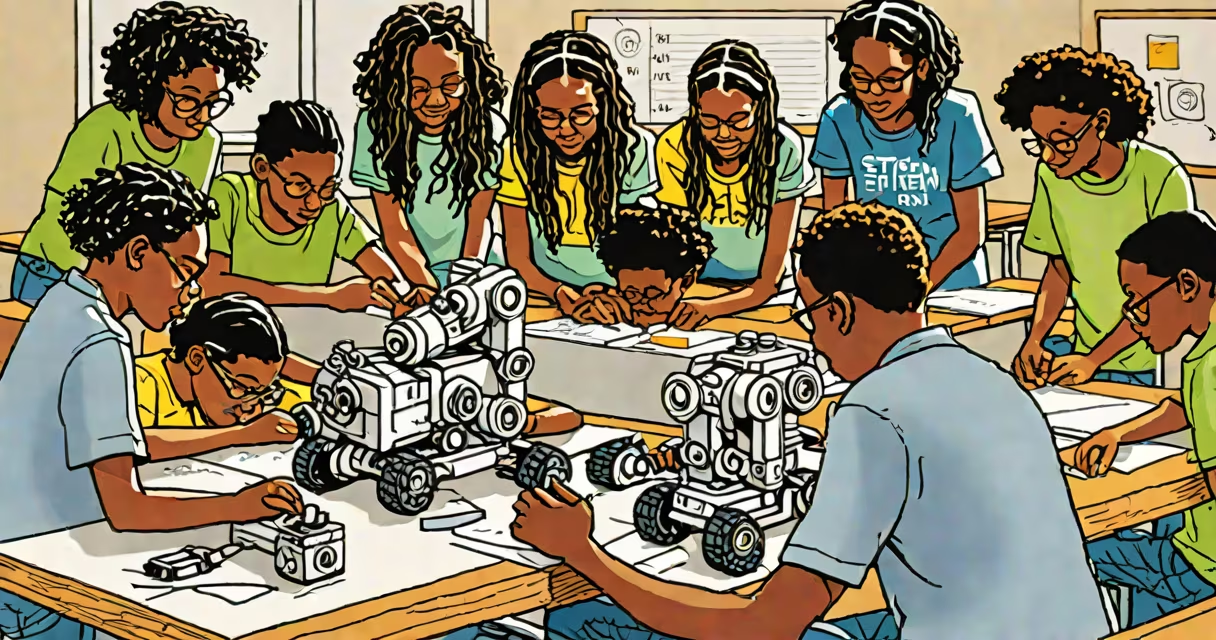
Stem education standards are nationally recognized, grade-specific learning benchmarks that define what K-12 students should know and be able to do in science, technology, engineering, and mathematics. These standards set clear expectations for content mastery and applied problem-solving skills across subjects.
They are developed through consensus among educators, subject-matter experts, and policymakers. The most widely adopted structure is the Next Generation Science Standards (NGSS), released in 2013 by a coalition led by Achieve, Inc., with input from 26 states and scientific organizations. NGSS emphasizes three-dimensional learning: disciplinary core ideas, science and engineering practices, and crosscutting concepts.
For example, a fifth-grade standard requires students to "plan and conduct investigations to provide evidence that changes in states of matter depend on energy." This is not just memorizing facts-it demands designing experiments, collecting data, and drawing conclusions based on evidence. A student might test how temperature affects ice melting time using controlled variables and repeated trials.
These standards operate as performance-based guides rather than rigid lesson plans. They specify what students must demonstrate-not how teachers deliver content. This allows flexibility in pedagogy while ensuring consistency in expected outcomes.
Each standard includes a verb indicating the skill level: "analyze," "design," "evaluate." These verbs align with Bloom's Taxonomy levels, ensuring cognitive rigor. For instance, a high school physics standard may require students to "use mathematical models to predict motion under varying forces," which involves algebraic reasoning and experimental validation.
States adopt or adapt these standards into state curricula. California's academic content standards for science, for example, mirror NGSS but include additional local context such as environmental impacts specific to the state's ecosystems. Teachers then use these standards to design units, select materials, and assess student work.
Standards are organized by grade band and subject area. The table below outlines the primary categories and their focus areas:
| Subject Area | Focus Areas | Example Standard (Grade 8) |
|---|---|---|
| Science | Physical sciences, life sciences, Earth and space sciences | MS-PS1-4: Develop a model to describe how the total number of atoms is conserved during a chemical reaction. |
| Mathematics | Algebra, geometry, statistics, functions | 8.EE.C.7: Solve linear equations in one variable. |
| Engineering | Design process, systems thinking, prototyping | ETS1.A: Define a simple design problem reflecting a need or want that includes criteria for success and constraints. |
| Technology | Information systems, digital tools, automation | HS-TECH-1: Use programming to create interactive simulations of real-world phenomena. |
Some states combine disciplines into integrated STEM courses. In New York, eighth graders complete a year-long unit called "Energy and Sustainability" that blends physics, environmental science, and civil engineering principles. Students build small-scale wind turbines, measure output, and compare efficiency across designs-all guided by state standards.
One widespread misunderstanding is that stem education standards mandate teaching coding or robotics in every classroom. That is incorrect. While computational thinking is embedded in many standards, implementation varies by district and grade level. Not all schools have access to lab equipment or trained instructors.
A second error is equating stem education standards with advanced coursework. These standards begin in kindergarten. A preschool standard asks children to "sort objects by size, weight, or color"-a foundational step toward later classification and data analysis skills. Early exposure builds conceptual readiness, not immediate expertise.
Another misconception is that standards are static. On the contrary, they undergo periodic review. The NGSS was updated in 2020 to include greater emphasis on equity and culturally responsive pedagogy. Research shows that students from underrepresented groups perform better when standards incorporate real-world problems tied to community contexts.
Without consistent standards, disparities in student achievement grow. A 2022 study by the National Center for Education Statistics found that students in districts with implemented stem standards scored 14% higher on national science assessments than those in unstandardized regions. Achievement gaps narrowed particularly among low-income and rural populations.
These standards also prepare students for careers. According to the U.S. Bureau of Labor Statistics, employment in STEM occupations is projected to grow 8% from 2022 to 2032-faster than average. By aligning classroom learning with workforce demands, standards reduce the gap between education and industry needs.
I once observed a sixth-grade class in Portland, Oregon, where students redesigned a school rainwater collection system using NGSS-aligned engineering standards. They measured flow rates, calculated storage capacity, and presented solutions to the school board. Their project met multiple standards: MS-ESS3-1 (human impact on Earth systems), MS-ETS1-2 (engineering design), and CCSS.MATH.CONTENT.6.RP.A.3 (ratio and proportional relationships).
Stem education standards are implemented in public and private schools, charter networks, and after-school programs. They inform teacher training, textbook selection, standardized testing, and professional development.
Teachers use standards to scaffold instruction. A high school biology teacher might start with a standard about cellular respiration, then build a lab where students measure oxygen consumption in yeast cultures. The assessment rubric maps directly to the standard's performance indicators: "Students will calculate metabolic rate and explain deviations based on environmental variables."
When standards are applied correctly, they reduce instructional drift-the tendency for teachers to cover topics without clear goals. A 2021 report from the American Educational Research Association found that schools using well-defined stem education standards reported 30% fewer instances of off-topic instruction compared to those relying on informal syllabi.
Stem education standards differ from curriculum, which is the actual material taught. A standard says "students will analyze data from a controlled experiment." The curriculum includes the lab handout, the dataset, and the worksheet. Standards define the destination; curriculum defines the route.
They also differ from learning objectives, which are teacher-written statements for individual lessons. A standard is broad and enduring. An objective is narrow and time-bound. For example, a standard covers "understanding energy transfer in ecosystems" over a semester. An objective might be "today, students will label trophic levels in a food web diagram."
Finally, stem education standards are not synonymous with college readiness. While they support college preparation, they are designed for K-12 learners. Advanced Placement (AP) courses and dual enrollment programs build on these standards but go beyond them in complexity and depth.
Stem education standards are not optional. They are the foundation of equitable, future-ready education. When implemented with fidelity, they ensure that every student-regardless of zip code-has access to the knowledge and skills needed to thrive in a technology-driven world.