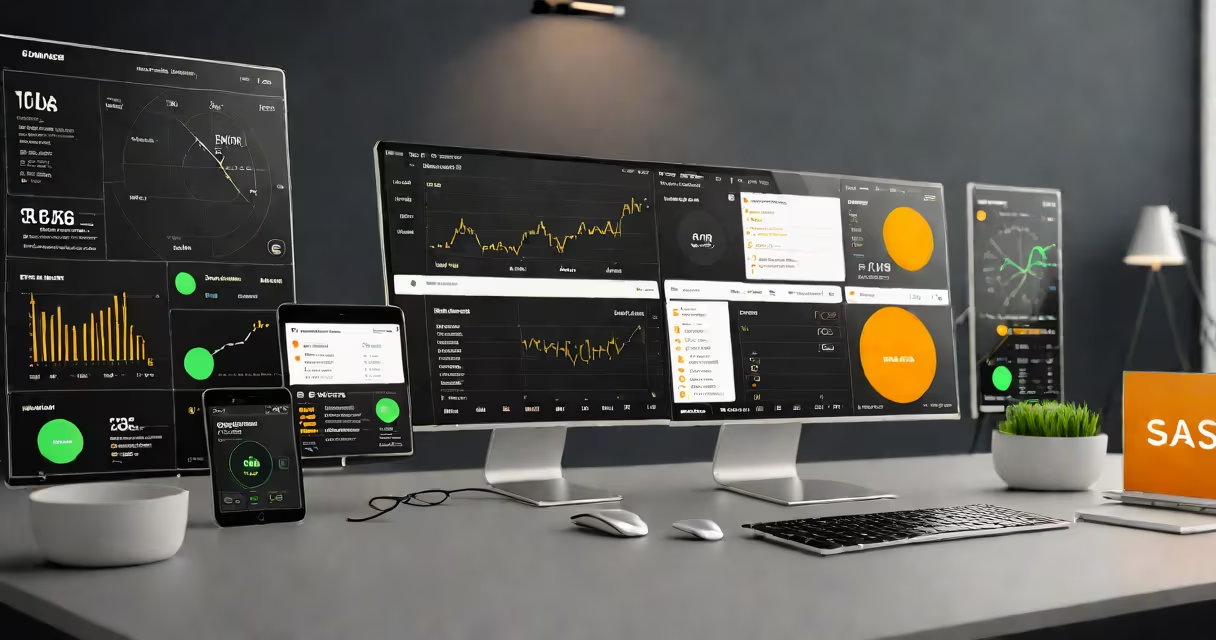
The software as a service (SaaS) business model delivers software applications over the internet on a subscription basis, eliminating the need for users to install, maintain, or upgrade software locally. Instead of buying a perpetual license, customers pay monthly or annually for access to a centralized application hosted in the cloud.
SaaS operates on a cloud infrastructure where providers manage servers, security, updates, and backups. Users access the software through web browsers or mobile apps, enabling instant deployment across devices and locations. This model supports rapid scaling, automated billing, and continuous feature improvements without disrupting service.
Major platforms like Salesforce, Microsoft 365, and Zoom use the SaaS model. These services update automatically, ensuring all users run the latest version. The shift from on-premise software to SaaS began in the early 2000s and accelerated with faster internet and reliable cloud platforms like AWS and Google Cloud.
Under the SaaS model, software is developed, deployed, and maintained in a centralized data center. Customers subscribe to use the application remotely, typically through a web browser. Access is granted via authentication credentials, and usage data is tracked in real time.
Revenue flows through recurring subscriptions rather than one-time purchases. A company might offer a free tier with limited features, then charge for advanced tools or higher user counts. Subscriptions renew automatically unless canceled, creating predictable income streams.
Updates happen continuously. When developers release new features or fix bugs, all users receive them instantly. There's no need to download patches or reinstall software. This eliminates downtime and ensures consistent performance across thousands of users simultaneously.
SaaS systems rely on three core elements: cloud hosting, subscription pricing, and centralized management. Hosting occurs on remote servers managed by third-party providers such as Amazon Web Services (AWS), Microsoft Azure, or Google Cloud Platform. These platforms ensure high availability, scalability, and security compliance.
Subscription models vary based on user count, functionality, and usage volume. Common tiers include:
| Type | Users | Pricing | Use Case |
|---|---|---|---|
| Free Tier | 1-5 | Zero | Individuals testing basic features |
| Starter Plan | 5-20 | $10-$25/month | Small teams needing core tools |
| Professional Plan | 20-100 | $50-$150/month | Departments requiring integrations and reporting |
| Enterprise Plan | 100+ | Custom pricing | Large organizations with dedicated support and SLAs |
Some SaaS products focus on vertical markets-like healthcare or legal services-while others serve broad horizontal needs such as email, project management, or CRM. Examples include Notion (productivity), HubSpot (marketing automation), and Stripe (payment processing).
Businesses adopt the SaaS model because it reduces upfront costs, speeds up deployment, and simplifies IT operations. Organizations no longer need to buy hardware, hire system administrators, or manage software licenses. Everything runs in the cloud, accessible from any device with internet access.
For startups, SaaS enables rapid prototyping and customer acquisition. A new app can launch in days using existing cloud infrastructure. Developers can iterate quickly based on user feedback, improving retention and reducing churn.
According to Gartner, global spending on public cloud services-including SaaS-reached $480 billion in 2023, with SaaS accounting for nearly 60% of that total. The market continues to grow as companies migrate legacy systems to cloud-based platforms.
Many people assume SaaS is simply "cloud software," but that's incomplete. Not all cloud-hosted applications follow the SaaS model. For example, a company might host a custom internal tool on AWS-but if users pay a one-time fee and the vendor doesn't manage updates or provide ongoing access, it's not SaaS.
A key distinction lies in ownership and control. With SaaS, the provider retains full control over the software stack. Customers don't own the code, can't modify it, and have no access to underlying databases or server configurations. This contrasts with on-premise software, where clients manage their own installations.
Another misconception is that SaaS is always cheaper. While initial costs are lower, long-term subscription fees can exceed the price of a perpetual license over five years. A small business using a $50/month plan for 10 users pays $6,000 annually-more than most one-time software purchases.
Consider a fictional SaaS company called TaskFlow, which offers team task management software. They host the application on AWS in multiple regions for low latency. Their platform includes real-time collaboration, file sharing, and calendar sync.
TaskFlow offers four plans:
When a user signs up, they're assigned a unique account in a shared database. All data is encrypted both in transit and at rest. The company uses automated scripts to scale servers during peak hours. Monthly invoices are generated via Stripe, and users can cancel anytime.
Over 18 months, TaskFlow grew from 1,200 to 15,000 paying customers. Churn rate remained below 5% due to regular feature releases and responsive support. Revenue rose from $14,000 to $1.8 million annually, demonstrating the scalability of the SaaS business model.
I once helped develop a minimal viable product (MVP) for a SaaS startup focused on scheduling for freelance creatives. We used React for the frontend, Node.js for the backend, and PostgreSQL for storage. Deployment happened via Docker containers on AWS ECS.
We launched with a free trial and charged $15/month after 14 days. Within six weeks, we had 430 sign-ups and 120 conversions. The biggest surprise was how much time we spent on onboarding and customer education-users expected immediate setup, but configuration took 15 minutes on average.
Our retention improved after adding guided tutorials and in-app tooltips. This confirmed that usability matters as much as functionality in SaaS. The model worked because we didn't require users to install anything-they accessed the app from any browser.
The software as a service (SaaS) business model defines how modern software is delivered and monetized. It replaces outdated licensing models with scalable, cloud-based access. Success hinges on consistent updates, reliable uptime, and clear value delivery.