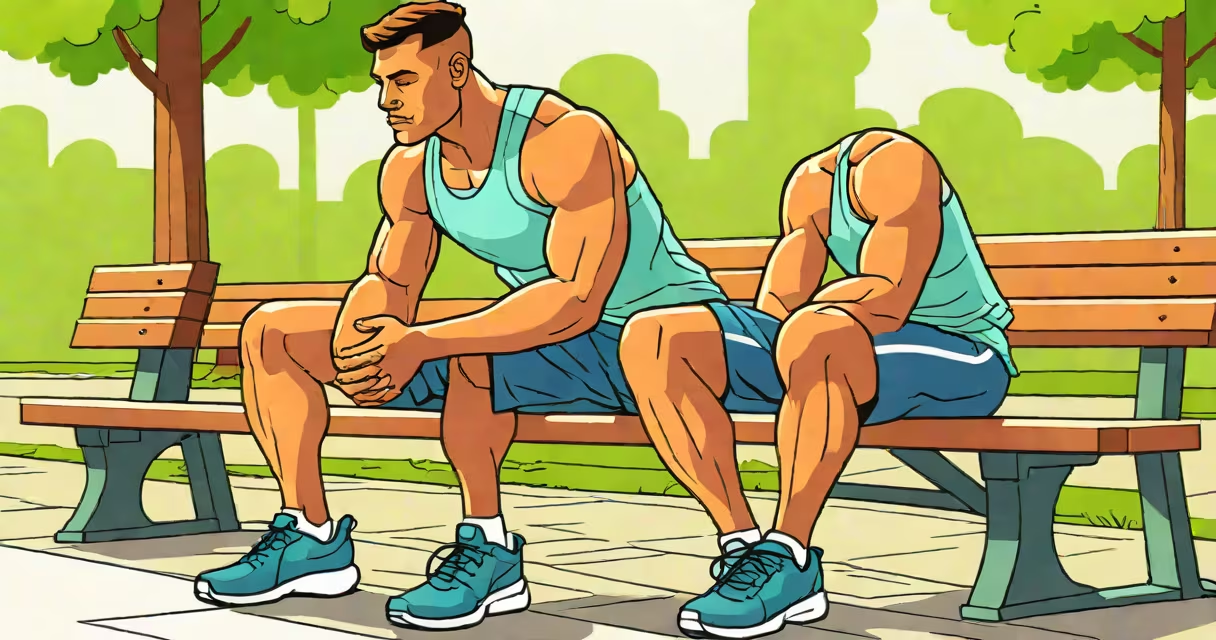
Whether you should workout if you're sore depends on the type and intensity of your soreness. Mild delayed onset muscle soreness (DOMS) from recent exercise typically improves with light activity, while sharp pain or persistent discomfort may indicate injury and requires rest.
Delayed onset muscle soreness (DOMS) appears 12 to 48 hours after unaccustomed or intense exercise. It results from microscopic damage to muscle fibers during resistance training or high-intensity movement. This soreness usually peaks around 24 to 72 hours post-exercise and resolves within five to seven days without intervention. Research published in the Journal of Strength and Conditioning Research confirms DOMS is a normal adaptation response and not a sign of muscle damage requiring extended downtime.
True muscle soreness from exercise is distinct from joint pain, nerve pain, or acute injuries. Soreness from DOMS feels like a dull ache or stiffness in muscles, not a sharp or localized pain. If you feel pain that worsens with movement, limits range of motion, or causes swelling, it's likely not DOMS and may require medical evaluation. The American Council on Exercise (ACE) states that pain during exercise-especially if it changes with position-is a red flag for tissue strain or overuse injury.
Soreness arises from microtears in muscle fibers during eccentric contractions-when muscles lengthen under load, such as lowering a weight or running downhill. These tears trigger inflammation and increased sensitivity in pain receptors. The body responds by sending immune cells to repair damaged tissue, which leads to swelling and tenderness. This process strengthens muscle fibers over time, improving resilience and performance.
Recovery happens through protein synthesis and satellite cell activation. A 2021 study in Frontiers in Physiology found that low-intensity aerobic activity like walking or cycling increases blood flow to sore muscles, accelerating waste removal and nutrient delivery. This supports faster recovery without increasing muscle breakdown. Light movement may reduce perceived soreness by up to 30% compared to complete rest, according to a controlled trial at the University of Queensland.
When you're sore, your nervous system becomes more sensitive to pain signals. This heightened perception can make mild discomfort feel worse than it is. The brain interprets muscle tension and inflammation as danger, even when no structural harm exists. This is why some people avoid working out after a hard session-even though their muscles are ready to adapt.
Not all soreness is the same. Distinguishing between DOMS, joint stress, and injury-related pain prevents unnecessary rest or overtraining.
| Type | Onset | Pain Quality | Duration | Response to Movement |
|---|---|---|---|---|
| Delayed Onset Muscle Soreness (DOMS) | 12-72 hours post-exercise | Dull, achy, generalized | 3-7 days | Improves with light movement |
| Acute Joint Pain | During or immediately after exercise | Sharp, localized, often near bone or tendon | Varies; may persist if ignored | Worsens with movement |
| Injury-Related Pain | Gradual or sudden onset | Stabbing, burning, or shooting | Days to weeks without treatment | Doesn't improve with gentle motion |
DOMS affects muscles uniformly and spreads across the entire muscle group. For example, after a heavy squat session, your quads and glutes may feel stiff and tender throughout. Acute joint pain, however, often concentrates in one spot-like knee pain during lunges or shoulder pain during overhead presses. If pain is sharp or radiates, it may involve tendons, ligaments, or nerves rather than muscle tissue.
One common mistake is treating all soreness as the same. A 2019 survey by the National Institute of Health found that 68% of recreational lifters stopped training due to soreness, even when it was DOMS. This disrupts training consistency and slows progress. The key is recognizing whether the soreness is adaptive or warning-based.
Light to moderate soreness from a previous workout does not hinder performance. In fact, training with mild DOMS can maintain momentum and support metabolic health. A 2020 study in Medicine & Science in Sports & Exercise showed that participants who trained through mild soreness maintained strength gains better than those who rested for 72 hours.
Use this rule: if your soreness score is 1-3 on a 10-point scale (where 10 is unbearable pain), and movement doesn't increase discomfort, continue training. Focus on different muscle groups or lower-intensity movements. For example, if your legs are sore from squats, do upper-body work or walk for 20 minutes. This keeps circulation flowing and supports recovery.
If soreness is above 5 or worsens during activity, stop. Sharp pain, joint instability, or numbness indicates potential injury. I once trained through soreness after a heavy deadlift session-just a dull ache in my lower back. After two sets of front squats, the ache turned into a stabbing sensation. I stopped. The next day, I had trouble standing straight. A physical therapist later confirmed a minor disc irritation. That experience taught me that listening to the body isn't passive-it's proactive.
Rest is not always needed. Active recovery-low-intensity movement, foam rolling, hydration, and sleep-can be more effective than complete inactivity. The American College of Sports Medicine recommends 30 minutes of light cardio on recovery days to improve recovery without disrupting adaptation.
Many assume soreness equals progress. That's false. Soreness is a side effect of training, not proof of effectiveness. You can train effectively without being sore. A 2022 review in Journal of Human Kinetics found that elite athletes often train with minimal DOMS due to consistent volume and proper recovery strategies.
Another myth is that stretching prevents soreness. Stretching after exercise reduces short-term stiffness but does not prevent DOMS. A 2018 randomized trial in Scandinavian Journal of Medicine & Science in Sports showed no difference in soreness levels between groups that stretched and those that didn't. The benefit lies in improved flexibility, not reduced muscle damage.
Some believe you must wait until soreness disappears before training again. This is inefficient. Training frequency matters more than soreness level. The ACE recommends training each major muscle group twice per week for optimal growth. Missing sessions due to temporary soreness undermines long-term goals.
The decision to workout when sore hinges on distinguishing between normal adaptation and injury. DOMS is not a barrier to training. Pain is. When in doubt, err on the side of caution-but don't let soreness dictate your entire routine.