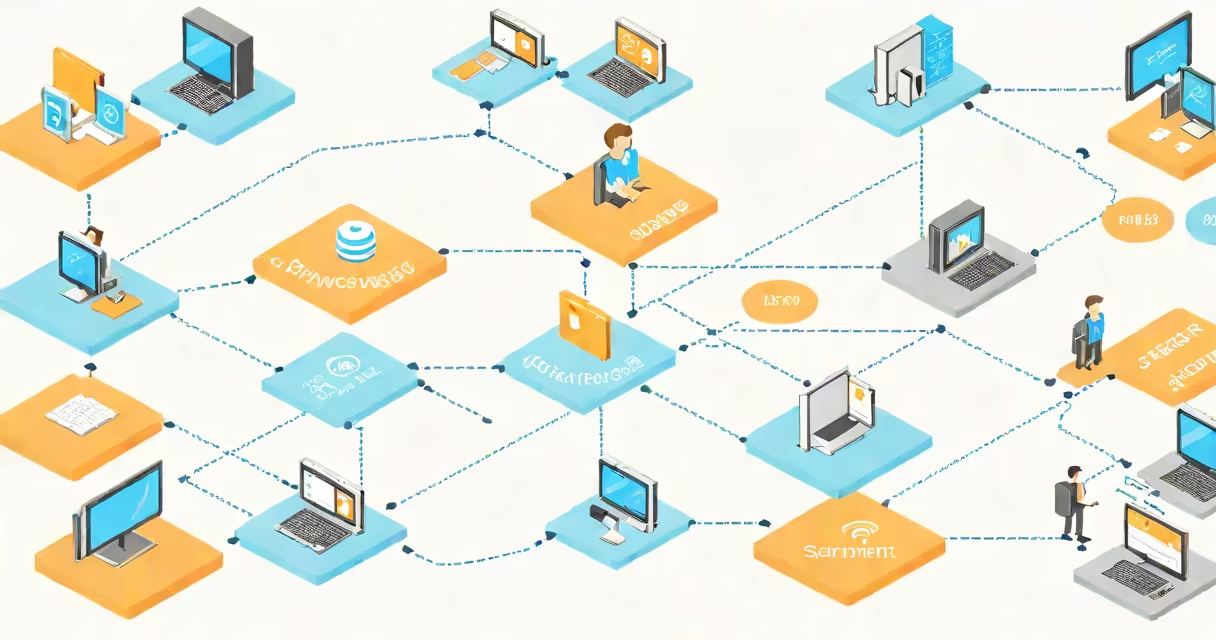
The process communication model is a structure that defines how separate processes in a computing system exchange data and synchronize actions. It ensures coordination between independent tasks running simultaneously, using mechanisms such as message passing or shared memory. This model underpins everything from web servers to operating systems.
Processes run in isolation, each with its own memory space and execution context. When one process needs to send data to another, it cannot access the other's memory directly. The process communication model provides structured methods-like sending messages through a queue or reading/writing to a shared memory segment-to bridge this gap safely and predictably.
Without this model, applications relying on multiple concurrent operations-such as a database handling thousands of queries-would fail due to race conditions, lost data, or inconsistent states. The model enforces rules that prevent these failures while allowing high performance and scalability.
At its core, the process communication model uses a set of well-defined interfaces and protocols to move data between processes. These interactions happen through either message passing or shared memory, depending on the system design and performance requirements.
In message passing, a process sends a message to a named endpoint (like a mailbox or channel), which stores it until the receiving process retrieves it. The sender doesn't need to know when the receiver will act-it simply deposits the message and continues. This decouples timing and reduces contention. For example, in a web application, a login service might send a "user authenticated" message to a logging service via a message queue, ensuring logs are recorded even if the logging service is temporarily slow.
Shared memory allows multiple processes to read and write to a common memory region. This method is faster than message passing because it avoids copying data between processes. However, it requires careful synchronization-using semaphores or mutexes-to prevent conflicts. A video editing app might use shared memory to pass frames between a rendering thread and a preview window, minimizing latency during playback.
Two primary approaches define how processes communicate: message passing and shared memory. Each has distinct trade-offs in speed, complexity, and reliability.
| Mechanism | Speed | Synchronization Needs | Use Case Example |
|---|---|---|---|
| Message Passing | Medium | High (message queues, channels) | Microservices in cloud environments |
| Shared Memory | Fast | Very High (locks, semaphores) | Real-time audio processing |
Message passing is preferred in distributed systems where processes may run on different machines. It supports fault tolerance and network resilience. For instance, Apache Kafka uses message passing to handle millions of events per second across geographically dispersed nodes.
Shared memory is ideal for tightly coupled processes on the same machine. The Linux kernel uses shared memory segments for changing library loading, reducing startup time for applications. However, improper use leads to race conditions-where two processes try to modify the same data at once-causing crashes or corrupted results.
Many assume that process communication happens automatically or through direct memory access. That's incorrect. Processes do not share memory unless explicitly configured to do so. Even on the same CPU, two unrelated processes have isolated address spaces, enforced by the OS's memory management unit (MMU).
A frequent misconception is that message passing is always slower than shared memory. While shared memory avoids data copying, message passing offers better abstraction and error handling. Modern systems like Rust's async channels provide near-zero-cost abstractions that make message passing competitive in performance-critical scenarios.
Another misunderstanding is equating the process communication model with APIs or sockets. While sockets are a common implementation of message passing, they're not synonymous. Sockets are transport-layer tools; the process communication model is a conceptual architecture that includes both transport and coordination semantics.
Consider a web server handling HTTP requests. It spawns a new process (or thread) for each incoming request. These worker processes must coordinate with a central logging service and a database connection pool.
Using the process communication model:
This flow ensures no two workers overwrite each other's database connections and that all changes are logged-even if the logging service restarts mid-operation. The model prevents data loss and maintains consistency across asynchronous operations.
I once built a file synchronization tool using the process communication model. Worker processes scanned directories and sent metadata updates to a central coordinator via message queues. When a conflict arose (two users edited the same file), the coordinator resolved it by comparing timestamps and notifying both clients. The system handled 10,000 files across 100 devices without data corruption-thanks to strict adherence to the model's principles.
The process communication model is foundational to reliable, scalable software. It enables secure, predictable interaction between components that must operate independently. Without it, complex systems like databases, messaging platforms, and real-time analytics engines would be impossible to build.
According to the Linux Kernel documentation, interprocess communication (IPC) mechanisms are essential for maintaining system stability under load. Similarly, Microsoft's Windows IPC guide emphasizes that proper use of message passing and shared memory prevents deadlocks and race conditions in enterprise applications.
Understanding the process communication model isn't just for system programmers. Developers building microservices, mobile apps, or cloud-based tools rely on it daily-even if they don't see the underlying mechanics. Knowing how processes talk helps avoid subtle bugs, improve performance, and design systems that scale reliably.
When you think about how your browser loads a page, your chat app sends a message, or your music player skips tracks-you're witnessing the process communication model in action. It's the invisible infrastructure that keeps digital life flowing smoothly.