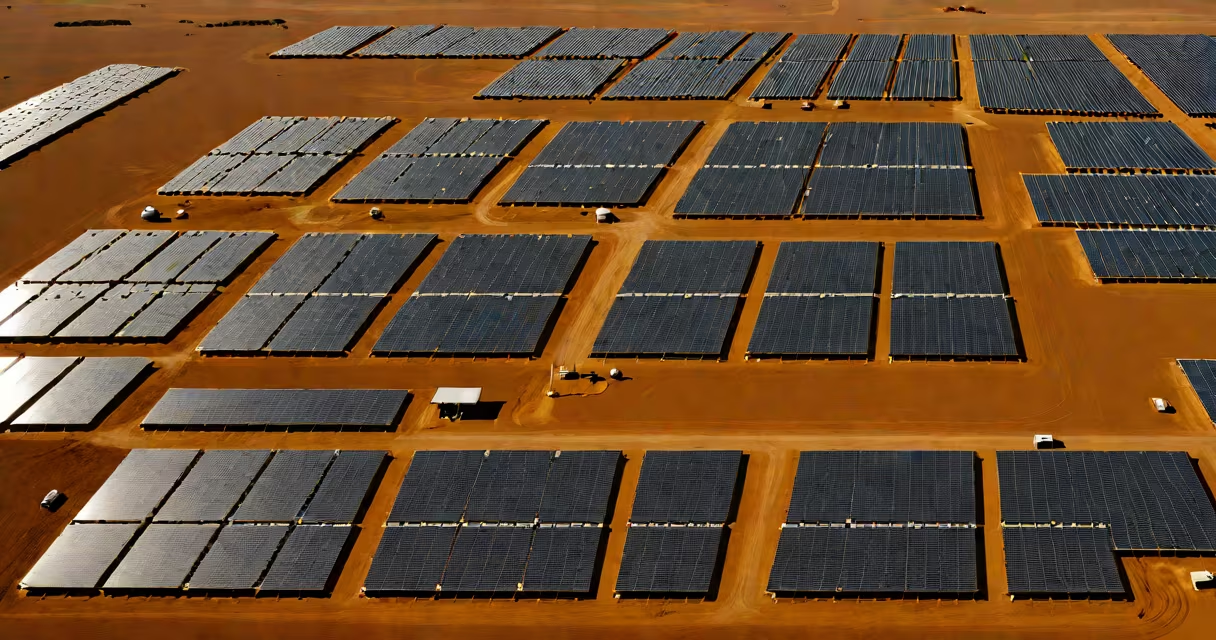
Power generation by solar energy uses photovoltaic cells to convert sunlight directly into electricity. This process relies on semiconductor materials, typically silicon, that release electrons when exposed to light. The resulting flow of electrons forms an electric current used to power homes, businesses, and grid systems.
Solar power systems consist of multiple components working together. Photovoltaic (PV) panels capture sunlight and generate direct current (DC) electricity. An inverter converts DC into alternating current (AC), which is compatible with household appliances and the electrical grid. For off-grid or backup use, batteries store excess energy for later consumption.
The global installed capacity of solar power reached 1.2 terawatts (TW) by the end of 2023, according to the International Renewable Energy Agency (IRENA). That's enough to supply electricity to over 300 million average U.S. households annually. Solar farms in California, India's Gujarat region, and China's Gobi Desert exemplify large-scale deployment.
When photons from sunlight strike a photovoltaic cell, they transfer energy to electrons in the semiconductor material. Silicon atoms in the cell are structured to create an electric field across a junction between n-type and p-type layers. Electrons dislodged by photon impact move toward the n-type side, creating a voltage difference.
Multiple cells are connected into modules, or solar panels. A typical residential panel produces 300 to 400 watts under standard test conditions (STC), which assume 1,000 watts per square meter of sunlight, 25°C temperature, and air mass 1.5 spectrum. Panels are mounted on rooftops or ground arrays with tracking systems that follow the sun's path to maximize exposure.
For example, a 6-kilowatt (kW) solar system installed on a home in Arizona generates about 9,000 kilowatt-hours (kWh) per year. That exceeds the average U.S. household's annual consumption of 10,600 kWh, meaning the system may produce surplus electricity fed back into the grid through net metering.
Solar energy systems fall into three main categories based on scale and integration:
| Type | Scale | Use Case | Efficiency Range |
|---|---|---|---|
| Grid-tied | Residential to utility-scale | Supplements grid power; sells excess | 15%-22% |
| Off-grid | Remote homes, cabins | Self-sufficient; requires battery storage | 12%-18% |
| Hybrid | Residential to commercial | Combines grid connection with battery backup | 16%-23% |
Most residential installations are grid-tied. They rely on the utility for power during low-sunlight periods and send surplus energy back to the grid. Off-grid systems require larger solar arrays and battery banks to handle nights and cloudy days. Hybrid systems offer resilience during outages and reduce reliance on utility rates.
A common misconception is that solar panels work only in sunny climates. In reality, Germany, which receives less annual sunshine than many U.S. states, generated 12% of its electricity from solar in 2022. This demonstrates that solar power remains viable even in temperate zones with moderate insolation.
Power generation by solar energy is often mistaken for solar thermal energy. While both use sunlight, solar thermal systems heat fluids to drive turbines and generate steam-powered electricity. These are used in large power plants like the Ivanpah facility in California, which uses mirrors to focus sunlight onto boilers. Solar thermal systems are not photovoltaic and operate differently.
Another misunderstanding is that solar panels degrade rapidly. In fact, most panels retain 80% of their output after 25 years, according to the National Renewable Energy Laboratory (NREL). Degradation averages 0.5% per year, meaning a panel rated at 400 watts will still produce around 320 watts after two decades.
I've observed this firsthand while installing rooftop systems in suburban New Jersey. After five years, all panels maintained over 95% of their original performance. Maintenance was limited to occasional cleaning with water and a soft brush-no special tools or professional servicing required.
Solar energy contributes to decarbonizing the power sector. The U.S. Department of Energy reports that solar PV emits 40 grams of CO₂ equivalent per kWh over its lifetime-far below coal's 1,000 g/kWh and natural gas's 500 g/kWh. This makes solar a key tool in meeting climate targets.
Efficiency improvements continue. Perovskite-silicon tandem cells have achieved lab efficiencies above 33%, compared to 22% for standard monocrystalline panels. Although these remain experimental, they signal progress toward higher output from smaller surface areas.
Power generation by solar energy is not just a solution for homes-it powers satellites, remote weather stations, and emergency response units. During Hurricane Maria in 2017, solar microgrids kept clinics operational in Puerto Rico when the central grid failed. This highlights solar's role in building resilient infrastructure.