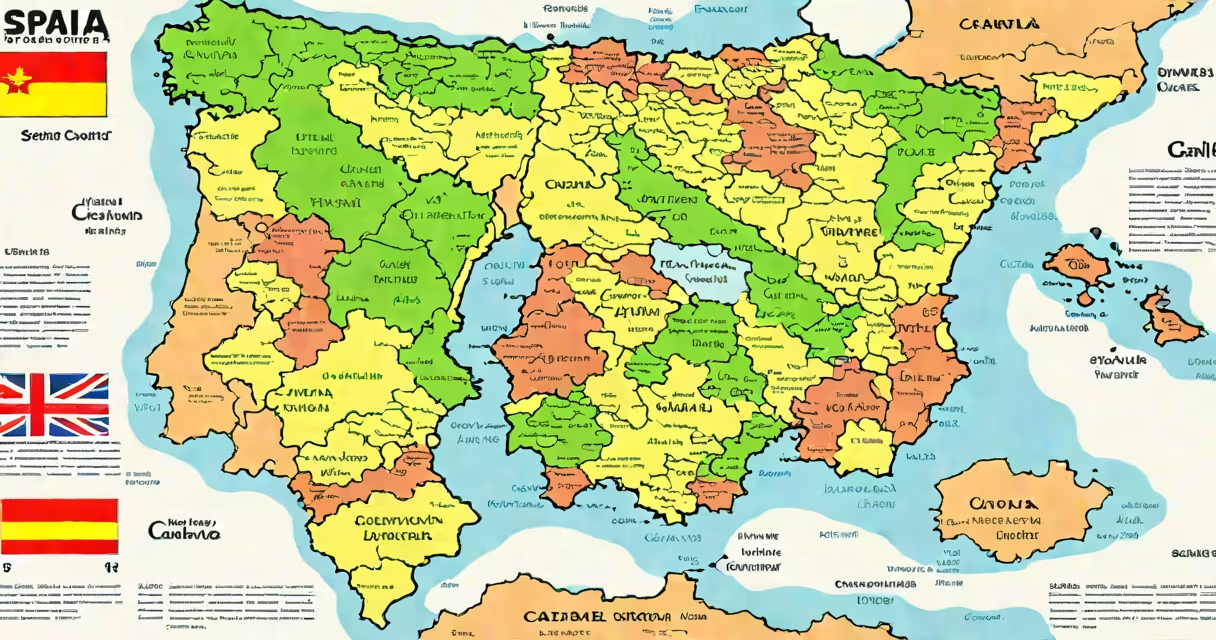
Spain recognizes four official languages: Spanish (Castilian), Catalan, Basque (Euskara), and Galician. These languages reflect centuries of cultural and political development across distinct regions.
Spanish, known as Castellano in official contexts, is the national language and used in government, education, and media nationwide. It is spoken by approximately 90% of the population as a first or second language. The other three-Catalan, Basque, and Galician-are co-official in their respective autonomous communities, where they hold equal legal status with Spanish in public administration and education.
Catalan is spoken in Catalonia, Valencia (where it is called Valencian), and the Balearic Islands. Basque is spoken in the Basque Country and parts of Navarre. Galician is used in Galicia. Each language has its own standardized form, written rules, and institutional support through regional governments.
Spain's language policy operates under a decentralized system. The Constitution of 1978 grants autonomy to regions, allowing them to designate their own official languages. This structure enables local authorities to promote regional languages while maintaining Spanish as the primary medium for national communication.
In practice, bilingualism is common. In Barcelona, signs appear in both Catalan and Spanish. In Bilbao, public documents are issued in Basque and Spanish. Schools in Galicia teach core subjects in Galician, with Spanish introduced later. This dual-language model ensures access to both regional identity and national integration.
A 2022 study by the Instituto de Estudios Fiscales found that 68% of people in Catalonia speak Catalan daily, compared to 52% who speak it fluently in Valencia. In the Basque Country, 44% of residents report using Basque regularly, with higher usage among younger generations due to immersion programs.
The following table outlines the four official languages, their geographic reach, and key facts:
| Language | Region(s) | Number of Speakers | Official Status |
|---|---|---|---|
| Spanish (Castilian) | Nationwide | ~40 million | National language |
| Catalan | Catalonia, Valencia, Balearic Islands | ~9 million | Co-official in designated regions |
| Basque (Euskara) | Basque Country, Navarre | ~700,000 | Co-official in designated regions |
| Galician | Galicia | ~2.5 million | Co-official in Galicia |
Spanish dominates public life in most of Spain. However, in regions like Catalonia, Catalan is used in courts, schools, and local government. In the Basque Country, Basque is required for certain public services. Galician is taught in all schools in Galicia and appears on road signs and municipal documents.
Non-official languages also exist. Aranese, a dialect of Occitan, is spoken in the Val d'Aran region of Catalonia and holds limited recognition. Extremaduran and Leonese are spoken in small pockets but lack formal status.
Many assume that "Spanish" is the only language used in Spain. This is incorrect. While Spanish is dominant, regional languages are constitutionally protected and actively promoted. In fact, the European Charter for Regional or Minority Languages recognizes Catalan, Basque, and Galician as minority languages under international law.
Another misconception is that regional languages are declining. Data from the 2023 Census of Population shows that Basque speakers increased by 5% between 2011 and 2023, driven by school immersion programs. Catalan usage in Catalonia remains stable, with 72% of residents aged 15-24 reporting proficiency.
Some confuse Valencian with Catalan. They are mutually intelligible but differ in spelling and pronunciation. The Generalitat Valenciana officially recognizes Valencian as the regional variant, though linguists classify it as a dialect of Catalan.
I once attended a town council meeting in Vitoria-Gasteiz, capital of the Basque Country. All documents were printed in Basque and Spanish. The mayor spoke in Basque during the opening remarks, then switched to Spanish for the public portion. Audience members responded in either language. This smooth bilingualism reflects how institutions integrate multiple languages without hierarchy.
Consider a student in Santiago de Compostela. Their high school curriculum includes classes in Galician and Spanish. They take exams in both languages. By graduation, they can read official documents in Galician and understand news broadcasts in Spanish. This dual competence supports both local identity and national mobility.
These examples show that multilingualism in Spain is not theoretical-it shapes daily life, governance, and personal identity.