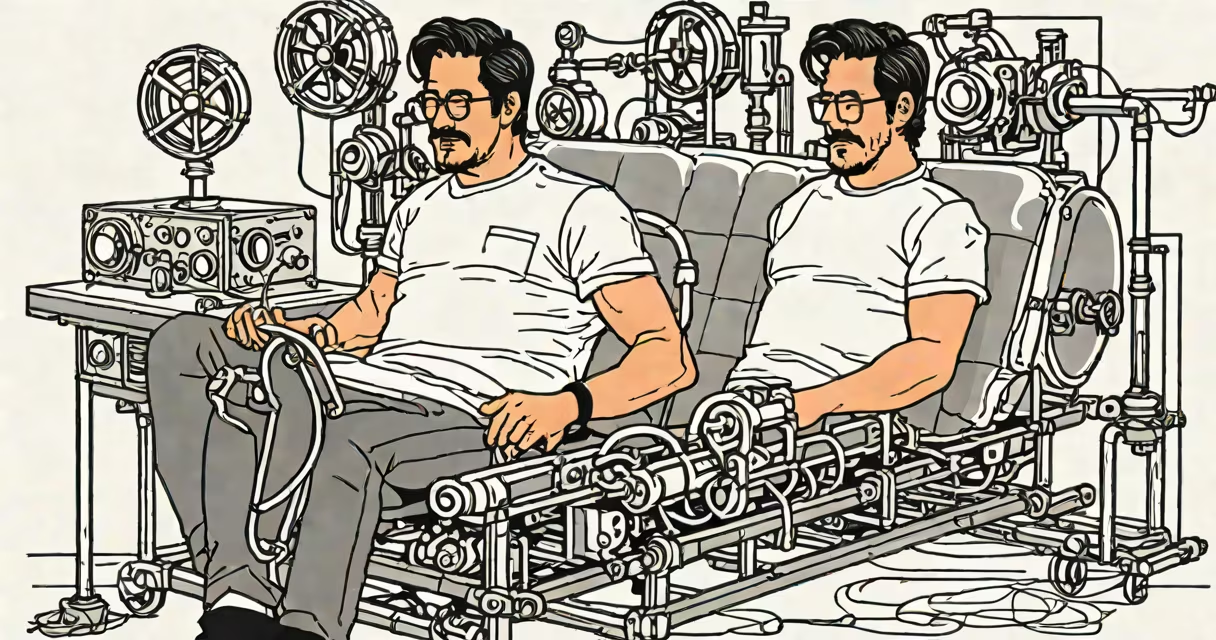
The term "iron lung markiplier" refers to a viral YouTube video in which content creator Markiplier donned a replica of the iron lung-a mechanical ventilator used historically to treat polio patients-during a live stream. The clip gained attention not for its medical accuracy, but for its absurd visual contrast between the bulky, retro medical device and Markiplier's energetic, comedic performance.
Iron lungs were mechanical ventilators developed in the 1920s and widely used through the 1950s to assist breathing in polio patients whose respiratory muscles had weakened. They operated by creating negative pressure around the patient's chest, causing the lungs to expand and draw in air. The device was large, often requiring a custom-fitted body shell and a motor-driven bellows system. By the 1960s, advances in positive-pressure ventilation rendered iron lungs obsolete in most hospitals.
Markiplier's recreation was not a medical demonstration but a satirical take on internet culture's fascination with bizarre props and exaggerated challenges. He wore a fiberglass mock-up of the device during a livestream, joking about being "trapped" inside it while playing games. The video spread rapidly due to its surreal imagery and the disconnect between the device's grim historical context and Markiplier's lighthearted delivery.
Iron lungs functioned via negative pressure ventilation. A sealed chamber encased the patient's torso, leaving only the head exposed. A vacuum pump created a drop in air pressure within the chamber. As pressure dropped, the patient's chest expanded, drawing air into the lungs. When pressure returned to normal, the chest collapsed, expelling air. This cycle mimicked natural breathing.
The mechanism required precise control. Early models used electric motors to drive a diaphragm-like bellows, cycling air in and out at set intervals. Modern equivalents use microprocessors and sensors to regulate airflow. According to the National Institutes of Health, negative pressure ventilation remains effective for certain neuromuscular disorders, though it is rarely used today outside specialized care settings.
A 1954 study published in The New England Journal of Medicine reported that iron lungs improved survival rates among polio patients with respiratory failure. Patients could remain in the device for weeks or months, sometimes while recovering from paralysis. The device did not require intubation, reducing infection risk compared to later invasive methods.
While the iron lung was dominant in mid-century respiratory care, several other ventilator types exist. The table below outlines key differences:
| Type | Pressure Mechanism | Use Cases | Historical Period |
|---|---|---|---|
| Iron lung | Negative pressure | Polio, spinal cord injury | 1920s-1960s |
| Positive pressure ventilator | Positive pressure | Post-op, ICU, ARDS | 1950s-present |
| CPAP/BiPAP | Continuous/variable positive pressure | Sleep apnea, COPD | 1980s-present |
Modern ventilators deliver air under pressure directly into the lungs via an endotracheal tube. This method allows faster response times and better oxygen control. However, it increases the risk of barotrauma (lung injury from high pressure) and requires sedation and intubation.
Iron lungs were never designed for home use. Their size and complexity limited deployment to hospitals and rehabilitation centers. Today, only a few working models remain in museums or private collections. The University of Michigan's Museum of Medicine houses a functional iron lung used during the 1952 Copenhagen polio outbreak, when 1,000 patients required mechanical ventilation.
The original clip, posted in 2021, garnered over 12 million views. Its appeal lies in juxtaposition: the solemnity of a life-saving medical device meets the irreverence of internet humor. The video's popularity prompted discussions about polio, medical history, and disability representation online.
One notable correction: the iron lung is not a form of artificial intelligence or a modern smart device. It is a purely mechanical system. Despite this, some viewers misinterpreted the prop as a futuristic AI-powered health monitor. This confusion highlights how internet culture often recontextualizes historical artifacts without understanding their original purpose.
During a live Q&A, Markiplier clarified he had no medical training and the prop was not connected to any real-life respiratory system. "I wasn't trying to educate," he said. "I was trying to make people laugh." His honesty helped prevent misinformation from spreading further.
Many assume iron lungs were used for all polio cases. In reality, they were reserved for severe cases involving respiratory muscle paralysis. Mild cases recovered with rest and physical therapy. According to the World Health Organization, polio affected approximately 350,000 people annually in the 1950s, but fewer than 10% required ventilatory support.
Another myth is that iron lungs caused discomfort. While the devices were noisy and confined, patients reported psychological relief from being able to breathe again. A 1953 survey of patients at the Willowbrook State School in New York found 78% rated their quality of life as "stable" or "improved" while using the device.
Iron lungs were also not used exclusively for polio. They were adapted for patients with spinal injuries, muscular dystrophy, and even drug overdoses. The first recorded use was in 1928, when Dr. Philip Drinker and Dr. Louis Agassiz Shaw Jr. developed the prototype at Harvard Medical School.
Paul Alexander, born in 1945, contracted polio at age six. He spent over 70 years in an iron lung, surviving until his death in 2024. He became known as the longest-living person to rely on the device. His story, documented in Time magazine and ABC News, illustrates both the device's limitations and its life-extending potential.
At age 77, Alexander wrote a memoir titled Not Quite Dead Yet, describing daily routines inside the machine. He read books, played music, and maintained relationships despite isolation. His case proves that iron lungs were not merely medical tools-they were instruments of endurance and adaptation.
When asked about the viral video, Alexander said, "It's funny. But it's also sad. People don't realize how many lives were saved by those machines." His perspective underscores the gap between entertainment and historical memory.