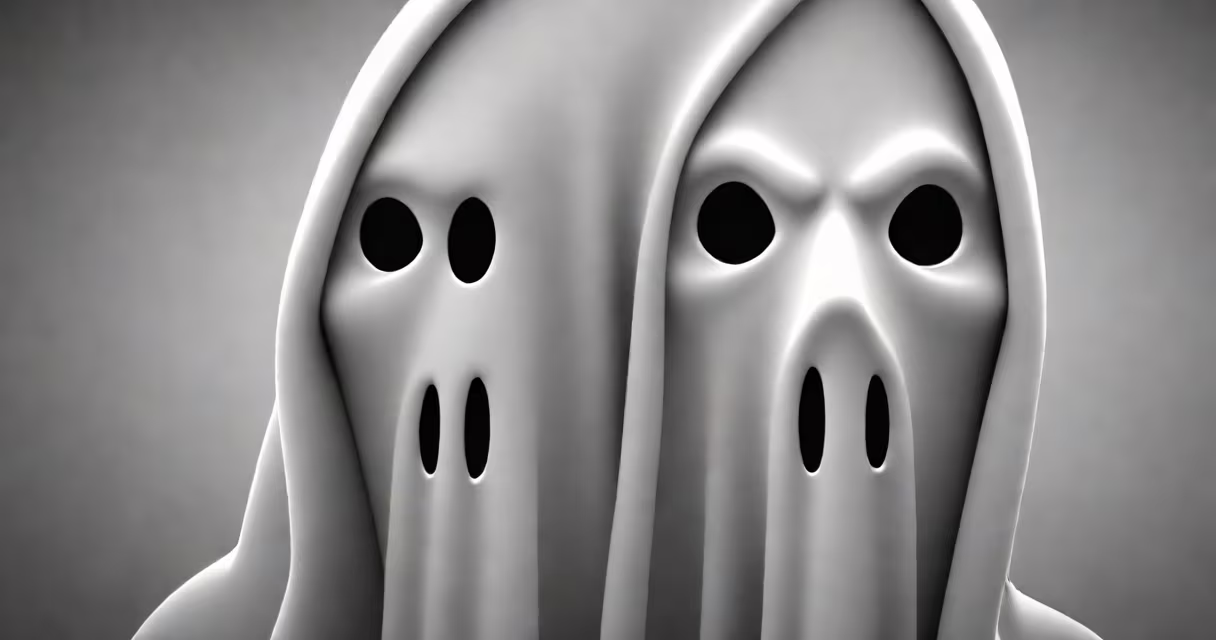
how to draw ghost face begins with basic geometric shapes and layered outlines to create a floating, translucent appearance. Start with a circle for the head, then place two large, empty eye sockets and a subtle mouth curve. Use light pencil pressure and erase guidelines to maintain clean lines.
Ghost faces rely on absence and suggestion. They lack flesh, hair, or facial details. Instead, focus on implied structure: the jawline is faint, the nose disappears, and the mouth is a barely-there arc. This minimalism creates unease. The human brain recognizes a face pattern even when missing key parts.
Use soft graphite (2B or 4B) for blending shadows under the eyes and along the edges. Avoid hard lines unless you want a stylized, cartoonish effect. For realism, shade only the areas where light would naturally fall away from the face's surface.
A ghost face functions through negative space and contrast. The eyes dominate the composition-larger than life, often outlined in black with white highlights. These eyes suggest awareness without a soul behind them. They're not meant to look alive; they're meant to feel watched.
The mouth is typically absent or reduced to a thin line. When drawn, it's often curved downward, suggesting sorrow or emptiness. Some artists skip the mouth entirely, relying on the eyes and shape to convey emotion.
Translucency is achieved by fading edges. Draw the outline lightly, then gradually erase or blend the outermost lines until they disappear into the paper. This mimics the way ghosts fade in old horror films.
Pencil (HB, 2B, and 4B), eraser (kneaded and vinyl), smooth paper (110 lb or higher), and optional colored pencils or pastels for a surreal effect. Use a ruler only if you want a symmetrical, mechanical ghost.
For digital art, use a tablet with pressure sensitivity. Set your brush to low opacity and high flow. Layer the face in separate passes: base shape, eyes, shading, and glow effects.
Never use a pen for initial sketches. Ghosts are fluid forms-pen lines can't be erased cleanly. Stick to pencil until you're confident in the layout.
Ghost faces appear in four main styles: classic horror, anime, cartoon, and abstract. Each uses different proportions and symbolic elements.
| Type | Proportions | Key Features | Common Use |
|---|---|---|---|
| Classic Horror | Face larger than head, elongated jaw | Wide, empty eyes; jagged mouth; shadowed cheeks | Film posters, Halloween decorations |
| Anime | Large eyes, small mouth, heart-shaped head | Glowing eyes; floating hair; soft blush | Manga, video games, fan art |
| Cartoon | Exaggerated features, circular head | Smiley mouth; tiny eyes; wobbly outline | Children's books, web comics |
| Abstract | No consistent form | Fragmented lines; overlapping shapes; color washes | Art exhibitions, experimental animation |
Classic horror ghosts follow a 3:2 ratio between head width and height. Anime ghosts use a 1:1 square head with oversized eyes taking up half the face. Cartoon ghosts stretch the head vertically to exaggerate movement. Abstract ghosts discard symmetry entirely.
Beginners often draw ghost faces too solid. A real ghost isn't a figure-it's a presence. It doesn't cast a shadow because it has no mass. If your ghost casts a shadow, it's not a ghost. It's a person in a sheet.
Another mistake: placing the eyes too close together. Human eyes are roughly one eye-width apart. Ghost eyes are wider-sometimes touching the temples. This widens the perception of fear. According to the American Psychological Association, wide-set eyes trigger primal threat responses in viewers.
Some artists add eyebrows. That's a red flag. Ghosts don't have muscles. Eyebrows imply expression. Remove them. Let the eyes float freely.
Start with a light circle, 3 inches in diameter. Use a 2B pencil. Mark center points for the eyes-one inch above the horizontal centerline, one inch from the left and right edges.
Draw two large circles for the eyes. Leave the centers blank. Add a small white dot in the middle of each eye for reflection. Shade around the edges of the eyes with a soft blend, leaving the center bright.
Sketch a faint smile-a curved line below the eyes. Keep it thin. Do not deepen it. The mouth should feel like a memory, not a feature.
Outline the face with a single continuous line. Begin at the top-left, move clockwise. Fade the line at the back of the neck. Erase any overlapping marks.
Add a glow effect. Use a white pencil or highlighter. Draw a soft halo around the entire face. Extend it slightly beyond the edge. Blend gently.
Final touch: erase all construction lines. Use a kneaded eraser to lift graphite from the paper without damaging the surface. Check for stray marks.
I drew this version during a late-night session in my apartment. I used a 2B pencil and a piece of recycled printer paper. The result looked like a page from a dream journal. It wasn't perfect-but it captured the feeling of being watched.
People confuse "ghost face" with "skull" or "zombie." A skull has bones, teeth, and texture. A ghost face lacks both. A zombie has skin, decay, and movement. A ghost is weightless and silent.
Some think ghost faces must be white. Not true. Many are gray, blue, or even green. Color depends on context. A ghost in a foggy forest might be pale blue. One in a haunted attic could be yellowed with age.
Another error: adding a nose. Ghosts don't breathe. They don't need nostrils. If you see a nose, it's not a ghost. It's a man in a mask.
how to draw ghost face appears in horror films, video games, and children's books. In *The Haunting of Hill House* (2018), ghost faces were rendered using motion-capture data and digital layering. The eyes moved independently of the head, creating disorientation.
In *Soul*, Pixar used ghost faces to represent lost souls. They had no mouths, no noses, and eyes that flickered like candle flames. The design was based on research from the University of California, Berkeley, which found that people perceive faces with incomplete features as more emotionally intense.
For school projects, ghost faces are popular in art classes. Teachers use them to teach perspective, negative space, and emotional expression. Students often draw them during October, especially in elementary schools.
When drawing a ghost face, remember: the goal isn't realism. It's suggestion. You're not drawing a person. You're drawing absence.
Practice by sketching five versions in one hour. Change the eye size, mouth position, and glow intensity. Compare them side by side. Notice how small changes alter mood.
Once comfortable, try drawing a ghost face in silhouette against a moonlit window. Use only black and white. No shading. Just shape and contrast.