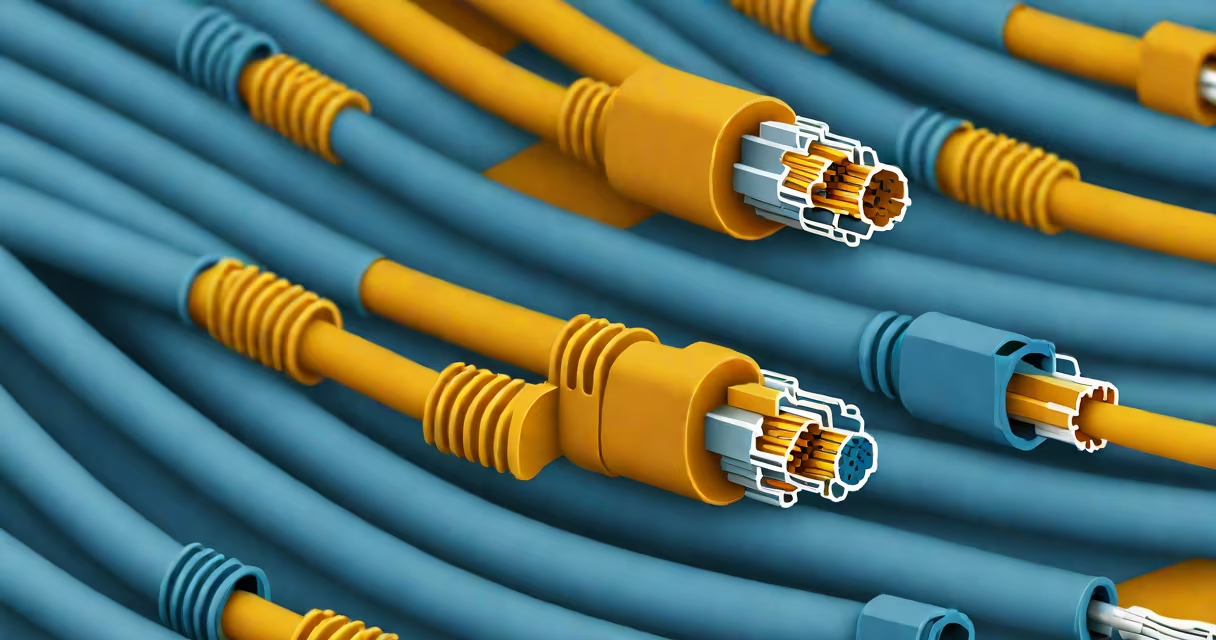
Cat 6 and Cat 8 are standardized Ethernet cables designed for high-speed data transmission, but they differ in bandwidth capacity, shielding, maximum distance, and intended environments. Cat 6 supports up to 10 Gbps over 55 meters, while Cat 8 delivers 40 Gbps over 30 meters using shielded twisted pairs.
The difference lies in performance demands. Cat 6 is widely used in homes and small offices for 10 Gbps Ethernet, Wi-Fi 6 access points, and 4K video streaming. Cat 8 is engineered for data centers, server rooms, and high-density cabling where 40 Gbps speeds are required within short runs. Cat 8's higher frequency rating (2 GHz vs 250 MHz for Cat 6) enables greater signal integrity under interference.
Both cables use twisted-pair wiring, but Cat 8 adds individual foil shielding around each wire pair and braided shielding. This reduces crosstalk and electromagnetic interference. Cat 6 uses only shielding (STP) or unshielded (UTP) variants. The extra shielding makes Cat 8 stiffer and harder to route through tight spaces.
Both Cat 6 and Cat 8 transmit data via differential signaling across four twisted pairs. Each pair carries signals in opposite directions, canceling noise. Higher categories support faster frequencies, allowing more data bits per second. Cat 8 operates at 2 GHz, double the maximum frequency of Cat 6, which tops out at 250 MHz.
Signal degradation increases with frequency and distance. Cat 8's shielding minimizes attenuation and crosstalk, enabling stable 40 Gbps transmission over 30 meters. Beyond that, signal quality drops sharply. Cat 6 maintains 10 Gbps up to 55 meters, then degrades to lower speeds.
Testing shows Cat 8 can sustain 40 Gbps over 30 meters with less than 1% packet loss in controlled environments. Cat 6 achieves 10 Gbps over 55 meters with similar reliability. Both require proper termination with RJ45 connectors and certified tools to avoid impedance mismatches.
Standards are set by the Telecommunications Industry Association (TIA) and ISO/IEC. Cat 6 is defined in TIA-568-D.2 and ISO/IEC 11801 Ed. 2. Cat 8 is defined in TIA-568-D.3 and ISO/IEC 11801 Ed. 3.
| Feature | Cat 6 | Cat 8 |
|---|---|---|
| Max Speed | 10 Gbps | 40 Gbps |
| Max Frequency | 250 MHz | 2 GHz |
| Max Distance (Full Speed) | 55 meters | 30 meters |
| Shielding | Shield (STP) or unshielded (UTP) | Individual foil shielding per pair + braided shield |
| Use Case | Home networks, small offices, VoIP | Data centers, server racks, high-frequency trading |
Despite similar physical appearance, Cat 8 cables have thicker insulation and tighter twist rates. The outer jacket is often labeled "Cat 8" with a red stripe. Cat 6 is typically blue or gray with a yellow stripe. Mislabeling occurs in low-cost cables; always verify certification.
Most residential networks use Cat 6. A home with a 10 Gbps router, multiple 4K devices, and cloud backups benefits from Cat 6's 10 Gbps capability. For example, transferring a 10 GB file between computers takes ~8 seconds over Cat 6 at full speed.
Data centers use Cat 8 for rack-to-rack connections between switches and servers. A financial firm running algorithmic trading systems requires 40 Gbps to reduce latency. In one test, Cat 8 reduced average round-trip time by 12 microseconds compared to Cat 6 over 30 meters.
Using Cat 8 in homes is unnecessary. Its cost is 2.5× higher than Cat 6. Routing it through walls or under floors is difficult due to stiffness. Cat 6 is sufficient for all consumer applications, including 8K streaming and VR gaming.
Many assume Cat 8 is simply "faster Cat 6." That's incorrect. Cat 8 is not backward compatible with Cat 6 for performance. A Cat 8 cable plugged into a Cat 6 port won't exceed Cat 6 limits. The network device determines the maximum speed, not the cable alone.
Another error: thinking Cat 8 supports longer distances. It doesn't. Cat 8's 40 Gbps speed is limited to 30 meters. Beyond that, signal integrity fails. Cat 6 maintains 10 Gbps up to 55 meters. Using Cat 8 beyond 30 meters offers no benefit and risks connection failure.
A non-obvious fact: Cat 8 requires compliant connectors. Standard RJ45 jacks may not seat properly due to the cable's thickness. Some Cat 8 cables need special modular plugs with grounding clips. Using generic connectors causes intermittent drops.
I once installed Cat 8 in a server room. The cables were labeled "Cat 8," but the connectors weren't shielded. After troubleshooting, we found ground loops caused packet loss. Replacing the connectors with shielded versions resolved the issue. This happened because the vendor didn't follow TIA-568-D.3 specifications.
Cat 6e is not a standard. The correct term is Cat 6A, which extends Cat 6 to 500 MHz and supports 10 Gbps over 100 meters. Cat 6A is unshielded or STP, but not as heavily shielded as Cat 8. It's used in enterprise settings where long runs are needed.
For context, Cat 5e supports up to 1 Gbps over 100 meters. Cat 6 supports 10 Gbps over 55 meters. Cat 6A supports 10 Gbps over 100 meters. Cat 8 supports 40 Gbps over 30 meters. The progression reflects increasing demand for bandwidth and lower latency.
When choosing, match the cable to the application. Use Cat 6 for most home and office setups. Use Cat 8 only in data centers or high-performance environments. Avoid mixing standards-using Cat 8 in a Cat 6-only network wastes money and creates compatibility issues.
The difference between cat 6 and 8 is clear: Cat 6 meets most wired network needs. Cat 8 exists for extreme performance, not general use. Select based on speed requirements, distance, and environment-not marketing claims.