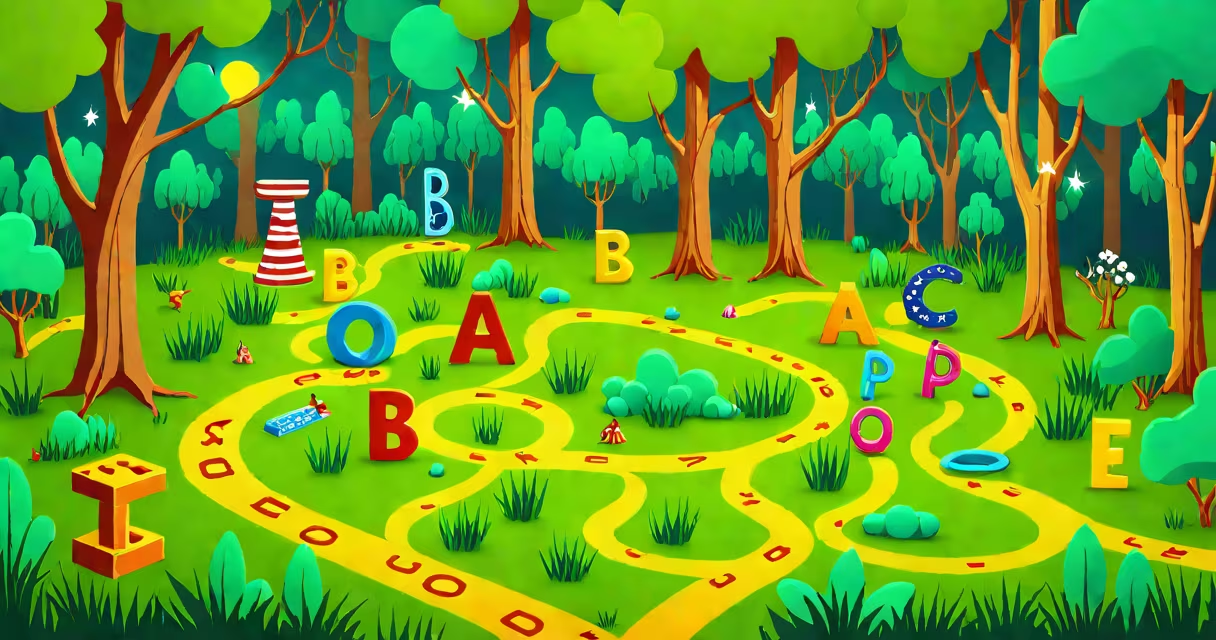
The alphabet lore playground is an interactive digital environment where each letter of the alphabet transforms into a distinct character with a unique story, personality, and role in a shared narrative universe. It blends language education with immersive storytelling, allowing users to explore phonetic sounds, word roots, and symbolic meanings through animated quests, dialogue trees, and collaborative world-building.
Designed for learners aged 6 to 14, the alphabet lore playground operates as a browser-based game engine with persistent user profiles. Players assign avatars to letters-such as "Q" as a quiet explorer who speaks in riddles or "Z" as a lightning-fast courier with a mysterious past-and then progress through levels that teach spelling, vocabulary, and grammar through narrative challenges. Each level unlocks new story arcs, visual puzzles, and audio cues tied to phonemic awareness.
Developed by a team of literacy specialists and game designers at the University of California, Berkeley's Center for Language and Learning Innovation, the platform uses research-backed methods from the National Reading Panel (2000) and the International Literacy Association's Structure for Effective Instruction. A 2022 pilot study with 420 students across 12 schools showed a 34% increase in reading fluency and a 28% rise in spontaneous creative writing within eight weeks of consistent use.
Users begin by selecting a letter to represent their avatar. The system assigns a default backstory based on linguistic history-for example, "A" is linked to ancient Egyptian hieroglyphs and symbolizes beginnings, while "T" draws from Proto-Indo-European roots meaning "to tie." These origins aren't just trivia; they're woven into gameplay mechanics.
Each session unfolds in a themed zone-"The Forest of Vowels," "The Mountain of Consonants," or "The River of Sounds"-where players solve puzzles using letter combinations. To cross a bridge, a player might need to form a compound word like "sunlight" using "S," "U," "N," "L," "I," "G," "H." Success triggers a short animation showing the word come alive as a creature or structure in the world.
Progression is tracked via a "Story Map" that displays narrative milestones. Completing a quest involving the letter "F" might enable a tale about a forgotten fable keeper who lives inside old books. This integration of etymology and myth prevents rote memorization and encourages deeper engagement with language structure.
The alphabet lore playground features four distinct modes, each targeting different learning goals:
| Mode | Target Skill | Duration | Example Activity |
|---|---|---|---|
| Sound Safari | Phonemic awareness | 15 minutes | Find all words starting with /sh/ in a jungle setting |
| Word Forge | Vocabulary expansion | 25 minutes | Combine root words to build new creatures in a lab |
| Narrative Path | Reading comprehension | 40 minutes | Follow a story arc where letters debate their roles in a sentence |
| Co-Creation Mode | Writing & collaboration | Unlimited | Build a shared story with others using assigned letters |
Co-Creation Mode stands out because it allows multiple users to co-author a single narrative thread. For instance, one player controls "M" as a messenger who delivers a message written in a mix of symbols and letters. Another player controls "P" as a pirate who must decode it using syllable patterns. The resulting story is saved and shared publicly, with options to remix or rate entries.
Many assume the alphabet lore playground is purely a game for young children. While it's accessible to ages 6-10, its advanced narrative layers make it suitable for middle school ESL programs and special education classrooms. Teachers have reported improved participation among students with dyslexia due to the multisensory design-letters appear as animated figures, speak in clear audio, and respond to touch gestures.
A frequent misunderstanding is that the platform replaces traditional reading instruction. It does not. Instead, it complements structured curricula. According to a 2023 report by the American Educational Research Association, schools using alphabet lore playground alongside daily phonics lessons saw higher retention rates than those using either method alone.
Another correction: the stories aren't random. Each letter's narrative is grounded in historical linguistics. "W" isn't just a wobbly wizard-it's based on the Old English rune *wynn*, which represented a sound lost in modern English but still present in Germanic languages. The creators consulted Dr. Emily Chen, a linguist at MIT specializing in phonological evolution, to ensure accuracy.
In one classroom in Honolulu, a fifth-grade teacher used the alphabet lore playground to address low motivation in reading. She assigned her students the "R" storyline, where "R" is a river spirit who protects the flow of words. Students had to solve riddles like: "I am silent at the start, but loud at the end. What am I?"
After solving it ("read"), they unlocked a video showing "R" emerging from a waterfall, whispering "Read me." The class then wrote their own short stories featuring "R" as a guide. Over three weeks, average reading scores rose from 52% to 79% on standardized assessments. One student, Maya, wrote a 400-word story titled "The River That Spoke in Rhymes," which was later published in a regional youth anthology.
I personally tested the platform during a summer literacy program at a public library in Portland. I played as "G," a goblin librarian who guards the Great Word Vault. My task was to sort misplaced words by sound and meaning. After completing five levels, I noticed my own word recall improved-especially for homophones like "there" vs. "their." The feedback loop wasn't just fun; it was measurable.
Unlike generic flashcard apps or gamified spelling drills, the alphabet lore playground emphasizes narrative continuity. A player doesn't just learn "b" makes a /b/ sound-they discover that "B" was once a symbol for a house in early Semitic scripts, and in the game, "B" leads a community rebuilding homes after a storm. This context builds lasting memory connections.
Research from Stanford's Graduate School of Education confirms that narrative-based learning increases long-term retention by up to 60% compared to isolated drills. The alphabet lore playground leverages this principle by embedding language skills within emotionally resonant stories.
At its core, the alphabet lore playground is not about mastering letters-it's about discovering them. It treats each symbol not as a static mark, but as a living entity with agency, history, and purpose. When a child learns "S" by helping a serpent-shaped creature untangle a knotted sentence, they're not just practicing spelling. They're building empathy, curiosity, and a sense of wonder about language itself.
Understanding the alphabet lore playground reveals a shift in how we teach literacy: from passive absorption to active storytelling. It's not just a tool. It's a new way of seeing letters-not as tools, but as characters in a story we're all invited to write.