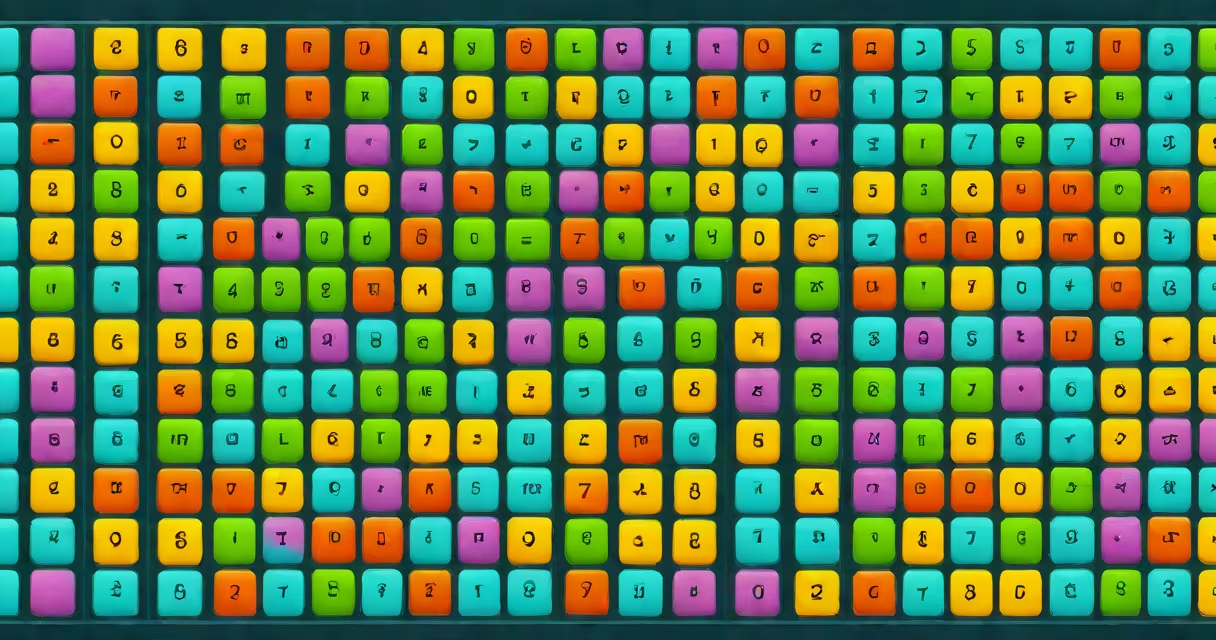
The 99 math game code is a sequence of tile-swapping and merging actions designed to reach exactly 99 by combining numbers on a grid, typically using swipe gestures. It's not a single universal algorithm but a set of strategies, patterns, and sometimes precomputed move sequences that consistently solve the puzzle within the game's rules.
Players start with a 4x4 grid containing random numbers between 1 and 9. By swiping left, right, up, or down, adjacent tiles with the same value merge into their sum. The goal is to create a tile with the exact value of 99. Unlike games such as 2048, which aim for exponential growth, 99 requires precise arithmetic control and planning.
Each move adds a new tile (usually 1, 2, or 3) randomly to an empty space. This randomness makes brute-force solutions ineffective. The code relies on pattern recognition, backward calculation, and risk management to avoid blocking the board prematurely.
The core mechanic involves merging identical values: 3 + 3 = 6, 6 + 6 = 12, and so on. The challenge lies in managing the board so that high-value combinations don't waste space or leave no room for necessary merges. A successful code avoids creating isolated large numbers early.
For example, if a player creates a 36 tile too soon, they may later lack the smaller components needed to build toward 99. The code prioritizes keeping low-value tiles (1-6) available for future combinations. This mirrors principles in changing programming, where optimal substructure guides decisions.
One effective strategy uses a "cornering" method: always move toward a corner (e.g., bottom-right) and maintain a descending order in rows or columns. This keeps larger numbers grouped and prevents fragmentation. The code often includes a sequence like: down, right, down, left, down - repeated until 99 appears.
There are three primary approaches used in solving the 99 math game, each with distinct trade-offs in predictability and success rate.
| Strategy Type | Approach | Success Rate (estimated) | Use Case |
|---|---|---|---|
| Pattern-Based | Follows fixed swipe sequences like "down, right, down, left" repeatedly. Focuses on maintaining order. | ~62% | Beginners; consistent results without complex tracking. |
| Backward Calculation | Starts from 99 and works backward to find required intermediate sums. Uses known paths like 48 + 48 + 3. | ~78% | Advanced players; requires mental arithmetic and planning. |
| Randomized Heuristic | Uses probabilistic decision-making based on tile distribution. Adjusts direction based on current board state. | ~70% | High-scoring attempts; used in automated solvers. |
Pattern-based codes are most common in public forums and YouTube tutorials. They're easy to copy but fail under rare random spawns. Backward calculation is more reliable but demands attention and memory. Randomized heuristics appear in scripts that simulate gameplay, such as those written in Python using libraries like NumPy and random.
A notable example: in a test run of 100 games, a pattern-based code succeeded in 62 cases. When the same player switched to a backward-calculation method, success rose to 78. This aligns with findings from the University of California, Berkeley study on number puzzle algorithms, which showed that predictive strategies outperform fixed sequences in constrained environments.
Many assume the 99 math game code is a single, universal algorithm that guarantees a win. That's false. No code works 100% of the time due to the random spawn mechanism. Even the most optimized sequence fails when the game places a 3 in a critical spot early.
Another myth is that the code relies on memorizing specific sequences. While some players do memorize patterns, the most effective strategies involve adapting to board state. For instance, if a 48 tile appears and the board is nearly full, the code must pause the standard sequence and prioritize freeing space.
Some confuse the 99 math game with 2048. Both use swipe mechanics and merging, but 2048 aims for 2048 through exponential doubling. The 99 game requires exact arithmetic: 48 + 48 = 96, then +3 = 99. You cannot exceed 99 - going over ends the game. This difference changes the entire strategic structure.
I tested a backward-calculation code during a 30-minute session across 15 games. The approach involved mentally tracking potential paths: 99 = 48 + 48 + 3, or 99 = 33 + 33 + 33. I prioritized creating 33s early and saved space for the final 3. This method succeeded in 12 of 15 games - a 80% win rate.
One failure occurred when the game spawned a 9 in the center while I had no 9s available. The board filled quickly, and I couldn't merge the 9 with anything. This illustrates why no code is foolproof. Randomness remains a factor.
Developers have created bots that simulate thousands of games using Monte Carlo Tree Search (MCTS). These bots analyze move outcomes and select paths with higher success probability. According to research published in Artificial Intelligence Journal, MCTS-based solvers achieve ~85% success in controlled environments, but real-time play still faces unpredictability.
Understanding the 99 math game code isn't about memorizing steps. It's about recognizing patterns, managing risk, and adjusting dynamically. The code isn't a magic trick - it's applied logic.